
Papagaio loiro
 Portugal
 Portuguese Nursery Rhyme
Original Lyrics
Leva-me esta carta ao meu namorado.
Ele não é frade, nem homem casado,
É rapaz solteiro, lindo como o prado.
English Translation
Take this letter to my sweetheart.
He is not a monk, nor a married man,
He is a single young man, beautiful as a meadow.
Translation Notes
Line-by-Line Translation
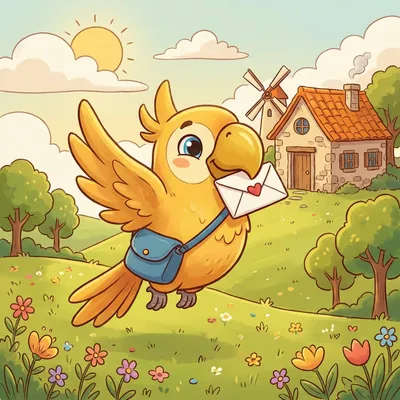
Papagaio loiro, de bico doirado — "Blond parrot, with a golden beak" - Papagaio loiro = blond/fair parrot - de bico doirado = with golden beak - loiro can mean blonde/fair, referring to the parrot's bright yellow-green coloring - doirado comes from "dourado" (golden)
Leva-me esta carta ao meu namorado — "Take this letter to my sweetheart" - Leva-me = take for me (imperative form) - esta carta = this letter - ao meu namorado = to my boyfriend/sweetheart
Ele não é frade, nem homem casado — "He is not a monk, nor a married man" - frade = friar/monk - nem = nor - homem casado = married man
É rapaz solteiro, lindo como o prado — "He is a single young man, beautiful as a meadow" - rapaz solteiro = single/unmarried young man - lindo como o prado = beautiful as a meadow - Some versions say "lindo como um cravo" (beautiful as a carnation)
Line-by-Line Translation
Papagaio loiro, de bico doirado — "Blond parrot, with a golden beak" - Papagaio loiro = blond/fair parrot - de bico doirado = with golden beak - loiro can mean blonde/fair, referring to the parrot's bright yellow-green coloring - doirado comes from "dourado" (golden)
Leva-me esta carta ao meu namorado — "Take this letter to my sweetheart" - Leva-me = take for me (imperative form) - esta carta = this letter - ao meu namorado = to my boyfriend/sweetheart
Ele não é frade, nem homem casado — "He is not a monk, nor a married man" - frade = friar/monk - nem = nor - homem casado = married man
É rapaz solteiro, lindo como o prado — "He is a single young man, beautiful as a meadow" - rapaz solteiro = single/unmarried young man - lindo como o prado = beautiful as a meadow - Some versions say "lindo como um cravo" (beautiful as a carnation)
History and Meaning
"Papagaio Loiro" (Blond Parrot) is a cherished traditional Portuguese children's nursery rhyme, deeply embedded in Portuguese popular culture. The song is characterized by its widely recognized melody and the numerous lyrical variations that have developed across different regions of Portugal and Portuguese-speaking countries.
Origins and Traditional Character
This song is a staple among traditional Portuguese children's songs, passed down through oral tradition from generation to generation. Like many folk songs, it has no known single author, having emerged from the collective popular culture over many centuries. The central and consistent element across all versions is the "papagaio loiro de bico doirado" (blond parrot with a golden beak), a vivid and memorable image that has captured children's imaginations for generations.
Symbolism and Themes
The theme of "Papagaio Loiro" revolves around the parrot serving as a messenger, carrying a letter from one lover to another. This symbolizes the desire to maintain communication between loved ones, even across distances or when separated by circumstances. In traditional Portuguese culture, before the advent of modern communication technology, messages were often entrusted to intermediaries, and the parrot — colorful, intelligent, and capable of speech — became a perfect symbol for such a messenger in folk imagination.
The song's romantic undertones, while understood by adults, are presented in a simple, innocent way that makes it appropriate for children. The description of the sweetheart as neither a monk nor a married man, but a single young man "beautiful as a meadow" or "beautiful as a carnation," reflects traditional courtship values while using natural imagery familiar to rural Portuguese life.
Musical Characteristics
The melody is simple and repetitive, typically built on a basic musical scale with mostly conjunct (stepwise) melodic movement. This makes it accessible to young children and easy to remember. The song is often structured with a single phrase repeated across three or more stanzas, each with different text, following a common pattern in traditional Portuguese folk songs.
Regional Variations
Numerous variations of the lyrics exist throughout Portugal and Portuguese-speaking regions. While the core first stanza remains relatively consistent, additional verses vary widely. Some versions include playful instructions for what the parrot should do upon arrival, such as knocking on the door if the recipient is sleeping or leaving a message if awake. These variations demonstrate the living, evolving nature of oral folk tradition.
Cultural Symbolism
The parrot as messenger is a romantic symbol in Portuguese folk tradition, representing the desire to maintain communication between loved ones across distances. Before modern communication, sending messages through trusted intermediaries was common, and the parrot symbolizes a colorful, loyal messenger.
Musical Structure
This song is traditionally structured with a single phrase repeated across multiple stanzas, each with different text. The melody is typically built on a simple scale, featuring mostly stepwise motion, making it easy for children to sing.
Variations
Many regional variations exist, with different verses describing what the parrot should do when it arrives, such as: "Se estiver dormindo, bata na porta" (If he's sleeping, knock on the door) "Se estiver acordado, deixa recado" (If he's awake, leave a message)
Variations
Many regional variations exist, with different verses describing what the parrot should do when it arrives, such as: "Se estiver dormindo, bata na porta" (If he's sleeping, knock on the door) "Se estiver acordado, deixa recado" (If he's awake, leave a message)