

La Cucaracha
 Mexico
 Spanish Nursery Rhyme
Original Lyrics
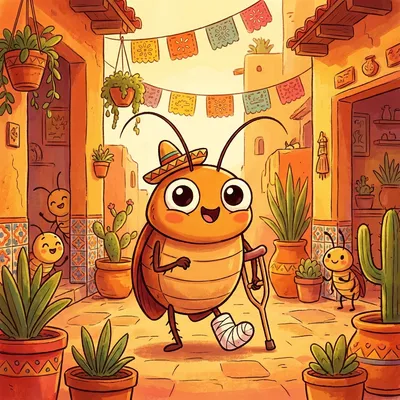
Ya no puede caminar.
Porque no tiene, porque le falta
Una pata para andar.
English Translation
Can no longer walk.
Because he doesn't have, because he lacks
A leg to walk on.
Translation Notes
Vocabulary
La cucaracha — the cockroach (feminine noun) - Cucaracha = cockroach - La = the (feminine definite article)
ya no puede caminar — can no longer walk - Ya no = no longer, not anymore - Puede = can, is able (third person singular of poder) - Caminar = to walk
porque — because
no tiene — doesn't have - No = not - Tiene = has (third person singular of tener, "to have")
le falta — is lacking, is missing - Le = to him/her/it (indirect object pronoun) - Falta = lacks, is missing (third person singular of faltar)
una pata — a leg (colloquial) - Una = a (feminine indefinite article) - Pata = leg, paw (colloquial term; more formal: pierna)
para andar — to walk on, in order to walk - Para = for, in order to - Andar = to walk, to go
marihuana / marijuana — marijuana, cannabis
que fumar — to smoke - Que = that, to (relative pronoun) - Fumar = to smoke
Grammar Notes
Gender Agreement: Spanish nouns have grammatical gender. Cucaracha is feminine, which is why we use: - La cucaracha (not el) - Una pata (not un)
All articles and adjectives must agree with the noun's gender.
"Ya no" (No Longer): This phrase expresses cessation of an action or state. "Ya" means "already" or "now," and combined with "no" creates "no longer" or "not anymore." It's a common construction for describing changes in state.
Modal Verb + Infinitive: "Puede caminar" follows the pattern of modal verb (poder - can/to be able) plus infinitive (caminar - to walk). The modal verb is conjugated while the main verb remains in infinitive form.
"Porque no tiene, porque le falta": The repetition of "porque" (because) creates a rhythmic, parallel structure emphasizing the double explanation—both "doesn't have" and "is lacking." This repetition is characteristic of folk song style.
Indirect Object Pronoun "le": "Le falta" literally means "to him/her/it is lacking." The indirect object pronoun "le" indicates who is experiencing the lack. In Spanish, faltar typically uses this indirect construction rather than a direct subject-verb pattern.
"Pata" vs. "Pierna": While "pierna" is the formal/anatomical term for a human or animal leg, "pata" specifically means a paw or animal leg. Insects technically have "patas." The use of "pata" here is colloquial and adds to the song's informal, folk character.
"Para + Infinitive": The construction "para andar" means "in order to walk" or "to walk on." Para followed by an infinitive expresses purpose or function.
Corrido Structure: Corridos typically use simple, direct language with clear rhyme schemes and repetitive choruses, making them easy to remember and sing. "La Cucaracha" follows this pattern perfectly, with its memorable chorus bracketing improvised verses.
History and Meaning
"La Cucaracha" (The Cockroach) is one of the most recognizable Mexican folk songs in the world, a corrido with mysterious origins that gained explosive popularity during the Mexican Revolution (1910-1920). This deceptively simple song about a cockroach that can't walk because it's missing a leg has served as everything from a revolutionary battle anthem to political satire to a commentary on substance use. Its adaptable nature—with countless improvised verses created throughout history—allowed it to function as a vehicle for social and political commentary, with soldiers, peasants, and rebels adding new stanzas to mock enemies, express frustrations, or rally troops. The song's most famous (and controversial) verse refers to marijuana, cementing its connection to cannabis culture and the harsh realities faced by Mexican Revolution participants. Today, it remains an iconic piece of Mexican musical heritage, though its darker historical meanings are often unknown to those who sing its catchy chorus.
Origins
The precise origins of "La Cucaracha" remain obscure, with various theories placing its genesis anywhere from medieval Spain to 19th-century Mexico. Some musicologists suggest the melody may have Spanish roots dating back to the Middle Ages or Renaissance, while others believe it emerged in Mexico during the 1800s. What is certain is that by the mid-19th century, versions of the song were being sung throughout Spanish-speaking regions.
"La Cucaracha" is classified as a corrido—a traditional Mexican narrative ballad that tells stories, often about historical events, folk heroes, or social issues. Corridos served as a form of oral journalism and cultural memory, allowing people to share news, express political views, and preserve history through song. The corrido tradition became especially important during periods of social upheaval when official media were controlled or inaccessible.
What makes "La Cucaracha" unique among corridos is its extreme adaptability. The core chorus about the disabled cockroach remained constant, but an unlimited number of verses could be added, removed, or improvised based on current events, local circumstances, or the singer's creativity. This flexibility transformed the song from a simple folk tune into a living, evolving form of expression—a musical framework onto which generations of singers projected their experiences, frustrations, and humor.
The Mexican Revolution Era
"La Cucaracha" achieved its greatest fame and cultural significance during the Mexican Revolution (1910-1920), when it became an anthem for both rebel and government forces. Soldiers on all sides of the conflict sang it as they marched, adding new verses to suit their purposes. The song's presence was so ubiquitous during this period that it became inextricably linked with the Revolution itself.
The song is particularly associated with Pancho Villa's revolutionary troops, who sang it extensively. One popular theory suggests that "la cucaracha" (the cockroach) referred to Villa's automobile, which was reportedly prone to mechanical breakdowns. Villa's soldiers would mockingly sing about the car's inability to move without fuel, using the cockroach metaphor for the broken-down vehicle. This interpretation connects the song to the Revolution's modernization theme—the introduction of automobiles and machinery into a largely agricultural society.
Revolutionary soldiers created countless verses improvising about: - Specific battles and military leaders - Shortages of food, ammunition, and supplies - Corrupt politicians and ineffective officers - Daily life in the revolutionary camps - Romantic exploits and local characters
This creative explosion transformed "La Cucaracha" into a repository of Mexican Revolution history and popular sentiment, preserving perspectives that might otherwise have been lost.
The Cockroach: Symbol and Metaphor
The "cockroach" in the song functions as a rich, multivalent symbol with different meanings depending on context and which verses are being sung:
Victoriano Huerta: The most prominent Revolutionary-era interpretation identifies the cockroach as Victoriano Huerta (1854-1916), a Mexican general who seized the presidency through a military coup in 1913 and was widely considered a traitor and tyrant. Huerta was known for heavy drinking and, according to some accounts, cannabis use. Revolutionary forces ridiculed him as a "cockroach" unable to function properly without his vices, making the song's chorus—about a cockroach that can't walk because something is missing—a pointed political satire.
Corrupt Politicians and Regimes: More broadly, "la cucaracha" could represent any corrupt politician or ineffective regime, including the dictatorship of Porfirio Díaz (1876-1911), whose authoritarian rule sparked the Revolution. The song provided a way for ordinary people to express political criticism through humor and metaphor, avoiding direct confrontation while still making their views known.
Soldaderas: In some contexts, "La Cucaracha" was a nickname for soldaderas—the brave women who fought alongside or followed the revolutionary troops, cooking, nursing wounded soldiers, smuggling weapons, and sometimes fighting directly in battles. These women were essential to the Revolution's success but often went unrecognized in official histories; the song helped preserve their memory.
Broken Vehicles: As mentioned, some verses specifically reference vehicles (cars, trains) that can't move without fuel or are mechanically unreliable—a commentary on the Revolution's struggle to modernize while lacking resources.
Cannabis Users: Some interpretations view the cockroach as symbolizing someone sluggish or demotivated, particularly in connection with marijuana use (discussed below).
The Marijuana Connection
The most famous—and controversial—verse of "La Cucaracha" explicitly references marijuana:
"La cucaracha, la cucaracha, ya no puede caminar / Porque no tiene, porque le falta, marihuana que fumar"
(The cockroach, the cockroach, can no longer walk / Because it doesn't have, because it lacks, marijuana to smoke)
This verse, added during the Mexican Revolution, highlights the role of cannabis among soldiers and peasants during the war. Many participants used marijuana recreationally or medicinally to cope with the Revolution's harsh realities—pain, trauma, exhaustion, and fear. Cannabis was relatively common and not yet criminalized in Mexico at this time, making it an accessible form of relief.
The verse serves multiple functions:
- Literal Reference: Acknowledges actual marijuana use among revolutionary forces
- Political Satire: Mocks figures like Victoriano Huerta, whose effectiveness was allegedly compromised by substance use
- Social Commentary: Reflects on dependency, coping mechanisms, and the conditions that drive people to seek escape
- Dark Humor: Uses comedy to address serious realities of war and trauma
This connection has given "La Cucaracha\" an enduring association with cannabis culture, making it recognizable even to those unfamiliar with its Revolutionary history. The verse remains controversial—sometimes omitted in children's versions or school performances, sometimes embraced as an honest acknowledgment of historical reality.
Cultural Significance
"La Cucaracha" occupies a complex position in Mexican cultural memory. On one hand, it's a fun, catchy tune played by mariachi bands at celebrations and weddings, taught to Spanish-language learners, and instantly recognizable worldwide. On the other hand, it carries layers of political satire, revolutionary history, and social commentary that most casual listeners never encounter.
The song represents: - Revolutionary Spirit: The resilience, humor, and adaptability of Mexican revolutionaries - Oral History: A record of popular perspectives on historical events - Political Satire: The use of humor and metaphor to critique power - Cultural Continuity: A connection between present-day Mexico and its revolutionary past
Today, "La Cucaracha" remains one of the most recognizable Mexican folk songs globally, though its meaning has largely shifted from political commentary to cultural symbol. Mariachi bands perform it, language learners study it, and people worldwide recognize its melody, often without knowing its revolutionary origins or its marijuana verse.