

Paru-Parong Bukid
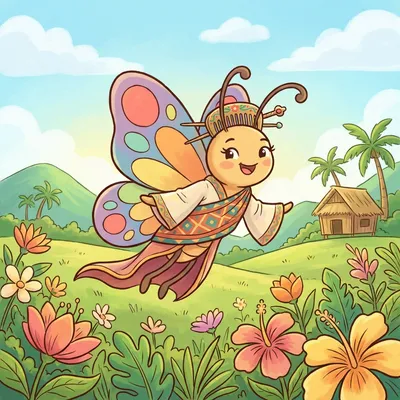

Tagalog Nursery Rhyme
Original Lyrics
Paru-parong bukid na lilipad-lipadSa gitna ng daan papaga-pagaspasIsang bara ang tapisIsang dangkal ang manggasAng sayang de kolaIsang piyesa ang sayadMay payneta pa siya - uy!May suklay pa man din - uy!
English Translation
Butterfly from the field flitting and floating by,In the middle of the road, waving its wings.A rectangular cloth wrapped around her,Sleeves a handspan long.Her skirt with a trainHas a long piece dragging.She even has a decorative hairpin - uy!And also a comb - uy!
Translation Notes
Line-by-Line Translation
Paru-parong bukid na lilipad-lipad - "Butterfly from the field flitting and floating by"
- Paru-paro = butterfly (reduplicated form)
- ng bukid = from the field/countryside
- na lilipad-lipad = that is flying (continuous/repetitive action through reduplication)
Sa gitna ng daan papaga-pagaspas - "In the middle of the road, waving its wings"
- Sa gitna = in the middle
- ng daan = of the road
- papaga-pagaspas = flapping/waving (reduplicated for continuous action)
Isang bara ang tapis - "A rectangular cloth wrapped around her"
- Isang bara = one vara (Spanish unit of measurement)
- ang tapis = the wrap-around skirt (traditional Filipino garment)
Isang dangkal ang manggas - "Sleeves a handspan long"
- Isang dangkal = one handspan (traditional measurement)
- ang manggas = the sleeves
Ang sayang de kola - "Her skirt with a train"
- saya de kola = skirt with a train (from Spanish "saya de cola")
Isang piyesa ang sayad - "Has a long piece dragging"
- Isang piyesa = one piece
- ang sayad = the dragging part
May payneta pa siya - "She even has a decorative hairpin"
- May = has
- payneta = decorative hair comb/pin (from Spanish "peineta")
- pa = even/still
- siya = she
May suklay pa man din - "And also a comb"
- suklay = comb
Grammar Notes
Reduplication everywhere: this song is a showcase for the Tagalog habit of doubling words. Paru-paro (butterfly) is already a doubled word, and lilipad-lipad (flitting and flitting) and papaga-pagaspas (fluttering on and on) repeat their roots to show movement that keeps going. The repetition makes you feel the wings never stopping.
Spanish loanwords: centuries of Spanish rule left their mark on the clothing words here, tapis, saya de kola (from saya de cola), and payneta (from peineta) all came from Spanish. Tagalog wove them in and made them its own.
"May" (has / there is): may payneta pa siya means "she even has a hairpin." The little word may announces that something exists or is possessed, doing the job of English "has" or "there is."
History and Meaning
"Paru-Parong Bukid" (Field Butterfly) compares a young countrywoman to a butterfly flitting down the road, then spends the rest of the song admiring her outfit: the wrap skirt, the long sleeves, the trailing train, the comb in her hair. It grew out of an 1890s Spanish song, "Mariposa Bella," and became a Tagalog favourite, helped along by a 1938 film of the same name.
What is the origin of the song Paru-Parong Bukid?
"Paru-Parong Bukid" originated from a Spanish-language song titled "Mariposa Bella" (Beautiful Butterfly), which was composed during the 1890s. The lyrics of "Mariposa Bella" poetically described a Filipina woman in her native attire, or traje de mestiza, the traditional formal dress of Filipino women.
The Tagalog adaptation, "Paru-Parong Bukid," is often credited to the prominent Filipino composer Felipe de León, though, as with many folk songs, the authorship is not firmly settled. The Tagalog version gained widespread popularity and largely overshadowed the original Spanish version, becoming one of the most recognizable Filipino folk songs.
The song achieved even greater fame when it was released as the soundtrack for a 1938 film of the same title, produced by Sampaguita Pictures, one of the major film studios in the Philippines during the golden age of Filipino cinema. The film's success helped cement the song's place in Filipino popular culture.
What does the butterfly represent in Paru-Parong Bukid?
The song compares a graceful young woman from the countryside to a butterfly fluttering through the fields, describing her elegant movements and traditional attire in detail. The lyrics paint a vivid picture of a Filipina woman dressed in her finest traditional clothes, including a long wrap-around skirt (tapis), a skirt with a train (saya de kola), decorative hair ornaments (payneta), and the characteristic butterfly sleeves of the traje de mestiza.
The butterfly metaphor works on multiple levels, describing how the woman moves gracefully, how her wide sleeves resemble butterfly wings, and symbolizing the beauty, freedom, and delicate grace associated with both butterflies and Filipino femininity.
The comparison also reflects the historical period when the song was created, during transitions in Philippine national identity from Spanish colonial rule through American occupation. The celebration of traditional Filipino dress and the shift from Spanish to Tagalog lyrics represented a growing sense of Filipino cultural pride and identity.
Lyrics from nurseryrhymes.info