

Pen Pen de Sarapen


Tagalog Nursery Rhyme
Original Lyrics
Pen pen de sarapen,De kutsilyo de almasen.Haw haw de karabaw batuten,Sipit namimilipit,Ginto't pilak,Namumulaklak sa tabi ng dagat.
English Translation
Pen pen de sarapen,Of the knife, of the store.Haw haw of the carabao... (nonsense),Pincers all a-twisting,Gold and silver,Blossoming beside the sea.
Translation Notes
Vocabulary
kutsilyo - knife (from Spanish cuchillo) almasen - warehouse, store (from Spanish almacén) karabaw - carabao, water buffalo sipit - pincers, clip, tongs ginto - gold pilak - silver namumulaklak - blooming, flowering dagat - sea
Grammar Notes
Mock-Spanish "de": the repeated de ("of") imitates Spanish phrasing, a leftover of the colonial era used here purely for sound. The lines are patterned to feel Spanish without forming real Spanish sentences.
Contraction "ginto't": ginto't pilak shortens ginto at pilak (gold and silver). Tagalog often clips at ("and") to 't after a vowel to keep a line flowing.
Ongoing aspect with reduplication: namimilipit (twisting) and namumulaklak (blooming) repeat the first syllable of the root to show an action that is going on, from pilipit (to twist) and bulaklak (flower).
History and Meaning
"Pen Pen de Sarapen" is a Filipino hand-clapping rhyme that children chant while slapping palms in time. Most of it is deliberate nonsense, a bouncy mix of mock-Spanish and Tagalog words picked for their sound. A knife, a store, a carabao, twisting pincers, gold and silver, flowers by the sea: the images do not add up to a story, and they are not meant to.
Origins
The rhyme has no known author and comes from the oral playground tradition of the Philippines. Its scraps of Spanish-sounding vocabulary (kutsilyo from cuchillo, knife; almasen from almacén, warehouse or store) reflect centuries of Spanish influence on Tagalog. Because it survives by word of mouth, several endings circulate. Some versions finish with lines about coins ("sayang pula, tatlong pera"); the one here is among the most widely chanted.
Meaning & Interpretation
The point of the rhyme is rhythm, not sense. Nonsense verse like this gives children a run of strong, clappable syllables and a few vivid pictures without asking them to follow a plot. That is exactly what makes it good for a clapping game: the beat is steady and easy to keep, and the funny, meaningless words are easy to remember. Trying to translate it literally only shows how much of it is pure sound.
How do you play Pen Pen de Sarapen?
Two children face each other and clap hands in a set pattern, their own hands and then each other's, in time with the chant. The rhyme sets the tempo, and the game often speeds up until someone misses a clap. It can also be played as a group elimination or choosing game.
What does Pen Pen de Sarapen mean?
Most of it means nothing on purpose. A few words are real, kutsilyo (knife), karabaw (carabao), ginto (gold), pilak (silver), dagat (sea), but they are strung together for rhythm rather than meaning, like the nonsense lines in many English clapping rhymes.
Line-by-Line Notes
Pen pen de sarapen - nonsense opening syllables chosen for rhythm
De kutsilyo de almasen - "of the knife, of the store," mock-Spanish phrasing
- kutsilyo = knife
- almasen = store, warehouse
Sipit namimilipit - "pincers all a-twisting"
- sipit = pincers, clip
- namimilipit = twisting, writhing
Ginto't pilak, namumulaklak sa tabi ng dagat - "gold and silver, blossoming beside the sea"
- ginto = gold
- pilak = silver
- dagat = sea
Free Printable Coloring Page
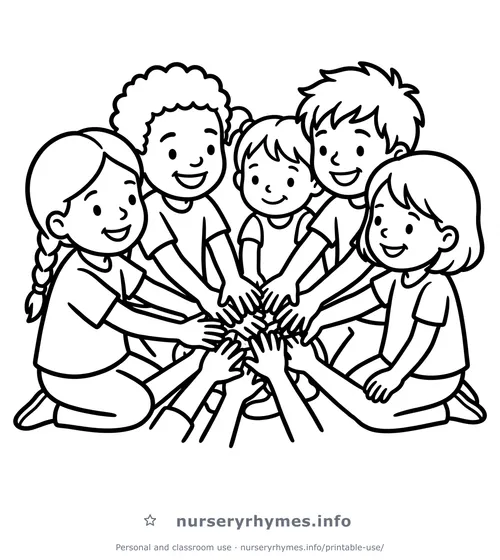
Print this Pen Pen de Sarapen coloring sheet for free and let little ones bring it to life with crayons or pencils.
Full-resolution PNG · Fits the paper size selected in your print dialog · Personal and classroom use
Lyrics from nurseryrhymes.info