

Tinker, Tailor


Lyrics
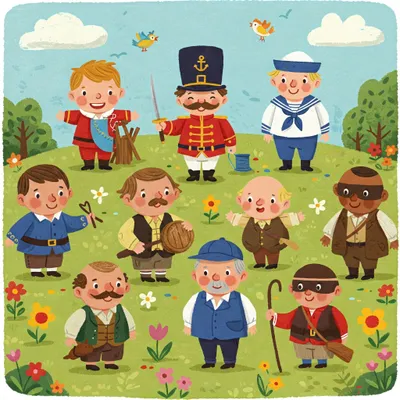
Tinker,Tailor,Soldier,Sailor,Rich Man,Poor Man,Beggar Man,Thief.
History and Meaning
"Tinker, Tailor, Soldier, Sailor" is a fortune-telling rhyme: a child counts cherry stones, buttons, or daisy petals down the list of trades, and whichever one lands on the last item is the husband they will supposedly marry. The list of professions goes back to the seventeenth century, and gave John le Carré a title.
What is the origin of the rhyme Tinker Tailor?
A categorization of societal roles appears in William Caxton's The Game and Playe of the Chesse, printed around 1475, which names the pawns as "Labourer, Smith, Clerk, Merchant, Physician, Taverner, Guard and Ribald." The first documented instance of the specific opening sequence, Tinker, Tailor, Soldier, Sailor, being grouped together occurs in William Congreve's play Love for Love from 1695, suggesting these core professions had entered common language by the late seventeenth century.
How is the fortune-telling game Tinker Tailor played?
The rhyme serves a dual function in traditional children's culture:
- Counting-Out: It works as a counting-out rhyme to randomly select someone from a group, often to determine who will be "It" in games like tag. The process involves pointing sequentially at each participant while reciting the stressed syllables.
- Divination: It serves as a fortune-telling game, particularly to predict a future husband's profession. Children count a series of items, such as cherry stones, buttons on clothing, daisy petals, ball bounces, or rope skips, while reciting the list of professions. The profession named on the count corresponding to the final item becomes the prediction.
What are the regional variations of Tinker Tailor?
The list of professions has evolved over time with notable regional variations. The most common modern version in the United Kingdom runs: "Tinker, Tailor, Soldier, Sailor, Rich Man, Poor Man, Beggar Man, Thief." In the United States, a frequently encountered version goes: "Rich Man, Poor Man, Beggar Man, Thief, Doctor, Lawyer, Indian Chief." Earlier collected versions show further variation. James Orchard Halliwell in the 1840s recorded a button-counting rhyme starting with the words "My belief, a captain, a colonel, a cow-boy, a thief." A.A. Milne's 1927 collection included an expanded version for counting cherry stones, adding roles like cowboy, policeman, jailer, engine driver, and rocket man.
What does the rhyme reveal about historical social roles?
The listed professions span society's spectrum, from itinerant craftsmen (Tinker) and essential tradesmen (Tailor) to figures of authority (Soldier, Sailor), economic status (Rich Man, Poor Man, Beggar Man), and criminality (Thief). The fortune-telling focus on determining a future husband's profession underscores the historical emphasis on marriage as a primary determinant of a woman's social standing and economic security. In modern times, the rhyme remains culturally resonant, most famously in John le Carré's espionage novel Tinker Tailor Soldier Spy.
Music Video
If the player is unavailable, watch this video on YouTube.
Lyrics from nurseryrhymes.info