
To Market, to Market


Lyrics
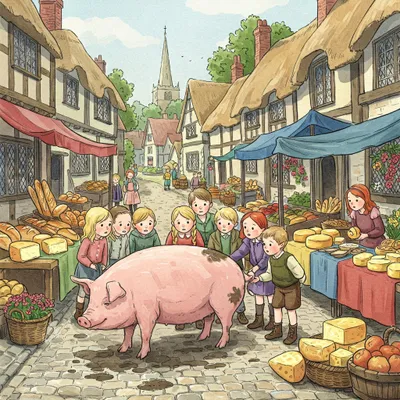
To market, to market, to buy a fat pig,Home again, home again, jiggety-jig.
To market, to market, to buy a fat hog,Home again, home again, jiggety-jog.
To market, to market to buy a plum cake,Home again, home again, market is late.
To market, to market, to buy a plum bun,Home again, home again, market is done.
History and Meaning
"To Market, to Market" is a knee-bounce rhyme: an adult jogs a child along to "jiggety-jig," then dips them on the last line. The trip to buy a fat pig is very old, its phrases turn up in a dictionary from 1598, though the children's version dates to 1805.
Origins
The song has roots in English agricultural history. The earliest written record of its lines dates to 1598, when the phrase "Home againe, home againe, market is done" was included in John Florio's dictionary A Worlde of Wordes. A similar line was also recorded in Thomas Tusser's 1573 farming manual, Five Hundred Points of Good Husbandry.
A more complete version of the rhyme was quoted in John Florio's 1611 bilingual dictionary Queen Anna's New World of Words. The rhyme was first published in its complete, contemporary form as a children's nursery rhyme in the 1805 collection Songs for the Nursery.
Meaning & Interpretation
The lyrics reflect the traditional rural custom of visiting local markets to buy and sell livestock and household goods. The references to buying a "fat pig" or a "fat hog" illustrate the historically vital role that pigs played in cottage economies, providing key winter sustenance for rural families.
The playful refrains "jiggety-jig" and "jiggety-jog" are thought to mimic the bouncing motion of a horse-drawn cart or horse ride to and from the market. Today, the rhyme is primarily used as a physical knee-ride game, where an adult bounces a child on their lap to the rhythm of the words and dips them backward on the final lines.
What is the history of the rhyme To Market to Market?
The rhyme is a traditional English folk song dating back to the late sixteenth century. Its phrases were documented by John Florio in 1598 and 1611, and the full children's song was first published in 1805.
What does jiggety-jig mean in the rhyme?
The phrase is a playful, onomatopoeic term meant to represent the uneven, bouncing motion of a horse or cart traveling on a rough road.
Music Video
If the player is unavailable, watch this video on YouTube.
Lyrics from nurseryrhymes.info