

Today Is Monday
Lyrics
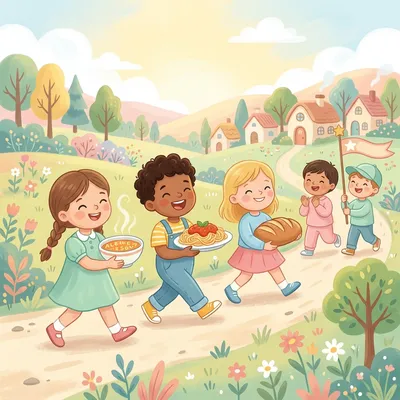
Today is Monday, today is Monday,Monday string beans,All you hungry children, come and eat it up!
Today is Tuesday, today is Tuesday,Tuesday spaghetti,Monday string beans,All you hungry children, come and eat it up!
Today is Wednesday, today is Wednesday,Wednesday soup,Tuesday spaghetti,Monday string beans,All you hungry children, come and eat it up!
(The song keeps going through Thursday, Friday, Saturday and Sunday,and every verse runs back down through all the days before it,so the Sunday verse names the whole week in reverse.)
History and Meaning
"Today Is Monday" gives each day of the week a food, then makes you sing the list backwards. Monday gets string beans. Tuesday adds spaghetti and then returns to Monday. By Sunday a child is reciting seven days in reverse order, at speed, before the song will let them stop.
That backwards run is the point. It is why preschool teachers and childminders keep reaching for this song when the days of the week need to stick, and why it survives in oral tradition without ever having a famous author attached to it.
Origins
The song is traditional and there is no documented first printing. It circulates as an oral folk piece, passed between summer camps, classrooms and family kitchens, and it turns up in twentieth-century American children's songbooks with no composer credit anywhere on the page. Any source that hands you a firm date or a named writer for it is guessing.
A related days-of-the-week song runs alongside it in the same folk tradition, one built on household chores rather than meals: Monday wash day, Tuesday ironing day, and so on down the week. That version reflects a real domestic schedule from an era when laundry genuinely consumed an entire day. Whether the food version grew out of the chore version, or the two developed in parallel, has not been settled.
Eric Carle first drew the sequence as a frieze in 1977, and Philomel published it as the picture book "Today Is Monday" in February 1993, with the music and lyrics printed at the back. Carle supplied the artwork and fixed one particular version of the words in print. The song itself is older than the book by decades.
Meaning & Interpretation
There is nothing hidden in the text. It is a food list mapped onto a week, and the closing line, "all you hungry children, come and eat it up", turns each verse into a call to the table. Some singers save that line for the final verse instead of repeating it every time, which moves the song along faster.
The mechanics are where the interest sits. Cumulative songs work by making every new verse contain all the verses before it. "The Twelve Days of Christmas" does it with gifts, "There Was an Old Lady Who Swallowed a Fly" does it with animals, and this one does it with dinner. A child who reaches the Sunday verse has said the word "Monday" seven separate times without anyone drilling them on it. The order of the week gets absorbed as a side effect of finishing the song.
Is Today Is Monday the same as Monday's Child?
No, and the two get confused constantly. Monday's Child is a fortune-telling verse that assigns a personality trait to each day and begins "Monday's child is fair of face, Tuesday's child is full of grace". "Today Is Monday" is a cumulative song that assigns a food to each day and repeats the whole list every verse. Different words, different tune, different purpose. The only thing they share is that both start on a Monday.
Did Eric Carle write Today Is Monday?
No. Carle illustrated the song and published his picture book version in 1993, but the words and melody were already traditional and in wide circulation long before that. The credit error is easy to make because his name sits on the cover and no other name is available to compete with it. Crediting him as illustrator and arranger is accurate; crediting him as author is not.
What food goes with each day?
It depends on which version you learned. One widely sung set runs string beans, spaghetti, soup, roast beef, fresh fish, chicken and ice cream from Monday through Sunday, and Carle's book uses its own sequence. Other singers substitute freely. Because the song was never fixed by a single printed source, no version is the correct one, and teachers often let a class pick their own foods, which works fine as long as everyone agrees before the singing starts.
Why is this song useful for teaching the days of the week?
The repetition does the teaching. Ordinary recitation gives a child one pass through the week; this song gives them twenty-eight passes through parts of it, always in the same direction, always ending on the day they started from. The food acts as a memory hook for each day, so a child who stalls on Thursday can often retrieve it by remembering what was for dinner.
Related Nursery Rhymes


Lyrics from nurseryrhymes.info