

Twenty Froggies

Lyrics
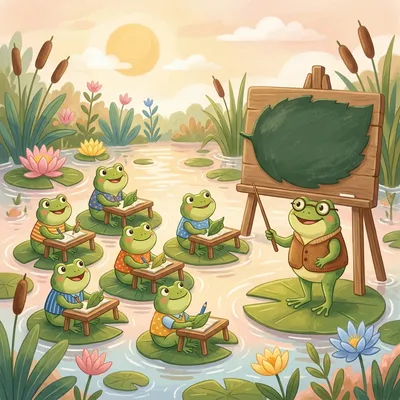
Twenty froggies went to school,Down beside a rushy pool;Twenty little coats of green,Twenty vests all white and clean."We must be in time," said they;"First we study, then we play;That is how we keep the rule,When we froggies go to school."
Master Bullfrog, grave and stern,Called the classes in their turn;Taught them how to nobly strive,Likewise how to leap and dive;From his seat upon the log,Showed them how to say "Ker-chog!"Also how to dodge a blowFrom the sticks which bad boys throw.
Twenty froggies grew up fast;Bullfrogs they became at last;Not one dunce among the lot,Not one lesson they forgot.Polished in a high degree,As each froggie ought to be,Now they sit on other logs,Teaching other little frogs.
History and Meaning
Twenty frogs in green coats and white waistcoats file down to a reedy pool, where a stern old bullfrog teaches them to strive, to leap, to dive, and to dodge sticks thrown by boys. That last detail is the one children remember. The poem is credited to the American writer George Cooper, and it spread through the schoolrooms of the late 1800s as a recitation piece, the sort of thing a child stood up and delivered from memory on a Friday afternoon.
It circulates under two titles. "Twenty Froggies" comes from the opening line, and "Frogs at School" is the heading it carried in several early printings. Both refer to the same poem.
Origins
George Cooper was born in New York City in 1840 and died there in 1927. He wrote well over two hundred song lyrics, including "Sweet Genevieve", and a large quantity of verse for children that turned up in school readers and juvenile magazines for decades.
Cooper's other claim on the record is his work with Stephen Foster. In the last months of Foster's life, Cooper supplied words that Foster set to music, among them "For the Dear Old Flag I Die!", published in 1863. Foster died in January 1864, so the partnership was brief and came right at the end. If you want to hear the composer at the other end of his career, the site also has Camptown Races, which Foster wrote in 1850, more than a decade before he and Cooper met over a manuscript.
Pinning the poem's first printing is harder than it should be. Secondary sources point to an appearance in The Nursery, a Boston monthly for young readers, in 1874, and to a reprint in Webster's Little Folks' Speaker in 1875, a book assembled specifically for memorisation and recitation. Neither claim is easy to confirm against the original volumes, so no single year is given here. What is clear is that the poem was in wide circulation through the 1870s and after, and that its home was the recitation book rather than the songbook.
Meaning & Interpretation
The moral sits on the surface, which is what a recitation piece needs. The froggies arrive on time, study before they play, and end the poem as accomplished bullfrogs with "not one dunce among the lot". Then they take up positions on their own logs and teach the next batch. Diligence is rewarded, and the reward is turning into the teacher.
The joke underneath is that the curriculum is entirely frog business. Leaping, diving, croaking, and evading small boys with sticks are the practical skills of pond life, and Cooper treats them with the same seriousness a Victorian schoolmaster would bring to Latin. The stick-throwing line is a small piece of realism about how children of the period actually treated frogs, dropped into an otherwise cheerful poem without comment.
Modern readers sometimes find Master Bullfrog a bit severe. He is "grave and stern", and the poem never questions him. That is period-appropriate rather than harsh, and children generally enjoy the character precisely because he is a frog behaving like an authority figure.
Who wrote Twenty Froggies?
George Cooper, an American poet and lyricist who lived from 1840 to 1927 and spent his life in New York City. He is best known for song lyrics such as "Sweet Genevieve" and for supplying words to Stephen Foster shortly before Foster's death in 1864. Cooper also produced a great deal of verse for children, which is how "Twenty Froggies" reached so many school readers.
Is Twenty Froggies a counting rhyme?
Not really, though it is often filed as one. The poem opens with twenty and then repeats the number three times in the first four lines, so it gives you a large number to say out loud, but it never counts down or works through a sequence the way "Ten Green Bottles" or "Five Little Ducks" does. Twenty stays twenty for the whole poem. It works well for practising the word and the idea of a group of twenty, and for talking about counting in twenties or pairs, but the poem is a recitation piece with a moral rather than a counting song.
Why is it also called Frogs at School?
Early printings used both titles, and neither ever fully won. "Frogs at School" was the heading in several nineteenth-century collections and remains the common title in Indian school textbooks, where the poem is still widely taught. "Twenty Froggies" is the more usual title elsewhere and comes straight from the first line. The text is the same either way.
What does "Ker-chog" mean?
It is Cooper's invented spelling for a frog's croak, in the same family as "ker-plunk" and "ker-splash". Within the poem it is treated as a lesson, something the young frogs have to be shown how to say properly, which is part of the running joke that frog school teaches frog subjects. Children reciting the poem usually give it the loudest delivery in the whole piece.
Related Nursery Rhymes



Lyrics from nurseryrhymes.info