

Three Craws

Lyrics
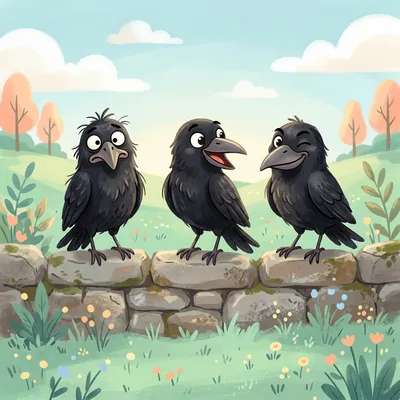
Three craws sat upon a wa,Sat upon a wa, sat upon a wa,Three craws sat upon a wa,On a cauld and frosty mornin.
The first craw was greetin for his maw,Greetin for his maw, greetin for his maw,The first craw was greetin for his maw,On a cauld and frosty mornin.
The second craw fell and broke his jaw,Fell and broke his jaw, fell and broke his jaw,The second craw fell and broke his jaw,On a cauld and frosty mornin.
The third craw couldnae flee at a,Couldnae flee at a, couldnae flee at a,The third craw couldnae flee at a,On a cauld and frosty mornin.
The fourth craw wasnae there at a,Wasnae there at a, wasnae there at a,The fourth craw wasnae there at a,On a cauld and frosty mornin.
The fifth craw wanted anither craw,Wanted anither craw, wanted anither craw,The fifth craw wanted anither craw,On a cauld and frosty mornin.
And that was a the sang the mannie sang,The sang the mannie sang, the sang the mannie sang,And that was a the sang the mannie sang,On a cauld and frosty mornin.
History and Meaning
The song is called "Three Craws" and it has at least five crows in it. That is the joke, and children work it out somewhere around the fourth verse, when the singer announces that the fourth craw "wasnae there at a" and carries on singing about it anyway. By the fifth verse the whole thing has come off its hinges, and the last verse gives up the pretence completely: that was all the song the man sang, so there is no more.
It is one of the first songs many Scottish children learn, usually in a primary school hall or a car back seat, and usually with everyone shouting the last line.
Origins
Three Craws is a well-established Scots children's song, sung across Scotland and taught in schools, but its origins are not documented. There is no reliable record of who wrote it or when it was first printed, and the versions that circulate differ from one another in the order of the verses and in how many crows survive to the end. That is normal for a song that travelled by ear through playgrounds rather than through songbooks.
What can be said is that it belongs to a living body of Scots-language children's songs that also includes Katie Bairdie and Ye Cannae Shove Yer Granny Aff a Bus. These share a family resemblance: short repeated lines, broad Scots vocabulary kept intact rather than translated, a simple tune anyone can hold, and humour aimed squarely at children rather than at the adults supervising them. Coulter's Candy sits in the same tradition, though it has a known author and a gentler mood.
Meaning & Interpretation
The structure is cumulative in shape but subtractive in logic. Each verse takes one crow and gives it a reason for not being on the wall any more, and the reasons get less and less plausible as the song goes on. The first craw is crying for its mother, which is at least a thing a young bird might do. The second has broken its jaw, which is unfortunate but imaginable. The third cannot fly at all, which is a stretch for a crow. The fourth was never there, which is not a reason at all, and the fifth simply wants another crow to turn up, which solves nothing.
Then the singer admits the whole thing was invented. "That was a the sang the mannie sang" is a shrug in verse form, and it is the reason the song sticks. Most nursery rhymes ask children to accept a small fiction without comment. This one builds the fiction, lets it collapse, and points at the wreckage.
The refrain does the structural work. "On a cauld and frosty mornin" ends every verse identically, which means the tune resets each time and any number of new crows can be slotted in. Groups of children take advantage of that, and improvised extra verses are part of how the song is actually sung.
What do the Scots words mean?
Almost every line has at least one Scots word, and the song is usually sung with them left in rather than smoothed into English.
craw - crow
craws - crows
wa - wall
cauld - cold
mornin - morning
greetin - crying or weeping, not greeting
maw - mother, mum
couldnae - could not
flee - fly
wasnae - was not
at a - at all
a - all
anither - another
mannie - man, with the -ie ending adding a familiar or slightly comic tone
sang - song
Why are there five craws in Three Craws?
Because the song is a joke about counting. The title promises three crows, the verses keep producing more, and nobody in the song acknowledges the problem until the final verse admits the singer was making it up. Some versions stop at three or four crows, and some go well past five, since the repeated refrain lets singers add as many verses as they can invent.
How do you sing Three Craws?
Each verse follows the same pattern: state the line, repeat the middle phrase twice, state the line again, then finish with "on a cauld and frosty mornin". The tune stays identical throughout, so the only thing that changes is the fate of the next crow. Children usually count the crows on their fingers and get louder with each verse, and the last line is normally bellowed.
Related Nursery Rhymes

Lyrics from nurseryrhymes.info