

Ye Cannae Shove Yer Granny Aff a Bus

Lyrics
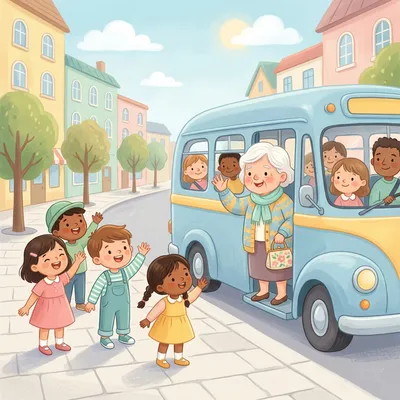
Ye cannae shove yer granny aff a bus,Ye cannae shove yer granny aff a bus,Ye cannae shove yer granny, for she's yer mammy's mammy,Ye cannae shove yer granny aff a bus.
Ye can shove yer other granny aff a bus,Ye can shove yer other granny aff a bus,Ye can shove yer other granny, for she's yer daddy's mammy,Ye can shove yer other granny aff a bus.
Singin' i-yi-yippy-yippy-i,Singin' i-yi-yippy-yippy-i,Singin' i-yi-yippy, i-yi-yippy,I-yi-yippy-yippy-i.
History and Meaning
The tune is American. Scottish children have been singing these words to the melody of She'll Be Coming Round the Mountain for as long as anyone can document, and that melody arrived in Scotland from the United States in the 1940s, according to the Scots Language Centre. Everything else about the song is a joke told at a child's volume: you may not push your grandmother off a moving bus, and the reason offered is not kindness or road safety but a point of family bookkeeping. She is your mammy's mammy.
Then comes the second verse, which is where the song earns its reputation. The other granny, the one on your father's side, is fair game.
Origins
The song is traditional and anonymous. Nobody knows who first put these words to the tune, and there is no manuscript, no first printing, and no named author to point at. The strongest claim about the words themselves is a family memory recorded by the Scottish folklorist and songwriter Ewan McVicar, who noted that his mother learned the first two verses in the school playground at Plean, near Stirling, when she was eight. That places the song in central Scotland rather than in any one city. The often-repeated line that it goes back to Glasgow before 1920 does not survive checking. It circulates on user-generated web pages without a source, and it cannot be right in any case, because a song cannot be sung in a playground decades before the tune it is sung to reached the country. The defensible window is roughly the 1940s onward, which makes this a twentieth-century Scots playground song rather than an old one.
McVicar also recorded that his father added a further verse, drawn from the chorus of a nineteenth-century comic song called "Phairson Swore a Feud". That is how playground songs usually grow. An adult contributes a scrap of something older, children keep the parts that scan, and the rest falls away.
Meaning & Interpretation
There is no lesson buried in this one. The comedy runs on a piece of mock-logic that children find genuinely funny: a rule is announced with great seriousness, a reason is given, and the reason turns out to have a loophole. Your maternal grandmother is protected by the chain of descent that produced you. Your paternal grandmother, by exactly the same reasoning, is not, and the song does not pause to explain why. The absurdity is the point.
It also helps that the whole thing is nonsense violence of the kind small children handle easily. Nobody is shoving anybody. The bus is a bus in the way that a bus in a knock-knock joke is a bus. The final verse abandons words altogether for a string of yippy-i syllables, which is the part groups sing loudest and the part that makes it work as a coach-trip song, a Scouts song, and a football-terrace song as much as a nursery one.
The song sits in a wider habit of Scots children's rhymes that put grannies at the centre of ridiculous situations. Affection and cheek arrive in the same breath, and neither cancels the other out.
What do the Scots words mean?
The vocabulary is small and most of it repeats.
ye - you
cannae - cannot
yer - your
aff - off
mammy - mummy, mother
granny - grandmother
shove - push (standard English, but here it means a good hard push)
The line "she's yer mammy's mammy" simply means "she is your mother's mother". The closing "i-yi-yippy-yippy-i" is not Scots and means nothing at all. It is a nonsense refrain to shout.
Why can you shove your other granny?
Because the song says she is your daddy's mammy, and the joke depends on that difference being treated as a serious legal distinction when it obviously is not. Children singing it are not making a point about which side of the family matters more. They are enjoying a rule that collapses the instant you look at it, which is a reliable source of playground comedy.
How old is Ye Cannae Shove Yer Granny Aff a Bus?
Probably from the 1940s or later. The tune it uses, "She'll Be Coming Round the Mountain", came to Scotland from the USA in the 1940s, so the words cannot be older than that in their current form. Claims that the song dates to before 1920 appear on unsourced websites and do not hold up. The earliest personal account, from Ewan McVicar, describes his mother learning it as a child at Plean school near Stirling.
Related Nursery Rhymes




Lyrics from nurseryrhymes.info