
She'll Be Coming Round the Mountain


Lyrics
She'll be coming 'round the mountain when she comes, (Toot! Toot!)She'll be coming 'round the mountain when she comes, (Toot! Toot!)She'll be coming 'round the mountain,She'll be coming 'round the mountain,She'll be coming 'round the mountain when she comes. (Toot! Toot!)
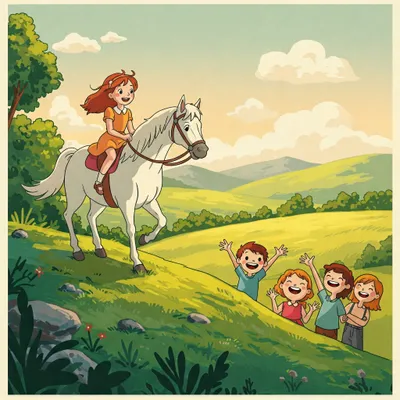
She'll be driving six white horses when she comes, (Whoa back!)She'll be driving six white horses when she comes, (Whoa back!)She'll be driving six white horses,She'll be driving six white horses,She'll be driving six white horses when she comes. (Whoa back! Toot! Toot!)
Oh, we'll all go out to meet her when she comes, (Hi Babe!)Oh, we'll all go out to meet her when she comes, (Hi Babe!)Oh, we'll all go out to meet her,We'll all go out to meet her,We'll all go out to meet her when she comes. (Hi Babe! Whoa back! Toot! Toot!)
We'll have chicken and dumplings when she comes, (Yum! Yum!)We'll have chicken and dumplings when she comes, (Yum! Yum!)We'll have chicken and dumplings,We'll have chicken and dumplings,We'll have chicken and dumplings when she comes. (Yum! Yum! Hi Babe! Whoa back! Toot! Toot!)
(Other potential verses include: "She'll be wearing pink pyjamas," "We'll kill the old red rooster," etc., accumulating the sound effects/responses.)
History and Meaning
Before it was a campfire singalong, "She'll Be Coming 'Round the Mountain" was an African-American spiritual about a heavenly chariot. Railroad crews turned the chariot into a train, and the "she" of the title is most likely a steam locomotive rounding the bend, toot toot.
Origins
The song has its roots in a nineteenth-century African-American spiritual titled "When the Chariot Comes." The spiritual featured a similar melody and structure, describing the arrival of a heavenly chariot.
During the late nineteenth century, as the railroad system expanded across the United States, Appalachian track-laying crews adapted the song into a secular work song. The spiritual "chariot" was replaced by a train, and the narrative shifted to the anticipation of a traveler's arrival. The song was first published in a formalized collection in 1927, when Carl Sandburg included it in his anthology The American Songbag.
Meaning & Interpretation
The secular lyrics describe the arrival of a female guest, celebrated with six white horses, a warm welcome, and a feast of chicken and dumplings. Historically, the "she" in the song has been interpreted in various ways. In the context of railroad workers, the pronoun likely referred to a steam locomotive, which was commonly personified as female. In other regional folk traditions, the character was associated with traveling organizers, family members, or delivery wagons.
The repetitive structure of the verses allowed singers to easily improvise new lines and add humorous call-and-response actions. Over the twentieth century, these physical responses, such as shouting "Toot! Toot!" and "Whoa back!", became standard parts of the performance, helping children practice motor coordination and timing.
What is the origin of She'll Be Coming 'Round the Mountain?
The song evolved from an old African-American spiritual called "When the Chariot Comes." During the late nineteenth century, railroad workers adapted the melody and structure into a secular work song about an arriving train. It was first compiled in print in 1927 by Carl Sandburg.
What was the original spiritual version of the song?
The original version was a religious spiritual about the Second Coming, where the "chariot" comes to carry believers home. The secular version adapted this concept to the excitement of a passenger train arriving in mountain communities.
Music Video
If the player is unavailable, watch this video on YouTube.
Related Nursery Rhymes




Lyrics from nurseryrhymes.info