
Shoe a Little Horse

Lyrics
Shoe a little horse,Pat the sole of one bare foot, three or four light taps.
Shoe a little mare,Pat the sole of the other foot the same way.
But let the little coltGo bare, bare, bare.Let both feet go, then tickle the soles or run your fingers up the legs.
History and Meaning
The whole rhyme is four lines long and takes about six seconds to say. The point of it is the tapping. You hold a baby's bare foot, pat the sole on "horse", pat the other sole on "mare", then let go and tickle on "bare, bare, bare". The joke underneath is that the baby is the horse and you are the farrier, the craftsman who shapes iron shoes and nails them on. Children who first heard this had watched that done in the street. Modern children mostly have not, which is the one part of the rhyme that now needs a footnote.
Origins
A version was in print by the 1780s. Joseph Ritson's collection Gammer Gurton's Garland, or The Nursery Parnassus, first issued as a chapbook in 1784, gives it in six clipped lines: "Shoe the colt, / Shoe the colt, / Shoe the wild mare; / Here a nail, / There a nail, / Yet she goes bare." James Orchard Halliwell printed the same text in The Nursery Rhymes of England in 1842, and from there it passed into the Victorian nursery books and into most of the collections still sold today.
The foot-patting use is documented separately, and later. In 1889 the Folk-Lore Journal carried a paper on Dorsetshire children's games which described a nurse pulling off a small child's shoes and socks, turning the feet toward the fire, and saying "Shoe the little horse, and shoe the little mare, but let the little colt go bare, bare." That one sentence is the clearest early record of what the words were for, and the wording is almost exactly what parents say now. The only real drift since is "shoe a little horse" in place of "shoe the little horse".
Both strands, the printed chapbook verse and the fireside foot game, run on the same idea. It is likely they were never separate, and that the collectors of the 1780s simply wrote down the words without bothering to note the actions, which was the usual practice.
Meaning & Interpretation
There is no hidden story here, no plague and no politics, whatever a shareable list might claim. Horse, mare, colt is a working stable in three words. The horse and the mare are the grown animals that pull and carry, so they get shod. The colt is the foal. It is too young to work, its hooves are still growing, and putting iron on it would be pointless. So the colt goes bare.
That gives the game its shape. Two feet get the serious treatment, and then the third character, the one the baby actually is, gets excused and tickled instead. The rhyme lets the youngest off. Small children who are old enough to follow it tend to enjoy being the colt very much, and will hold a foot out to be shod in order to reach the part where they are not.
The repeated "bare, bare, bare" is doing practical work too. It signals the tickle a beat before it lands, so the baby learns to anticipate it. That pause is why the rhyme keeps working on the twentieth repetition.
How do you play Shoe a Little Horse with a baby?
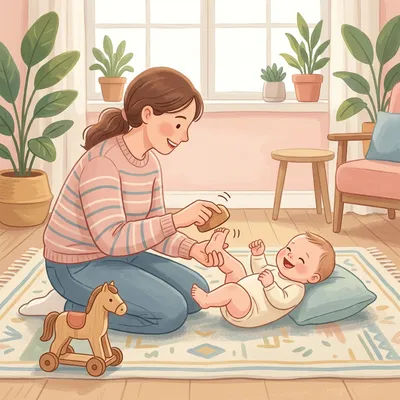
Sit the baby on your lap facing you, or lay them on their back on a changing mat with their feet toward you, and take the socks off. On "Shoe a little horse", tap the sole of one foot lightly with your fingertips or the flat of your hand, three or four taps in rhythm with the words. On "Shoe a little mare", do the same to the other foot. On "But let the little colt go bare, bare, bare", release both feet and tickle the soles, or walk your fingers up the legs to the tummy. Keep the taps gentle and stop if the baby pulls away. Nappy changes and post-bath drying are the natural moments for it, because the feet are already bare.
Does it hurt a horse to be shod?
No. The nails go into the hoof wall, which is made of keratin, the same material as a fingernail, and contains no nerves or blood vessels. A farrier drives each nail outward through the wall so the point emerges on the side of the hoof, then twists off and clenches down the protruding end. The sensitive inner structures are avoided entirely. A badly placed nail can prick the live tissue and cause lameness, which is why shoeing is a skilled trade with a long apprenticeship, but correct shoeing is painless and horses commonly stand still and dozing through it.
What is a colt?
A colt is a young male horse, usually one under about four years old. A young female is a filly. In this rhyme the word is doing looser duty for any foal, the baby of the group, which is the whole reason it is allowed to go without shoes.
What age is this rhyme good for?
It works from the newborn weeks, when it is essentially gentle foot massage with a voice attached, through to about three. Babies of a few months respond to the touch and the rhythm rather than the words. Around nine to twelve months many start to recognise the build-up and kick or laugh before the tickle arrives. Toddlers who can talk will often take over the shoeing themselves and pat your feet, or a doll's.
Related Nursery Rhymes


Lyrics from nurseryrhymes.info