

She Sells Seashells

Lyrics
She sells seashells by the seashore,The shells she sells are seashells, I'm sure.So if she sells seashells on the seashore,Then I'm sure she sells seashore shells.
History and Meaning
The four lines everyone knows are the chorus of a music-hall song from 1908, with words by Terry Sullivan and music by Harry Gifford. Sullivan did not invent the phrase. He built the song around a twister that had already been circulating in England for at least half a century, first as a dry classroom drill and then as a party puzzle. There is also a widely repeated story that the rhyme is about Mary Anning, the fossil hunter of Lyme Regis. That story is not documented, and the section below explains why.
Origins
The earliest known printing is from 1855, in Letters and Sounds: An Introduction to English Reading by Alexander Melville Bell, the Scottish phonetician who later devised the Visible Speech system and whose son Alexander Graham Bell built the telephone. Bell was not being playful. He included the sentence as an articulation exercise for pupils learning to separate two sounds that sit close together in the mouth.
By 1871 it had escaped the classroom. The Christmas number of The Family Herald, dated 1 December that year, printed it under the heading "Alliterative Puzzles" alongside other twisters, the first known appearance of it purely for fun.
Sullivan and Gifford turned the puzzle into a comic song in 1908. It was introduced by the music-hall comedian Wilkie Bard in the pantomime Dick Whittington at the Theatre Royal, Drury Lane, and the chorus was the whole joke: a performer publicly risking a sentence designed to defeat him. The song sold well and the chorus outlived the verses, which is why almost nobody can quote anything else from it. Because the words are older than the song, this page carries no single date of composition.
Meaning & Interpretation
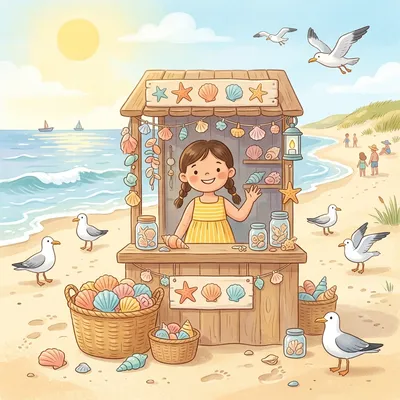
There is no story here and no hidden subject. The sentence describes a woman selling shells on a beach, which was an ordinary seaside trade in Victorian Britain, and then folds back on itself with a small piece of mock logic: if she sells seashells on the seashore, then what she sells must be seashore shells. That circular joke is the same trick "Peter Piper" plays when it demands to know where the peck of pickled peppers went.
The real content is phonetic. English has two sibilants made in almost the same place: /s/, formed with the tongue tip near the ridge behind the upper teeth, and /ʃ/, the "sh" sound, made with the tongue pulled back slightly and the lips often rounded. The twister alternates between them at speed, so the tongue has to shuttle back and forth several times per second while the lips keep changing shape. Under pressure the brain reuses whichever gesture it just made, and the line collapses into "she shells she shells". Speech therapists still use it for exactly this reason, and it remains a standard warm-up for actors and broadcasters.
Is She Sells Seashells about Mary Anning?
There is no evidence that it is. Mary Anning (1799 to 1847) sold fossils and curiosities from a shop on the seafront at Lyme Regis in Dorset, so the picture fits beautifully, but no source from her lifetime or for decades afterwards connects her to the rhyme. The earliest printing of the twister comes eight years after her death, and neither Bell in 1855, nor The Family Herald in 1871, nor Sullivan in 1908 mentions Anning, Lyme Regis, or fossils. Sullivan never claimed she was his subject. The folklorist Stephen Winick examined the claim for the Library of Congress in 2017 and found it to be folklore about folklore, a modern story attached to an older rhyme.
It is worth saying why the story is so popular. Anning found the first correctly identified ichthyosaur skeleton as a girl, then the first complete plesiosaur in 1823 and the first British pterosaur in 1828. Gentlemen geologists bought her specimens, published on them, and frequently left her name out. She was barred from the Geological Society of London because she was a woman. People repeat the seashells story because they want her to have a monument, and that instinct is a good one. The honest position is that she has better monuments than a tongue twister, and that repeating the claim as fact does her memory no favours.
Who wrote She Sells Seashells?
The 1908 song was written by Terry Sullivan, with music by Harry Gifford, and popularised by Wilkie Bard. The tongue twister itself has no known author. It appears in print in 1855 as an elocution exercise and was almost certainly passed around by teachers and children before that, which puts it in the anonymous oral tradition rather than with any one writer.
Why is She Sells Seashells so hard to say?
The difficulty comes from switching between "s" and "sh" faster than the tongue can reliably reposition. The two sounds differ only in where the tongue makes its narrow channel, a matter of a few millimetres, so the motor plan for one bleeds into the other. Slowing down and exaggerating the lip rounding on every "sh" fixes most stumbles, then the speed can come back gradually.
Is it "by the seashore" or "on the seashore"?
Both are in circulation. Printings and recordings of the 1908 song use "on the sea shore", while "by the seashore" is the more common opening in modern classroom and playground versions, especially in the United States. Neither is more correct than the other, and many singers use one in the first line and the other in the third, which is how the version above is set out.
Related Nursery Rhymes





Lyrics from nurseryrhymes.info