
Not Last Night but the Night Before
Lyrics
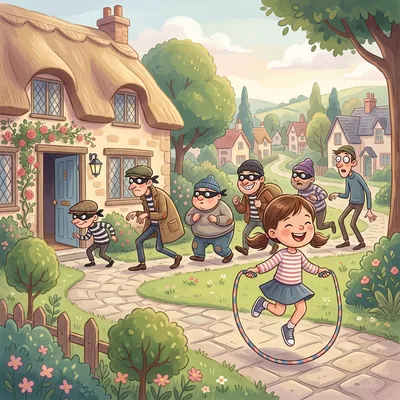
Not last night but the night before,Twenty-four robbers came knocking at my door.I ran out, they ran in,And this is what they said to me:
Spanish dancer, turn around,(turn all the way round while you jump)Spanish dancer, touch the ground,(bend and tap the floor, keep jumping)Spanish dancer, show your shoe,(kick one foot out in front)Spanish dancer, do the splits,(land once with your feet wide apart)Spanish dancer, get out of town.(run out of the rope without stopping it)
Then count the jumps until you miss:(the turners call "pepper" and turn as fast as they can)One, two, three, four,Five, six, seven, eight...
History and Meaning
Twenty-four robbers knock on the door and nobody in this rhyme is remotely frightened. That is the joke. The robbers arrive, and instead of robbing anybody they issue a list of dance moves. Every line after the knock is an instruction to the child in the rope: turn around, touch the ground, show your shoe, do the splits, get out. The chant is a set of exercises with a small comic story glued to the front of it.
That makes this one of the more useful rhymes on the playground, because the words tell the jumper exactly what to do next and the whole group can hear whether the move was managed. Most versions end with a speed section. The turners shout "pepper" or "red hot peppers", swing the rope as fast as they can manage, and everybody counts jumps out loud until the jumper trips. The rhyme is the warm-up and the counting is the score.
Origins
No author, no first printing, no fixed date. This is normal for skipping material, which travels from child to child in playgrounds rather than through books, and usually gets written down decades after it is already everywhere. The rhyme belongs to the skipping repertoire that Iona and Peter Opie spent thirty years collecting from British schoolchildren. Their survey volume, "Children's Games in Street and Playground" (1969), drew on more than 10,000 children, and skipping finally got a chapter of its own in "Children's Games with Things" (1997), the last book of the trilogy that also includes "The Singing Game" (1985). The Opies' earlier "The Lore and Language of Schoolchildren" (1959) had already shown how fast this kind of material moves between towns and how stubbornly it survives once it lands.
The variation is the interesting part. Collected versions count twenty-four robbers, twenty-eight, or forty-eight. The dancer is a Spanish dancer in some places, a Spanish lady in others, and versions have been recorded with Chinese dancers instead. The middle lines swap freely between turning, touching the ground, kicking, showing a shoe, doing the splits and doing the kangaroo. Endings differ most of all: some finish with the dancer being told to leave, some with the old American slang "twenty-three skidoo", some with a straight count. Anyone who tells you there is one correct version learned theirs in one playground.
Meaning & Interpretation
There is nothing to decode. The robbers are comic bogeymen, the same stock villains a child would draw with a striped jumper and a sack, and they behave in a way no burglar ever has. They knock politely. The narrator runs out while they run in, which is a swap rather than an escape. Then they give dancing orders.
What the words really do is grade the difficulty. The moves get harder line by line, from a turn (easy) to a touch of the ground (harder, because you have to bend and still clear the rope) to the splits (hardest, and usually attempted rather than achieved). Then the rope speeds up. A jumper who gets through the whole thing has done a small routine, and the count at the end gives everyone a number to beat next time.
How do you skip to this rhyme?
Two turners hold the rope and swing it steadily while one child jumps in the middle, and the group chants the words together. The jumper does whatever the line says on the beat: turn a full circle on "turn around", bend and tap the floor on "touch the ground", kick a foot out on "show your shoe", land once with the feet apart on "do the splits", and run out of the swinging rope on the last line without letting it stop. Then the turners speed up, usually on the call "pepper" or "red hot peppers", and everyone counts jumps aloud until the jumper catches the rope. That number is the score, and the next child steps in.
Who are the twenty-four robbers?
Nobody in particular. They are invented villains in a children's chant, and the rhyme treats them as a punchline rather than a threat, since they turn up at the door only to start calling out dance moves. There is no evidence linking them to any real crime, place or event.
Why is the version I learned different?
Because playground rhymes are passed on by ear, not by print. The number of robbers, the name of the dancer, the order of the actions and the final line all shift from school to school and from country to country, and each group treats its own version as the standard one. If your school said twenty-eight robbers, or ended on "twenty-three skidoo", that is simply the variant that reached your patch of tarmac.
Is it good for a class or a group?
Yes, and it works better with a group than with one child. It needs three players minimum (two turning and one jumping), it calls out named movements that everyone can check, and the counting at the end gives it a natural finish without an adult having to referee. For younger children who cannot manage a long rope yet, the same words work with the actions done on the spot, no rope required.
Related Nursery Rhymes


Lyrics from nurseryrhymes.info