
Bulbul Ka Baccha

Urdu Nursery Rhyme
Original Lyrics
Urdu script
بلبل کا بچہ، بلبل کا بچہکھاتا تھا کھچڑی، پیتا تھا پانیبلبل کا بچہ
گاتا تھا گانے، میرے سرہانےبلبل کا بچہ، بلبل کا بچہ
ایک دن اکیلا بیٹھا ہوا تھامیں نے اڑایا، واپس نہ آیابلبل کا بچہ، بلبل کا بچہ
Romanized (pronunciation)
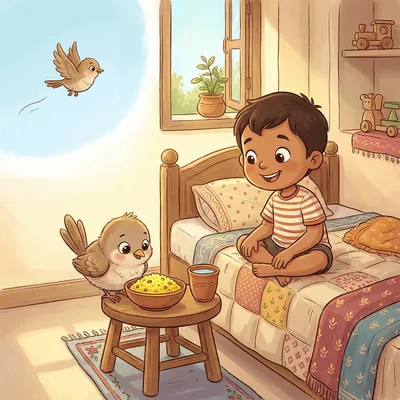
Bulbul ka baccha, bulbul ka bacchaKhaata tha khichdi, peeta tha paaniBulbul ka baccha
Gaata tha gaane, mere sirhaaneBulbul ka baccha, bulbul ka baccha
Ek din akela baitha hua thaMaine udaaya, waapis na aayaBulbul ka baccha, bulbul ka baccha
English Translation
The nightingale's child, the nightingale's childUsed to eat khichdi, used to drink waterThe nightingale's child
Used to sing songs, by my bedsideThe nightingale's child, the nightingale's child
One day it was sitting aloneI made it fly, it never came backThe nightingale's child, the nightingale's child
Translation Notes
Vocabulary
bulbul (بلبل) - nightingale, songbird baccha (بچہ) - child, baby khichdi (کھچڑی) - rice and lentil dish paani (پانی) - water sirhane (سرہانے) - bedside akeela (اکیلا) - alone udaaya (اڑایا) - flew, made fly
Grammar Notes
Past habitual tense: phrases like khaata tha (used to eat), peeta tha (used to drink), and gaata tha (used to sing) describe a repeated action in the past. They join a verb form ending in -ta with tha ("was"), the standard way to say "used to do" in Urdu and Hindi.
The "ne" construction: in maine udaaya (I made it fly), the main (I) becomes maine. With completed past actions of certain verbs, the doer takes the marker ne. This ergative pattern is one of the trickiest features for learners and appears constantly in storytelling.
The possessive "ka": bulbul ka baccha means "the nightingale's child." The little word ka links owner to thing owned, much like the English apostrophe-s. It changes to ki or ke depending on what is owned, but here the masculine baccha keeps it as ka.
History and Meaning
Bulbul Ka Baccha (The Nightingale's Child) is a short Urdu and Hindi rhyme with a quiet sting in its tail. A child keeps a baby bulbul as a pet, feeds it khichdi, listens to it sing by the bed, and then one day lets it go, and it never comes back. It is one of the first poems many South Asian children learn, and one of the first to teach them that some things you love are not yours to keep.
The rhyme is widely sung in homes and schools throughout Pakistan and India. It serves as one of the first poems taught to young children learning the Urdu and Hindi languages.
Origins
The song has its origins in the oral folklore of South Asia. There is no recorded poet or publication year associated with the rhyme, as it has been passed down through generations by word of mouth.
The bulbul (often translated as nightingale, though they are distinct families of birds) is a traditional symbol of song and beauty in classical Persian and Urdu poetry. This rhyme serves as a child-friendly introduction to this rich literary tradition.
Meaning & Interpretation
The poem explores the concepts of friendship, growth, and letting go. In the story, the narrator cares for the young bird, feeding it khichdi (a traditional South Asian rice and lentil dish) and giving it water. In return, the bird sits near the narrator's bedside and sings sweet songs.
The final stanza describes the child making the bird fly away, only for it to never return. This ending introduces children to the transient nature of childhood pets and the concept of wild creatures belonging in nature. Rather than being a tragic story, it is interpreted as a lesson in letting go and respecting a creature's freedom.
What is the moral of the poem Bulbul Ka Baccha?
The poem teaches children about the importance of freedom and letting go. Although the child cares for the baby bird, the rhyme concludes with the bird flying away to live in its natural environment, showing that wild creatures should not be kept captive.
What does bulbul mean in South Asian poetry?
The bulbul is a songbird that is historically celebrated in Persian, Urdu, and Hindi literature. It represents beauty, musical expression, and a deep love for nature.
Lyrics from nurseryrhymes.info