

What Shall We Do With the Drunken Sailor?
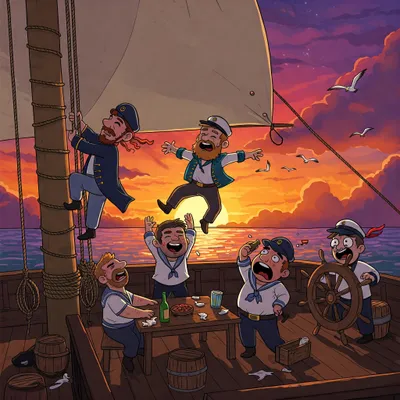

Lyrics
What shall we do with the drunken sailor,What shall we do with the drunken sailor,What shall we do with the drunken sailor,Earlye in the morning?
Chorus:Hooray an' up she rises,Hooray an' up she rises,Hooray an' up she rises,Earlye in the morning.
Put him in the longboat till he’s sober,Put him in the longboat till he’s sober,Put him in the longboat till he’s sober,Earlye in the morning.
Chorus
Keep him there and make him bale her,Keep him there and make him bale her,Keep him there and make him bale her,Earlye in the morning.
Chorus
Trice him up in a runnin’ bowline,Trice him up in a runnin’ bowline,Trice him up in a runnin’ bowline,Earlye in the morning.
Chorus
Tie him to the taffrail when he’s under,Tie him to the taffrail when he’s under,Tie him to the taffrail when he’s under,Earlye in the morning.
Chorus
Put him in the scuppers with a hosepipe on him,Put him in the scuppers with a hosepipe on him,Put him in the scuppers with a hosepipe on him,Earlye in the morning.
Chorus
Take him an’ shake him an’ try to wake him,Take him an’ shake him an’ try to wake him,Take him an’ shake him an’ try to wake him, Earlye in the morning.
Chorus
Shave his belly with a rusty razor,Shave his belly with a rusty razor,Shave his belly with a rusty razor,Earlye in the morning.
Chorus
That’s what we’ll do with the drunken sailor,That’s what we’ll do with the drunken sailor,That’s what we’ll do with the drunken sailor,Earlye in the morning.
Chorus
History and Meaning
"What Shall We Do with the Drunken Sailor?" is a work song disguised as a list of comic punishments: shave his belly, drop him in the longboat, hose him down in the scuppers. The real job was rhythm, sailors hauled ropes and walked the capstan in time to it. The tune is an old Irish march.
When was the Drunken Sailor shanty first published?
While the tune is much older, the earliest printed record of the melody appeared in 1824 in a Baltimore publication. The first written description of the shanty itself dates back to an 1839 whaling voyage out of New London, Connecticut, and was later published in 1841. Because it was passed down through oral tradition among merchant crews, it existed in various forms long before these early transcriptions.
What does "shave his belly with a rusty razor" mean?
The lyrics suggest several humorous and uncomfortable treatments for a crewmate who has drunk too much, such as putting him in the longboat until he is sober or putting him in the scuppers with a hosepipe. The famous line "shave his belly with a rusty razor" is a lighthearted, traditional punishment that mockingly threatens the offender. Many of these lines reference parts of the ship, including the longboat (a large utility boat towed behind or carried on the ship), the scuppers (drains on the edge of the deck), and the taffrail (the rail around the ship's stern).
What was the purpose of the Drunken Sailor shanty?
As a capstan or "stamp-and-go" shanty, the song was designed to keep the crew working in perfect synchronization. When sailors needed to haul a heavy rope or walk around the capstan to weigh the anchor, the rhythmic beat of the song kept everyone pulling at the exact same moment. The brisk tempo and repetitive chorus made it one of the most popular and energetic songs on merchant vessels.
Melodic Origins and Cultural Legacy
The shanty's melody is derived from the traditional Irish folk tune "Óró sé do bheatha 'bhaile" (meaning "Oh-ro, the welcome home"), an ancient clan march that acquired new lyrics during the Jacobite rising. In the 20th century, the song experienced a major revival, being adopted for glee singing at Eton College and becoming a regular at London's Savage Club, with the first audio recording made by composer Percy Grainger in 1906. It even gained renewed viral popularity on TikTok during the COVID-19 pandemic.
Music Video
If the player is unavailable, watch this video on YouTube.
Lyrics from nurseryrhymes.info