
When Good King Arthur Ruled This Land

Lyrics
When good King Arthur ruled this land,He was a goodly king;He stole three pecks of barley-mealTo make a bag-pudding.
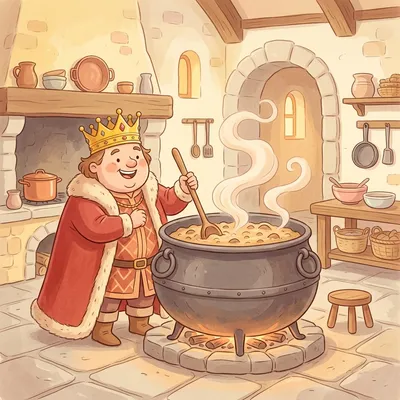
A bag-pudding the king did make,And stuffed it well with plums;And in it put great lumps of fat,As big as my two thumbs.
The king and queen did eat thereof,And noblemen beside;And what they could not eat that night,The queen next morning fried.
History and Meaning
The rhyme opens like a chronicle and ends like a kitchen. "When good King Arthur ruled this land" is the voice of romance and legend, the sort of line that should be followed by dragons, quests or the sword in the stone. What follows instead is a king shoplifting barley-meal, a boiled pudding full of fat and raisins, and a queen frying up the leftovers the next morning.
That gap is the joke. The rhyme is mock-heroic: it borrows the grandest name in British legend and then refuses to do anything grand with it. Arthur is called "a goodly king" in one line and shown stealing in the very next, which is a small piece of deadpan that children usually catch before adults do.
Origins
"When Good King Arthur Ruled This Land" belongs to the traditional English nursery repertoire, but no firm first printing has been established, and no reliable date can be attached to it. It is often repeated as an eighteenth century piece; that claim has not been substantiated here, so it is better to say simply that the verse comes down through English oral tradition and turns up in nursery collections without a settled origin.
What can be said is that the rhyme's furniture is old. Barley-meal, bag-puddings and dry measures like the peck were ordinary household matters in England for centuries before anyone thought to write children's verse down. The rhyme assumes its listeners know what a peck is and what a pudding boiled in a bag looks like, which is a good sign that it was current while those things were still everyday.
The rhyme has nothing to do with the historical or legendary Arthur beyond taking his name. There is no episode like this in Malory, in Geoffrey of Monmouth, or in any of the Arthurian romances. It is not a garbled memory of a real story about Arthur, and it should not be read as Arthurian source material. The name is there because it is the most famous king a child could be handed, which makes the fall from throne room to pudding basin as steep as possible.
Meaning & Interpretation
The whole verse works by deflation. Each stanza takes the story one step further from majesty. First the theft, which is petty rather than tyrannical: barley-meal, the cheap grain, not gold. Then the pudding itself, described with the precision of a recipe, with lumps of fat measured against a child's thumbs. Then the leftovers, which reduce royalty to the most ordinary domestic fact there is, the business of using up what was not finished.
The last line is the sharpest. A queen at a frying pan the morning after is about as far from courtly romance as the rhyme can travel. Nothing is punished, nobody learns anything, and the theft in the first stanza is never mentioned again. That refusal to moralise is part of why the rhyme has stayed funny.
For a child, the appeal is simpler: a king who steals, a pudding the size of a small feast, and fat in lumps as big as two thumbs. The measurement against thumbs invites the obvious gesture, and most people who learned this one learned it with their hands up.
What is bag pudding?
A bag-pudding was a pudding boiled in a cloth bag. The mixture, in this case barley-meal with dried fruit and suet or fat, was tied up in a floured cloth and lowered into a pot of boiling water, which cooked it into a solid round mass. It was an everyday English dish for centuries, well before pudding basins and ovens were common in ordinary kitchens, and the plum pudding served at Christmas is its best known descendant.
How much is a peck of barley-meal?
A peck is an old dry measure equal to two gallons, or a quarter of a bushel. Three pecks is therefore six gallons of meal, a serious quantity of flour rather than a handful, which is part of what makes the king's theft sound both criminal and slightly ridiculous.
Is this rhyme about the real King Arthur?
No. The rhyme borrows Arthur's name for comic effect and tells a story found nowhere in Arthurian legend or in any medieval account. Nothing in it reflects the tales of Camelot, the Round Table or the historical figure that legend may be built on. Arthur is used here purely as the grandest available king to place in a very small domestic scene.
What do the "plums" in the pudding mean?
In older English cookery "plums" usually meant dried fruit, especially raisins and currants, rather than fresh plums. The same usage survives in "plum pudding" and "plum cake", neither of which contains plums. So the king's pudding is a fruited one, stuffed with raisins and studded with fat.
Related Nursery Rhymes




Lyrics from nurseryrhymes.info