
Grandma's Spectacles

Lyrics
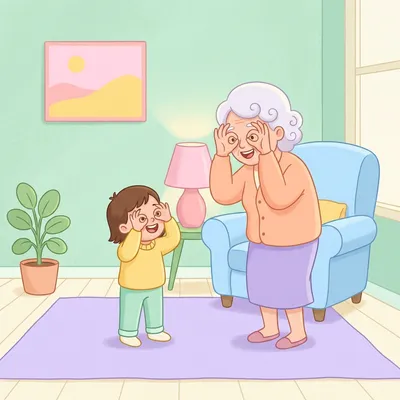
These are Grandma's spectacles,(make circles with thumbs and fingers, hold to eyes)And this is Grandma's hat;(make a peaked roof shape above your head)And this is the way she folds her hands,(fold hands slowly)And puts them in her lap.(rest folded hands in lap)
These are Grandpa's spectacles,(make larger circles, hold to eyes)And this is Grandpa's hat;(make a wider shape above your head)And this is the way he folds his arms,(fold arms across chest)And has a little nap.(close eyes, tilt head to one side)
History and Meaning
This one has a job to do. It is a settling rhyme, used by teachers and parents to bring a noisy group down to quiet, and the words are arranged so that the movements get smaller and slower as it goes. By the last line everybody's hands are in their laps, which is exactly where the adult wanted them.
Origins
The rhyme comes out of the American kindergarten movement of the late nineteenth and early twentieth centuries, when finger plays were being collected and printed in large numbers for classroom use. Emilie Poulsson's Finger Plays for Nursery and Kindergarten, published in 1893, was the best known of these collections and helped establish the form: a short verse where every line has a matching hand movement.
No author is recorded for Grandma's Spectacles. It circulated anonymously in kindergarten and Sunday-school collections in the early 1900s and spread by teachers copying it from each other, which is the usual route for this kind of material.
Meaning & Interpretation
The verse works by shape. Thumb and forefinger make a circle that reads instantly as a lens, and two hands held above the head make the peak of an old-fashioned bonnet or hat. Children do not need the words explained because the hands do the explaining.
The Grandpa verse is the payoff. It repeats the structure with bigger gestures and a different ending, so children who learned the first verse can predict the second and are rewarded for paying attention. Ending on a nap rather than folded hands lets the adult finish the rhyme with the whole group pretending to sleep.
What is a finger play?
A finger play is a short spoken rhyme with a hand or finger movement for each line. They were promoted heavily by the kindergarten movement from the 1880s onward because they hold a child's attention, build fine motor control, and can be led by one adult with no equipment at all.
What does "spectacles" mean?
Spectacles is the older word for eyeglasses, still common in British English. The rhyme keeps it because the longer word fits the rhythm of the line better than "glasses" does, and because it suits the old-fashioned picture of a grandparent the verse is drawing.
How do you use this rhyme to calm a group down?
Say it slowly and let each movement finish before starting the next line. The gestures shrink as the verse goes on, from wide shapes above the head to hands resting in the lap, so the rhyme naturally lowers the energy in the room. Repeating the Grandpa verse even more quietly usually finishes the job.
Related Nursery Rhymes
Lyrics from nurseryrhymes.info