
Humpty Dumpty
 1797
1797  England
 Lyrics
Humpty Dumpty had a great fall,
All the king’s horses and all the king’s men,
Couldn’t put Humpty together again.
History and Meaning
"Humpty Dumpty" is one of the most famous English nursery rhymes, with origins that have sparked numerous theories connecting it to English history, warfare, and wordplay.
The Siege of Colchester Theory
The most popular origin story connects Humpty Dumpty to the English Civil War, specifically the Siege of Colchester in 1648. According to this theory:
- "Humpty Dumpty" was the nickname for a large Royalist cannon
- The cannon was strategically placed on the wall of St. Mary's Church in Colchester
- Parliamentarian forces damaged the wall beneath the cannon with artillery fire
- The heavy cannon fell to the ground when the wall collapsed
- The Royalists ("all the King's men") were unable to remount the cannon
- This contributed to Colchester's fall after an eleven-week siege
While this is a well-known story, particularly promoted by the Colchester tourist board, historians note there is no conclusive evidence linking the rhyme to this specific event.
The King Richard III Theory
Another theory suggests Humpty Dumpty represents King Richard III, who was depicted as hunchbacked. According to this interpretation, Richard fell from his horse (nicknamed "Wall") during the Battle of Bosworth Field in 1485, and despite the efforts of his men, could not be saved.
Other Interpretations
- A Siege Engine: Professor David Daube suggested in 1956 that Humpty Dumpty was an armored siege engine (a "tortoise") used during the Siege of Gloucester in 1643
- An Alcoholic Drink: In the 17th century, "humpty dumpty" was a term for a drink made of brandy boiled with ale
- A Clumsy Person: The phrase described someone overweight, clumsy, or "short and dumpy" in 17th and 18th century slang
Originally a Riddle
The earliest recorded versions of the rhyme date from the late 18th century. Importantly, these versions never explicitly state that Humpty Dumpty was an egg. Scholars believe the rhyme was originally a riddle, with "an egg" being the answer.
Lewis Carroll's Influence
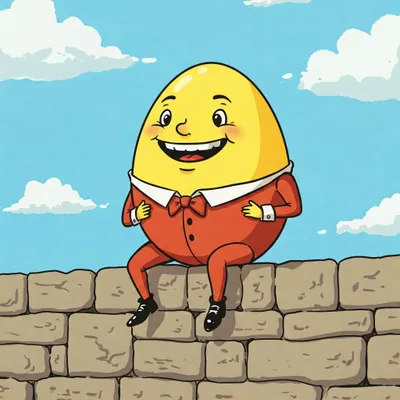
The iconic image of Humpty Dumpty as an anthropomorphic egg largely comes from Lewis Carroll's 1871 book "Through the Looking-Glass," where Humpty appears as a philosophical egg who speaks with Alice. Sir John Tenniel's illustrations for this book cemented the egg imagery in popular culture.
Cultural Legacy
Humpty Dumpty has become one of the most recognizable characters in English-language children's literature, referenced in countless books, films, and other media. The phrase "all the king's horses and all the king's men couldn't put Humpty together again" has entered common usage to describe situations that are irreparably broken.