
Hush Little Baby

Lyrics
You can either sing as 'Papa' / 'Mama' / 'Daddy' / 'Mummy'
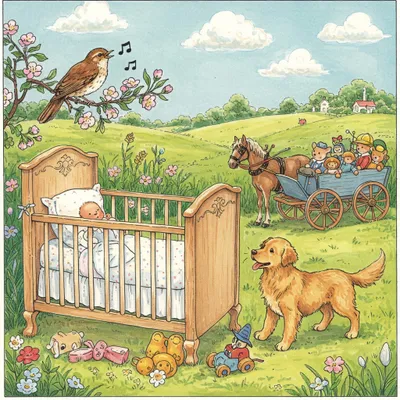
Hush little baby, don't say a word,Daddy's gonna buy you a mockingbird.
And if that mockingbird won't sing,Daddy's gonna buy you a diamond ring.
And if that diamond ring turns to brass,Daddy's gonna buy you a looking glass.
And if that looking glass gets broke,Daddy's gonna buy you a billy goat.
And if that billy goat won't pull,Daddy's gonna buy you a cart and bull.
And if that cart and bull turn over,Daddy's gonna buy you a dog named Rover.
And if that dog named Rover won't bark,Daddy's gonna buy you a horse and cart.
And if that horse and cart fall down,You'll still be the sweetest little baby in town!
So hush little baby, don't you cry.Mummy loves you and so do I.
History and Meaning
"Hush, Little Baby" is a lullaby that bribes a child quiet: a mockingbird, then a diamond ring, a looking glass, a billy goat, each gift promised in case the last one fails. Nobody knows who wrote it or exactly when. It is traditional, thought to come from the Southern United States, and catalogued in the Roud Folk Song Index as number 470, the reference number folklorists use to track variants of a song across collections.
When was Hush Little Baby first documented?
The earliest written record comes from the English folklorist Cecil Sharp, who spent the 1910s travelling through Appalachia noting down songs that mountain families still sang from memory. In 1918 he collected a version at Endicott, in Franklin County, Virginia, and a second from a singer named Julie Boone of Micaville, North Carolina, whose set of lyrics was complete. Sharp was hunting for English ballads that had survived transplantation to America, and the melodies he wrote down for this song are unmistakably European rather than anything newly invented in the mountains. That does not prove the words are old too; tunes and lyrics travel separately, and a family could easily set new words to an inherited melody. Alan Lomax later recorded further traditional performances across the American South during his song-collecting trips of the 1930s and 1940s, by which point the lullaby was clearly well established rather than a recent composition.
Who was Jean Ritchie, and why does her version matter?
Jean Ritchie grew up in a singing family in the Cumberland Mountains of Kentucky and became one of the most important carriers of Appalachian folk song into the twentieth-century mainstream. She performed her family's version of "Hush, Little Baby" in 1949 and put it on record in 1952, on an Elektra album of traditional songs she had learned at home. It is her family's arrangement, more than Sharp's field transcriptions, that most listeners today would recognize: the sequence of gifts and the wording in most modern recordings trace back to the Ritchie family tradition rather than to any single printed source.
Why does the song promise a mockingbird first?
This is the detail that gets flattened in most retellings, and it is worth restoring. Northern mockingbirds were, through the 1800s, one of the most sought-after caged songbirds in America, prized above other birds specifically for the range and mimicry of their singing. A good, older mockingbird singer could sell for as much as $50 in 1828, a sum equivalent to well over a thousand dollars today. John James Audubon described the mansions of Philadelphia gentlemen with cages hung from the windows, sometimes a dozen to a house. Thomas Jefferson owned several mockingbirds; his favorite, a bird he called Dick, is said to have perched on his shoulder, taken food from his lips, and sung while Jefferson played the violin, an account that comes from his friend Margaret Bayard Smith rather than from Jefferson himself. Demand was intense enough that trappers and nest-robbers stripped mockingbirds from large stretches of the East Coast, taking adults and nestlings alike to sell in Philadelphia, St Louis, and New York; legal protection for the species did not arrive until the early twentieth century. Set against that background, "Papa's gonna buy you a mockingbird" is not a whimsical opening image. To a nineteenth-century audience it named one of the most expensive, most aspirational pets a family could own, which is exactly why the song puts it first.
Is the 1960s pop song "Mockingbird" the same song?
No, and the two get mixed up constantly. The pop song "Mockingbird", built around the "Mock (yeah) / Ing (yeah) / Bird (yeah)" hook, has its own melody and its own lyrics; it is a separate composition, not an adaptation of this lullaby, and there is no established line of descent between them. The genuine source of confusion is different: a great many recordings simply titled "Mockingbird" are straightforward covers of "Hush, Little Baby" itself, since the lullaby's opening line gives it an obvious alternate title. When someone says they know a song called "Mockingbird", it is worth asking which one they mean.
Why does the lullaby list things breaking instead of things working?
Read the verses in order and the pattern is stranger than it first appears. The mockingbird will not sing. The diamond ring turns out to be brass. The looking glass gets broken. The billy goat will not pull. The cart and bull turn over, and by most tellings a dog named Rover and a horse and cart follow the same path before the song lets the child off the hook. Almost every gift in the chain fails or is revealed as fake before the next one is offered. A lullaby that on the surface sounds like an escalating shower of presents is, structurally, a list of disappointments. That matters for how the reassurance at the end lands: the very last line, "Mummy loves you and so do I," is the only promise in the whole song that is not tied to an object and cannot turn to brass or fall down. Everything material fails; only that does not. The brass line in particular carried a sharper edge for older listeners than it does now, since a ring "turning to brass" describes a real and mundane fear of the period, that a piece of jewelry sold as gold would turn out to be cheap plated metal, a familiar way to be cheated rather than a fairy-tale transformation. Cumulative songs that pile up a chain of objects, each one replacing the last, are common in Anglo-American folk tradition; what sets this one apart is that the chain is a chain of failures rather than successes, and the song never actually needs the list to resolve.
Why can the song be sung almost indefinitely?
Because the pattern is so simple to extend, a tired parent can keep inventing new links in the chain long after the traditional verses run out, swapping in whatever object comes to mind and pairing it with some way it might fail. That flexibility is not a flaw in the song; it is close to the point of it. A lullaby's job is to outlast a fussing child, and a form that can generate new verses on demand is far more useful at two in the morning than one with a fixed, finite ending.
Why do some versions say "Papa" and others say "Mama"?
The lyrics here are marked as singable with either "Papa" or "Mama", "Daddy" or "Mummy", and that is not a modern edit for inclusivity; it reflects how the song actually moved through families. As an orally transmitted lullaby, "Hush, Little Baby" was never fixed by a published score that everyone deferred to. Whoever was singing it swapped in their own name for themselves, and the specific gifts promised shifted from household to household and region to region in the same way. That kind of variation is the ordinary condition of a folk song passed down by ear rather than a sign that anyone tampered with an "original" text, since no single original text ever existed to tamper with.
Music Video
If the player is unavailable, watch this video on YouTube.
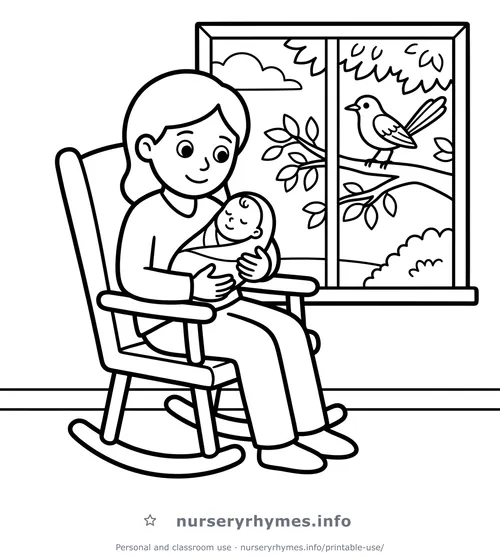
Free Printable Coloring Page
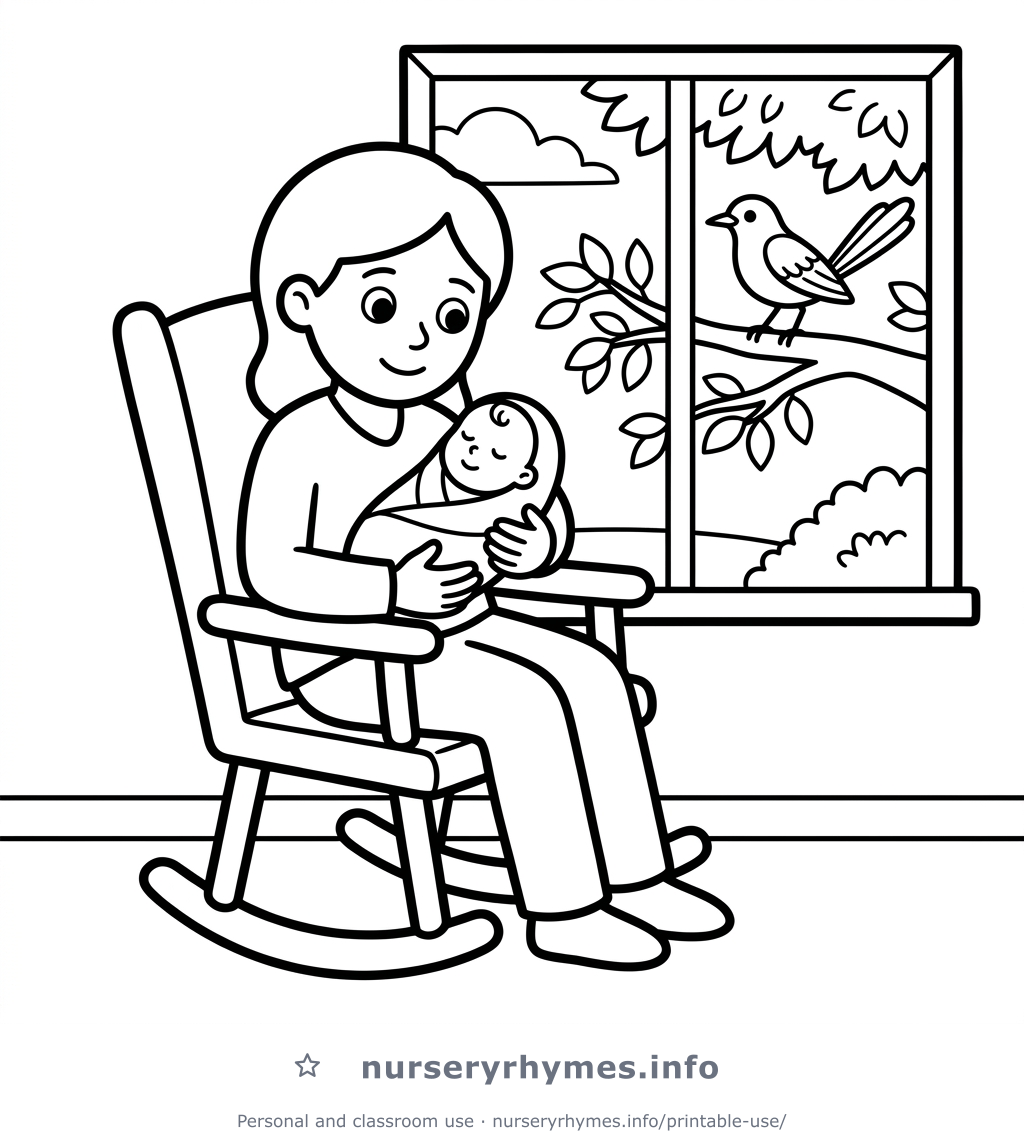
Print this Hush Little Baby coloring sheet for free and let little ones bring it to life with crayons or pencils.
Full-resolution PNG · Fits the paper size selected in your print dialog · Personal and classroom use
Related Nursery Rhymes
Lyrics from nurseryrhymes.info