
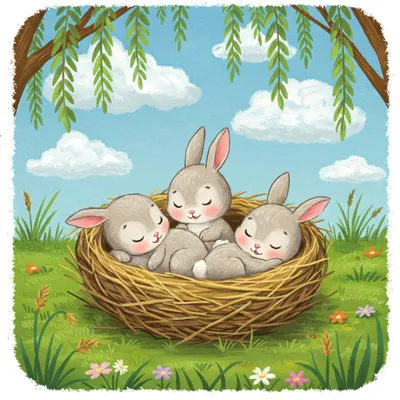
Sleeping Bunnies

Lyrics
See the little bunnies sleeping 'til it's nearly noonShall we wake them with a merry tune?They're so still, are they ill?No! Wake up, bunnies!
Hop little bunnies, hop, hop, hopHop little bunnies, hop, hop, hopHop little bunnies, hop, hop, hopHop little bunnies, hop and STOP!
See the little bunnies sleeping 'til it's nearly noonShall we wake them with a merry tune?They're so still, are they ill?No! Wake up, bunnies!
Hop little bunnies, hop, hop, hopHop little bunnies, hop, hop, hopHop little bunnies, hop, hop, hopHop little bunnies, hop and STOP!
See the little bunnies sleeping 'til it's nearly noonShall we wake them with a merry tune?They're so still, are they ill?No! Wake up, bunnies!
Hop little bunnies, hop, hop, hopHop little bunnies, hop, hop, hopHop little bunnies, hop, hop, hopHop little bunnies, hop and STOP!
Actions for kids to go with the rhyme:1. Lie down and pretend to sleep, as the bunnies do.2. 'Wake up bunnies' -> Jump up from the floor.3. 'Hop little bunnies' -> Children hop around the floor, until you say 'STOP'.
History and Meaning
"Sleeping Bunnies" trades on one delicious moment: a roomful of toddlers lying perfectly still, pretending to sleep, waiting for the "Wake up, bunnies!" that sends them all hopping. The jump from frozen stillness to a burst of movement is the whole appeal.
Where did Sleeping Bunnies come from?
The exact origins of "Sleeping Bunnies" are unknown. The song is believed to date back to at least the 1950s, though no specific composer has been identified. It likely emerged from the tradition of action songs and circle-time games used in British and American nurseries, where teachers needed simple songs that could engage a whole group of toddlers at once.
The song follows a classic call-and-response pattern found in many children's games: a quiet build-up followed by an exciting burst of activity. This structure appears in similar songs like "Sleeping Lions" and "What's the Time, Mr Wolf?" and taps into children's natural love of surprise and anticipation.
Why is it so popular with toddlers?
"Sleeping Bunnies" works brilliantly because it combines several elements that young children respond to:
- Anticipation and surprise: Children know the "Wake up, bunnies!" moment is coming, and the excitement builds each verse
- Whole-body movement: The hopping section lets children burn energy and practise gross motor skills like jumping and balancing
- Contrast: Moving between lying still and hopping energetically teaches body control and the concept of opposites (still vs. moving, quiet vs. loud)
- Repetition: The repeated verses give children confidence, since they know what comes next, which is deeply satisfying at this age
How is it used in early years education?
Early years practitioners use "Sleeping Bunnies" as more than just a fun song. It serves several developmental purposes:
- Listening skills: Children must listen for the cue to wake up and hop
- Following instructions: The song requires children to perform specific actions at specific times
- Social skills: When played in a group, children learn to take turns and share space
- Physical development: Hopping builds leg strength, balance, and coordination
- Time concepts: References to sleeping "til it's nearly noon" introduce basic ideas about time of day
The song is often adapted with different animals (sleeping kittens, sleeping puppies) or different actions (jump, skip, tiptoe) to keep it fresh and extend the learning opportunities.
Variations and adaptations
Many nurseries add extra verses with different times of day or different animal movements. Popular variations include having the bunnies "skip," "crawl," or "tiptoe" instead of hopping, which helps develop different motor skills. Some versions add a counting element, starting with "one little bunny" and adding more each verse, combining the action element with early numeracy.
Music Video
If the player is unavailable, watch this video on YouTube.
Free Printable Coloring Page
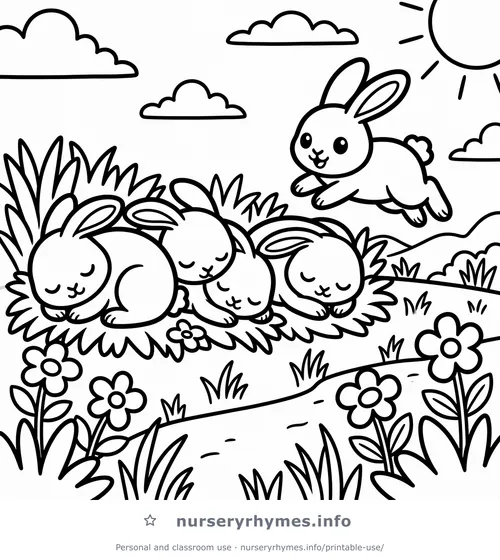
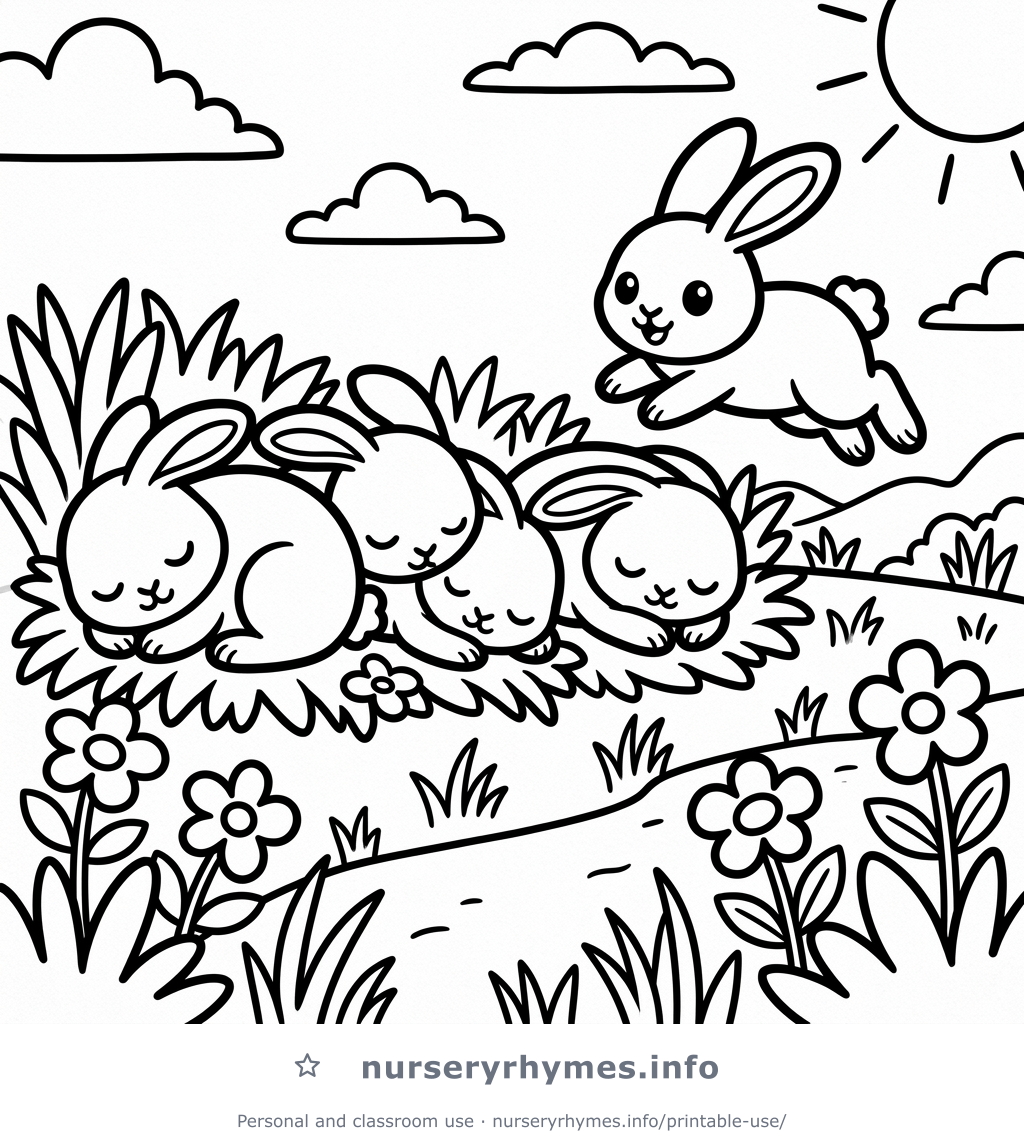
Print this Sleeping Bunnies coloring sheet for free and let little ones bring it to life with crayons or pencils.
Full-resolution PNG · Fits the paper size selected in your print dialog · Personal and classroom use
Related Nursery Rhymes
Lyrics from nurseryrhymes.info