
Snail, Snail, Put Out Your Horns

Lyrics
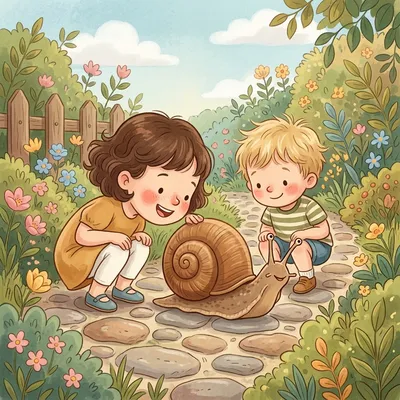
Snail, snail, put out your horns,I'll give you bread and barleycorns.
History and Meaning
A snail's horns are not horns. They are soft, boneless tentacles, and the long upper pair carries the eyes at the tips. That is the whole reason this rhyme exists. Crouch beside a garden snail with a shell pulled tight and nothing happens. Stay still, stay quiet, and after a minute or so the tentacles slide out again and swivel around. To a child that looks exactly like the snail obeying orders, and children have been giving those orders for a very long time.
The rhyme is short enough that most children learn it in one go. It is also one of the few nursery rhymes with a job to do: it is a charm, a set of words you say to make something happen, and the payment offered is bread and barleycorns.
Origins
The earliest known printing of a snail-calling rhyme in English is in Tommy Thumb's Pretty Song Book, published in London by Mary Cooper in 1744. That book is the oldest surviving collection of English nursery rhymes and it barely survives at all: no copy of the first volume is known, and only two of the second have turned up, one at the British Library and one at the Cotsen Children's Library at Princeton.
In the 1840s the antiquarian James Orchard Halliwell gathered several versions from around England. His collections print the gentle one, "Snail, snail, put out your horns, I'll give you bread and barleycorns", alongside rougher relatives such as "Snail, snail, come out of your hole, or else I will beat you as black as a coal" and an East Anglian version warning that robbers are coming to steal the snail's corn.
Iona and Peter Opie, whose Oxford Dictionary of Nursery Rhymes appeared in 1951, showed how far the habit spreads. Versions of children chanting at snails have been recorded from Denmark and Germany down through France, Spain and Italy, east into Romania and Russia, and beyond Europe entirely. Nobody can date the practice, but it is plainly much older than any book that prints it. Folklorists have pointed to a line in Shakespeare's The Merry Wives of Windsor, where a character searching a house calls "peer out, peer out", as an echo of the same formula.
Meaning & Interpretation
There is no story here and no moral. The rhyme is a bargain: come out, and you get fed. Barleycorns are single grains of barley, which makes the offer a joke as much as a bribe, since a snail wants leaves rather than grain.
Different places gave the charm different work. In parts of Scotland children asked the snail to forecast the next day's weather, on the understanding that a snail that puts out its horns is promising a fine morning. A Somerset version runs the other way and asks for rain to grow the corn. Local names for the animal turn up in local versions, including hodmandod and dodman in East Anglia and bulorn in Cornwall.
Harsher variants do exist, including ones that threaten to beat the snail or to burn it, and older printed collections record them without comment. The bread and barleycorns wording is the kinder one and the one usually given to children now.
Do snails really have horns?
No, though what they have is close enough to explain the name. A land snail has two pairs of tentacles on its head. The longer upper pair are eyestalks, each ending in a simple eye that senses light and shadow rather than detail. The shorter lower pair sweep the ground and handle smell and touch. All four are soft and muscular, with no bone or shell in them.
Why do snails pull their horns in?
A snail retracts a tentacle by turning it inside out and hauling it into the head with a retractor muscle, rather like pulling in the finger of a glove. It pushes the tentacle back out using fluid pressure from inside its body. Snails do this when startled, touched, or dried out by sun or wind, which is why a snail that has just been picked up looks blank and featureless.
How old is Snail, Snail, Put Out Your Horns?
The English text goes back at least to 1744 in print, and the wording was clearly in circulation well before that. The wider custom of chanting at snails is far older still and cannot be dated from the evidence that survives, but the Opies traced parallel versions across most of Europe and further east, which is the usual sign of a very old piece of children's lore rather than an invented verse.
Why does the rhyme offer bread and barleycorns?
Bread and barleycorns are the small, everyday food a child would have had to hand or could imagine having. A barleycorn is one grain of barley. The pattern of offering payment to an animal or a natural thing in exchange for doing something runs through a lot of children's charms, including rhymes addressed to ladybirds and to rain.
Related Nursery Rhymes

Lyrics from nurseryrhymes.info