
Giro Girotondo
 Italy
Italy Italian Nursery Rhyme
Original Lyrics
Casca il mondo,
Casca la terra,
Tutti giù per terra!
English Translation
The world falls down,
The earth falls down,
Everyone down to the ground!
Translation Notes
Vocabulary
Giro girotondo = Round and round (from "girare" meaning to turn or spin; "tondo" meaning round) Casca = Falls (from the verb "cascare," a colloquial form of "cadere") Il mondo = The world La terra = The earth, the ground Tutti = Everyone, all Giù per terra = Down to the ground (literally "down for/to the ground")
History and Meaning
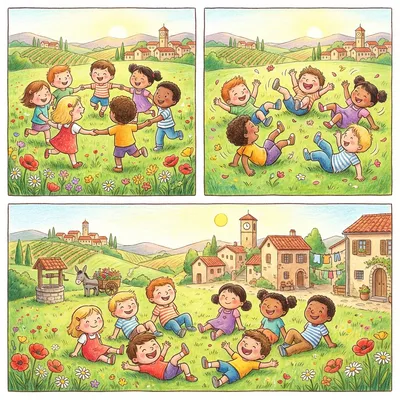
"Giro girotondo" is one of Italy's most beloved children's circle games and songs, equivalent to the English "Ring Around the Rosie." For centuries, Italian children have held hands and walked in circles while singing this cheerful rhyme, before gleefully falling to the ground on the final line. It remains one of the most popular playground games in Italy, played in schools, parks, and piazzas across the country.
Origins
The exact origins of "Giro girotondo" are lost to history, though the rhyme likely emerged sometime between the 15th and 17th centuries. The English version "Ring a Ring o' Roses" is believed to have originated around 1600, with its first printed appearance in 1881, though earlier oral versions were in circulation by the late 18th century. The Italian version likely followed a similar trajectory, passed down through generations via oral tradition long before being written down.
Circle games involving children holding hands and falling down appear to be ancient, possibly extending back to pre-Christian pagan rituals celebrating the cycles of nature, life, and renewal. The circular movement itself represents continuity and community, while the falling action symbolizes a return to the earth—themes that resonate across many cultures and time periods.
Meaning & Interpretation
The standard Italian lyrics—"Giro girotondo, casca il mondo, casca la terra, tutti giù per terra!"—translate literally to "Round and round, the world falls, the earth falls, everyone down to the ground!" At its surface level, the rhyme is simply a playful game about spinning in circles until dizziness makes you fall down.
However, like its English counterpart, "Giro girotondo" has been the subject of considerable folkloric interpretation. Many theories link the English "Ring Around the Rosie" to the Great Plague that swept through England between 1665 and 1666, with various lines supposedly symbolizing symptoms of bubonic plague: the "ring of roses" representing the rose-colored rash, "pocket full of posies" referring to herbs carried to ward off disease, sneezing sounds representing symptoms, and "all fall down" symbolizing death.
While the Italian version has also been associated with the Black Death that devastated Europe in the 14th century, its lyrics are less explicitly suggestive of plague symptoms compared to English versions. Some researchers suggest that adults may have used such rhymes to introduce children to serious themes like illness and death in a gentle, playful manner. However, modern folklorists caution against over-interpreting these rhymes, noting that simpler explanations—such as "ring-a-ring" describing circular dance and "fall down" representing a bow or curtsy—are often more historically accurate.
The phrase "casca il mondo, casca la terra" (the world falls, the earth falls) could represent childlike wonder at physical sensations—the dizzying feeling that the world itself is tumbling when you spin in circles. This interpretation emphasizes the rhyme's roots in pure play rather than darker historical events.
Cultural Significance
"Giro girotondo" has been a cornerstone of Italian childhood for generations and continues to be one of the first social games Italian children learn. The game teaches valuable social skills: cooperation (holding hands together), coordination (moving in unison), rhythm (timing the song with movement), and the simple joy of synchronized group play.
The rhyme exists in numerous regional variations throughout Italy. Some versions include different verses or substituted words, reflecting local dialects and traditions. This regional diversity demonstrates how oral traditions adapt and change as they pass through different communities, with each area adding its own flavor while maintaining the core structure of the game.
In Italian schools and kindergartens, "Giro girotondo" is often among the first group activities taught to young children, helping them develop social bonds with their classmates and experience the pleasure of communal singing and movement. The game requires no equipment, needs no preparation, and can be played anywhere—making it perfectly suited to spontaneous playground fun or organized classroom activities.
Educational Value
Beyond pure entertainment, "Giro girotondo" offers multiple educational benefits. The rhyme helps children develop:
- Motor coordination through synchronized circular movement
- Rhythmic awareness by matching movement to song
- Social skills through cooperative play requiring holding hands and moving together
- Language development through repetitive, memorable lyrics
- Cultural connection to Italian traditions and community
The act of falling down together at the end creates a moment of shared laughter and release, reinforcing social bonds and teaching children that organized chaos can be fun and safe.