
Mary Had a Little Lamb
 1830
1830  USA
USA Lyrics
little lamb, little lamb.
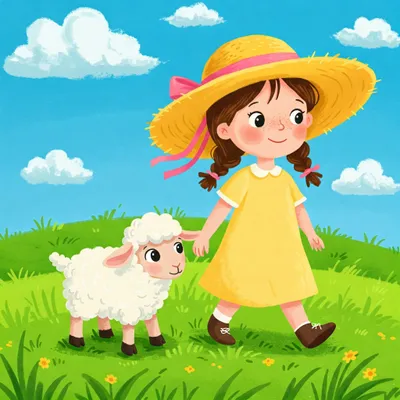
Mary had a little lamb, its fleece was white as snow.
And everywhere that Mary went,
Mary went, Mary went,
and everywhere that Mary went, the lamb was sure to go.
It followed her to school one day
school one day, school one day,
It followed her to school one day, which was against the rules.
It made the children laugh and play,
laugh and play, laugh and play,
it made the children laugh and play to see a lamb at school.
And so the teacher turned it out,
turned it out, turned it out,
And so the teacher turned it out, but still it lingered near,
And waited patiently about,
patiently about, patiently about,
And waited patiently about till Mary did appear.
"Why does the lamb love Mary so?"
Love Mary so? Love Mary so?
"Why does the lamb love Mary so," the eager children cry.
"Why, Mary loves the lamb you know."
The lamb, you know, the lamb, you know,
"Why, Mary loves the lamb you know," the teacher did reply.
History and Meaning
"Mary Had a Little Lamb" is one of the most famous nursery rhymes in the English language, first published in Boston in 1830 by Sarah Josepha Hale in her collection "Poems for Our Children."
Based on a True Story
The rhyme is widely believed to be based on a real incident involving Mary Elizabeth Sawyer (born 1806) of Sterling, Massachusetts. The story goes:
When Mary was nine years old, she rescued a sickly, abandoned lamb and nursed it back to health. The lamb became deeply attached to Mary, following her everywhere. One day, at her brother's suggestion, the lamb followed Mary to the Redstone School in Sterling.
The lamb's presence caused a commotion in the classroom. The teacher put it outside, but the faithful lamb waited patiently until Mary was dismissed.
Authorship Debate
There is some debate about who wrote the original verses:
- John Roulstone: Some accounts claim a young man named John Roulstone, who was visiting the school that day, was inspired by the incident and wrote the first three stanzas for Mary
- Sarah Josepha Hale: The prominent writer and editor published her version (possibly with additional moral verses) in 1830
Mary Sawyer herself later claimed that Roulstone's original poem consisted of only three stanzas, while Hale added additional verses with a moral lesson. Regardless, Hale is widely recognized as the author who brought the rhyme to public attention.
First Words Ever Recorded
In 1877, Thomas Edison chose the opening lines of "Mary Had a Little Lamb" as the first words ever recorded on his newly invented phonograph. This historical moment forever linked the nursery rhyme to the dawn of recorded sound technology.
The Redstone School
The one-room schoolhouse where the incident allegedly occurred was built in 1798. It was later moved to Sudbury, Massachusetts, where it can still be visited today.
Mary Sawyer's Later Life
Mary Sawyer (later Mary Tyler) kept the memory of her lamb alive throughout her life. She even donated wool from her lamb's fleece to help raise money for the preservation of the Old South Meeting House in Boston, unraveling her old lamb wool stockings to provide authentic pieces of history.
Enduring Legacy
"Mary Had a Little Lamb" has become one of the most recognized rhymes worldwide, translated into many languages and sung by generations of children. Its simple story of a child's love for a pet continues to resonate nearly two centuries after its first publication.