

Mary, Mary, Quite Contrary


Lyrics
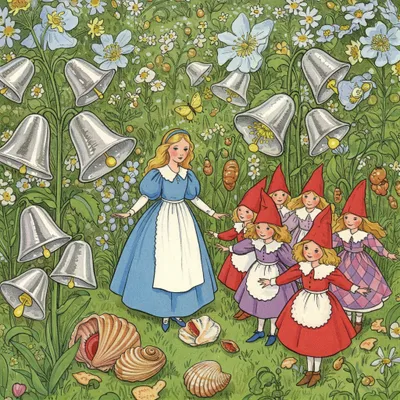
Mary, Mary, quite contrary,How does your garden grow?
With silver bells, and cockle shells,And pretty maids all in a row.
History and Meaning
A pretty rhyme about a garden of silver bells and cockle shells, "Mary, Mary, Quite Contrary" has attracted some unusually grim readings, from the persecutions of "Bloody Mary" to the court of Mary, Queen of Scots. None is proven, but the garden imagery keeps inviting the guesswork.
Origins
The song is cataloged under number 19626 in the Roud Folk Song Index. It first appeared in print in London around 1744, published in the early compilation Tommy Thumb's Pretty Song Book.
Historians have suggested several theories connecting the rhyme to royal figures. The most common theory links the song to Queen Mary I of England, who ruled from 1553 to 1558. Known as "Bloody Mary" for her persecution of Protestants, she was described as "contrary" because of her efforts to restore Catholicism in England. Another theory suggests the rhyme refers to Mary, Queen of Scots, with the "silver bells" representing Catholic cathedral bells and the "pretty maids" referring to her famous ladies-in-waiting (Mary Beaton, Mary Seton, Mary Fleming, and Mary Livingston).
Meaning & Interpretation
The lyrics are structured as a riddle asking Mary how her garden grows. The "silver bells" and "cockle shells" mentioned in the lyrics are often interpreted as symbols rather than actual garden objects. In the Queen Mary I theory, "how does your garden grow" represents her inability to produce a Catholic heir, while the "silver bells" and "cockle shells" represent instruments of torture.
A separate religious theory suggests the garden refers to the Virgin Mary, where the "cockle shells" symbolize the badges worn by pilgrims traveling to the shrine of Santiago de Compostela in Spain, and the "pretty maids" represent nuns. Since these interpretations were proposed centuries after the rhyme was first recorded, they remain speculative.
Who was the real Mary in Mary Mary Quite Contrary?
The rhyme is often linked to Queen Mary I of England or Mary, Queen of Scots. However, these connections are unproven, and the song may have simply originated as a traditional children's riddle.
What do the silver bells and cockle shells represent?
In political interpretations, they are viewed as Catholic symbols or instruments of torture from the reign of Queen Mary I. In religious folklore, cockle shells represent badges worn by pilgrims traveling to the shrine of St. James in Spain.
Music Video
If the player is unavailable, watch this video on YouTube.
Related Nursery Rhymes





Lyrics from nurseryrhymes.info