

Old Mother Goose
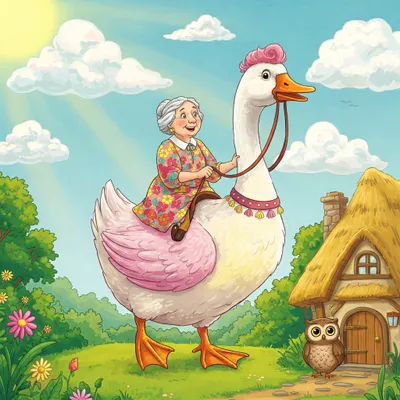
 1780
1780  England
 Lyrics
she wanted to wander,
Would ride through the air
On a very fine gander.
Mother Goose had a house,
‘Twas built in a wood.
An owl at the door
For a porter stood.
She had a son Jack,
A plain-looking lad.
He was not very good,
Nor yet very bad.
She sent him to market,
A live goose he bought.
“Here! Mother,” says he,
“It will not go for naught.”
Jack’s goose and her gander
Grew very fond;
They’d both eat together,
Or swim in the pond.
Jack found one morning,
As I have been told,
His goose had laid him
An egg of pure gold.
Jack rode to his mother,
The news for to tell.
She called him a good boy
And said it was well.
And Old Mother Goose
The goose saddled soon,
And mounting its back,
Flew up to the moon.
History and Meaning
The true identity and origin of "Old Mother Goose" remain shrouded in mystery and legend, with no single definitive historical figure behind the name. The concept likely has roots in French folklore, where the terms "mère l'oye" or "mère oye" (Mother Goose) appeared as early as 1626, used to describe older women who told captivating stories to children—essentially the equivalent of "old wives' tales." Some theories trace the figure even further back to the 10th century with legends like "Goose-Foot Bertha," the wife of King Robert II of France, or to Bertrada II of Laon, mother of Charlemagne, who reportedly entertained children with folk tales in the 8th century. The first major publication to associate Mother Goose with a collection of stories was Charles Perrault's "Contes de ma mère l'oye" (Tales of My Mother Goose) in 1697, which was translated into English in 1729. English publisher John Newbery later solidified the association of Mother Goose with nursery rhymes specifically through his 1781 publication "Mother Goose's Melody; or, Sonnets for the Cradle." Ultimately, Mother Goose is considered a legendary figure—often depicted as an elderly woman riding a flying gander—whose name has become synonymous with the body of traditional children's songs and verses dating from the 16th, 17th, and 18th centuries.