
Old Mother Hubbard
 1805
1805  England
 Lyrics
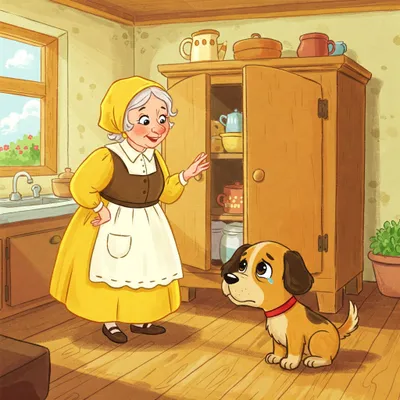
Went to the Cupboard,
To give the poor Dog a bone;
When she came there,
The Cupboard was bare,
And so the poor Dog had none.
She went to the Baker’s
To buy him some Bread;
When she came back
The Dog was dead!
She went to the Undertaker’s
To buy him a coffin;
When she came back
The Dog was laughing.
History and Meaning
"Old Mother Hubbard" is a well-known English nursery rhyme first published in 1805 by Sarah Catherine Martin in "The Comic Adventures of Old Mother Hubbard and Her Dog," which became an immediate success. Martin reportedly wrote and illustrated it primarily to entertain her sister's children, and it may have been inspired by an old housekeeper who lived in a cottage on her sister's property in Devon, England—a cottage that still stands today and can be visited. The rhyme's core verse tells of Old Mother Hubbard going to her cupboard to fetch a bone for her dog, only to find it bare, followed by a series of comic inventions depicting the dog engaging in various amusing and human-like activities such as playing dead, smoking a pipe, playing the flute, and even reading the news. While generally understood as a whimsical tale, one prominent theory suggests a deeper political meaning: that Old Mother Hubbard represents Cardinal Thomas Wolsey, the cupboard is the Catholic Church, the dog is King Henry VIII, and the bone is the divorce Henry sought from Catherine of Aragon—with Wolsey's failure to secure the annulment from the Pope symbolized by the "bare cupboard," leading to his downfall. Whether viewed as political satire or simple entertainment, the rhyme's enduring popularity stems from its playful personification of the dog and its status as a beloved cultural artifact.