
One, Two, Three, Four (Mary at the Cottage Door)

Lyrics
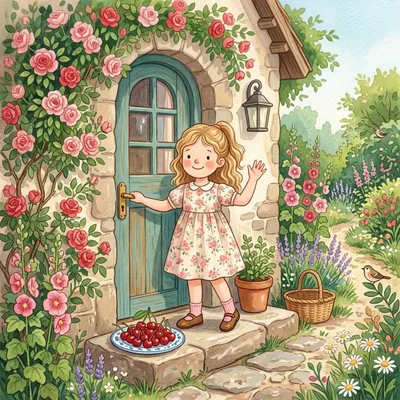
One, two, three, four,Mary at the cottage door;Five, six, seven, eight,Eating cherries off a plate.
History and Meaning
This is the counting rhyme that gets confused with another one almost every time it comes up. "One, Two, Three, Four, Mary at the cottage door" and One, Two, Three, Four, Five open with the same run of numbers and then go in completely different directions. The Mary rhyme keeps counting: four numbers, a line about Mary, four more numbers, a line about cherries. The other one stops counting at five and turns into a story about catching a fish and letting it go again because it bit a finger. If you are hunting for the fish, you want the other page. If you are hunting for the cherries, you are in the right place.
The rhyme itself is four lines long and does one job well. It carries a child from one to eight in two matched halves, each half being four numbers followed by a single rhyming line. That shape matters more than it looks.
Origins
The earliest printing is not firmly established. The rhyme circulated in speech long before anyone bothered to write it down, which is normal for short counting rhymes, and it turns up in Mother Goose collections through the twentieth century, including the 1912 edition illustrated by Jessie Willcox Smith. Any specific year attached to it elsewhere on the internet should be treated with suspicion.
What can be documented is a close relative. Iona and Peter Opie recorded an even-numbers version used for choosing players in street games: "Two, four, six, eight, Mary's at the cottage gate, eating cherries off a plate, two, four, six, eight." They traced that form back to the early nineteenth century. So the cherries and the cottage are old, and the doorway version most likely grew out of, or alongside, the counting-out chant rather than the other way round. Some printings still end the rhyme with "O-U-T spells out", which is the fingerprint of a counting-out rhyme: the last child touched is eliminated or becomes "it".
Meaning & Interpretation
There is no hidden meaning here, and no plague, no monarch, no coded politics. Mary stands in a doorway. Then somebody eats cherries off a plate. Both images were ordinary domestic scenes in nineteenth-century England, and both exist mainly because "four" needs a rhyme and "eight" needs a rhyme.
That is the actual design of the thing. Every even-numbered stopping point lands on a rhyme word: four with door, eight with plate. A child who forgets what comes after three can often recover the number by reaching for the sound. The rhyme is doing the same work a mnemonic does, which is why it survived in playgrounds while prettier verses were forgotten.
For parents, the practical value is the two-part structure. Counting past five is where a lot of children stall, because the sequence stops feeling like a single memorized chunk. Splitting one to eight into two four-beat halves gives each half its own tune and its own landing point, so the second half can be learned separately and then joined on. Clap the numbers and speak the rhyme lines, or step the numbers out on stairs. Cherries on a plate also make an easy counting prop if you happen to have any.
How is this different from One, Two, Three, Four, Five?
They are two separate rhymes that happen to start the same way. This one counts one to eight and features Mary at the cottage door and cherries on a plate. "One, Two, Three, Four, Five" counts to five, then counts to ten while a fish is caught, released, and blamed for biting a finger. Neither is a version of the other, and mixing them up is the most common mistake people make with both.
How high does the rhyme count?
To eight, in two halves of four. Some collections extend it or attach extra numbers, and some end it with "O-U-T spells out" instead, a leftover from its use as a counting-out chant for picking players in games.
Who is Mary?
Nobody in particular. No historical figure has ever been credibly linked to her, and Mary was among the most common English girls' names of the period, which makes her a generic child rather than a portrait of anyone. She is in the rhyme because her name fits and "door" rhymes with "four".
Related Nursery Rhymes





Lyrics from nurseryrhymes.info