
The Quartermaster's Store

Lyrics
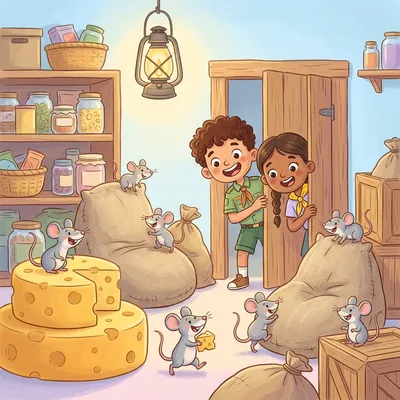
There was rats, rats, big as bloomin' cats,In the store, in the store.There was rats, rats, big as bloomin' cats,In the Quartermaster's store.
Chorus
My eyes are dim, I cannot see,I have not brought my specs with me,I have not brought my specs with me.
There was mice, mice, running through the rice,In the store, in the store.There was mice, mice, running through the rice,In the Quartermaster's store.
There was cheese, cheese, walking round on knees,In the store, in the store.There was cheese, cheese, walking round on knees,In the Quartermaster's store.
History and Meaning
This is a complaint set to a tune. British and ANZAC soldiers sang it during the First World War, and the joke behind every verse is that the food, kit and bedding handed out from the quartermaster's stores was verminous, stale or plainly not fit for use. The chorus then backs out of the accusation: the singer says his eyes are dim and he has forgotten his glasses, so perhaps he did not see what he just described.
The other reason it survived is that it never ends. Any singer who can find a rhyme can add a verse, which is exactly why Scout troops, Guide companies and summer camps took it over from the army.
Origins
Both the tune and the words are of uncertain authorship, and no first printing has been pinned down. It was already circulating among British and ANZAC troops in the First World War, when the quartermaster's department was the branch responsible for supplies, rations and quarters. It may well be older than that war, carried in by regular soldiers of the prewar army, and one suggestion traces it back as far as the English Civil War in the seventeenth century. That last claim is unproven and should be treated as a guess rather than a finding.
The song was known in the United States by the 1930s and was sung by the Lincoln Battalion, the American volunteers who fought for the republican side in the Spanish Civil War between 1936 and 1939. During the Second World War it was popular in the RAF as well as the Army. From there it moved out of the services altogether and settled into Scouting and Guiding, where it is still one of the standard campfire songs.
Soldiers' versions were frequently rude, and many of the verses passed around barracks are not for children. The camp tradition solved this simply by keeping the frame and replacing the content, so the surviving verses are almost all about vermin, bad rations and cheese with a mind of its own.
Meaning & Interpretation
A quartermaster's store is a supply depot, and grumbling about it was a soldier's steady occupation. The song turns that grumbling into entertainment by exaggerating past the point of belief: rats the size of cats, cheese walking under its own power. Nobody is meant to take it literally, which is what the chorus admits.
"Specs" is ordinary British shorthand for spectacles, so the chorus means "my eyesight is poor and I left my glasses behind". Sung straight after a tall story, it works as a mock apology and lets the next singer start a fresh lie.
How does the add-your-own-verse structure work?
Every verse follows one fixed pattern, so a new one only needs a noun and a rhyme for it. Line one is "There was [thing], [thing], [something that rhymes]", line two is "In the store, in the store", line three repeats line one, and line four is "In the Quartermaster's store". Then everyone sings the chorus. Well-worn examples include beans as big as submarines, bread like lumps of lead, butter running in the gutter, and eggs nearly growing legs. Group leaders often go round the circle and give each child a turn to invent one, and the daft rhymes usually get the biggest laugh.
What is a quartermaster?
The quartermaster is the officer in charge of supplies: food, clothing, equipment, fuel and accommodation for a unit. The name comes from the duty of arranging quarters, meaning where soldiers sleep. In the British Army the post is often filled by an officer commissioned from the ranks after long service, which is one reason the quartermaster was a familiar and much-teased figure to the men singing about his storeroom. Scout and Guide groups borrowed the title too, so a camp quartermaster looks after tents, cooking gear and stores.
Is The Quartermaster's Store suitable for young children?
The camp version is, and it is the one printed above. Because the song invites new verses, adult versions collected from barracks and rugby clubs can be coarse, so it is worth checking any songbook or online list before handing it to a group. Sticking to animals, food and household objects keeps the game going without any of that.
Related Nursery Rhymes





Lyrics from nurseryrhymes.info