
This Is the Way the Ladies Ride


Lyrics
This is the way the ladies ride,Trit-trot, trit-trot, trit-trot.
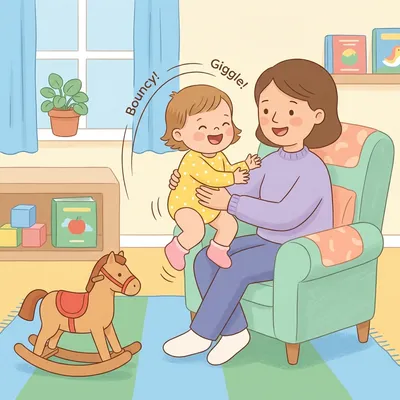
Sit the child on your knees, facing you, and bounce lightly and evenly.
This is the way the gentlemen ride,A-gallop, a-gallop, a-gallop.
Bounce twice as fast and a little higher, keeping a steady rhythm.
This is the way the farmers ride,Hobbledy-hoy, hobbledy-hoy,Hobbledy, hobbledy, hoy!
Bounce roughly and unevenly, rolling the child from side to side as well as up and down.
And down into the ditch!
Open your knees and let the child dip between them, holding on the whole way.
History and Meaning
The whole rhyme is a set of instructions for an adult's knees. A child sits astride them, and the words tell the grown-up how fast to bounce: a neat little trot for the ladies, a bigger gallop for the gentlemen, then a lurching jog for the farmers that usually ends with the child dropped between the knees. The verse is short because it is really a script for a game, and the game is the point.
It belongs to a family of English lap rhymes that includes Ride a Cock Horse to Banbury Cross and A Farmer Went Trotting. All of them borrow the rhythm of a horse to give an adult and a small child something to do together, and all of them get faster or bumpier as they go.
Origins
The earliest known printing is in James Orchard Halliwell's "Popular Rhymes and Nursery Tales" of 1849, where it appears among a group he labelled knee-songs. That places the rhyme firmly in the nineteenth century in print, though rhymes of this kind were passed on by voice long before anyone bothered to write them down, so an older spoken life is possible without being provable.
Halliwell was collecting at a time when horseback was still an ordinary way to travel, not a hobby. Anyone reciting the rhyme in 1849 had watched real riders go past and knew exactly what a lady's trot and a farmer's jolting jog looked like.
The wording has never settled. Some versions give the gentlemen the trot and the ladies a gentler pace, some add a huntsman, a soldier, a butcher or a baby to the list of riders, and the nonsense sounds shift between trit-trot, nim-nim-nim, gallop-a-trot and hobbledy-hoy depending on who is reciting. The ending varies most of all: the child falls into a ditch, into a hole, into a hedge, or the rhyme simply stops after the third rider with no fall at all.
Meaning & Interpretation
The rhyme sorts riders by class. The lady rides daintily and sits neatly, the gentleman rides grandly with a horse and the leisure to gallop it, and the farmer bumps along on a working animal with a job waiting at the other end. That was an accurate reading of an English road in the 1800s. How you rode, and what you rode, announced who you were before you were close enough to speak, and the rhyme turns that social reading into something a two-year-old can feel in their legs.
There is no lesson attached. Nobody in the rhyme is praised or scolded for their riding style. The farmer gets the roughest ride and the biggest laugh, which is a fair trade in a nursery game, and the escalation from smooth to rough is doing the same work as the build-up in any tickling rhyme: the child knows what is coming and enjoys the wait.
How do you do the knee-ride?
Sit down and place the child astride your knees, facing you, with your hands holding them securely under the arms or around the ribs. For the ladies, bounce your heels lightly and evenly, a small tidy movement in time with "trit-trot". For the gentlemen, double the speed and raise the bounce a little so it feels like a canter. For the farmers, break the rhythm on purpose: bounce unevenly and rock the child from side to side as well as up and down. On the last line, part your knees so the child dips down between them, keeping both hands firm the whole time, then lift them straight back up.
Why do the ladies, gentlemen and farmer ride differently?
Because in nineteenth-century England each one really did. Women rode sidesaddle in long skirts, which suited a controlled trot rather than a headlong pace. Gentlemen rode for sport and for show and could gallop for the pleasure of it. Farmers rode working horses over rutted lanes, often with goods or tools loaded up, and their pace was a bumpy jog. Children learned the whole social ladder as a bouncing game.
What does "hobbledy-hoy" mean?
It is a sound rather than a word with a settled meaning, chosen to imitate an uneven, jolting ride, and it changes from version to version. The nearest ordinary English relative is "hobble", which describes exactly the lurching movement the line is asking you to make with your knees.
Is the drop at the end safe?
It is safe as long as you never let go. The child should dip a short distance between your knees while your hands stay firmly around their chest, and the drop should be small and slow with a baby and only bigger with an older child who is asking for it. Plenty of families skip the fall entirely and end after the farmer, which works just as well since the rhyme has no fixed ending anyway.
Related Nursery Rhymes



Lyrics from nurseryrhymes.info