
Baloo Baleerie

Lyrics
Baloo baleerie, baloo baleerie,Baloo baleerie, baloo balee.
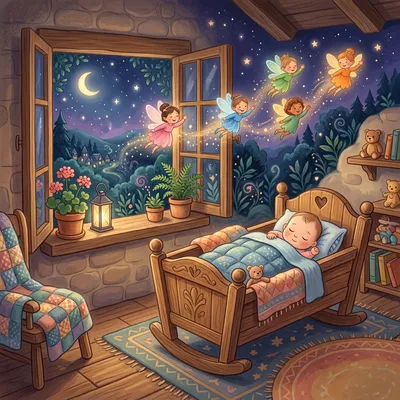
Gang awa peerie faeries, gang awa peerie faeries,Gang awa peerie faeries, frae oor ben noo.
Doon come the bonny angels, doon come the bonny angels,Doon come the bonny angels, tae oor ben noo.
Baloo baleerie, baloo baleerie,Baloo baleerie, baloo balee.
History and Meaning
Most lullabies ask a baby to sleep. This one clears the room first. "Baloo Baleerie" comes from Shetland, and its middle verses do a specific job: the fairies are told to leave, and the angels are invited in to take their place. Sung slowly, on three repeated lines per verse, it is one of the gentlest tunes in the Scots songbook, and also one of the few with a piece of working folk belief still sitting inside it.
Origins
The version sung today traces to a recording held in the BBC's Glasgow archives, made on 22 January 1949 on Bressay, the island that sits across the sound from Lerwick. Because of that, the song is also known as "The Bressay Lullaby". Alan Lomax published it in 1951, and from there it moved into the folk revival, into school songbooks, and onto a long list of recordings by Scottish singers and choirs.
How old the song is before 1949 is not known. You will sometimes see a claim that it dates to the 1100s. There is no evidence for that, and it should be treated as unproven; what can be said is that the language and the belief behind it are both genuinely old.
"Baloo" is the Scots lullaby word, the equivalent of "hush-a-bye". It appears in Scots song well before Shetland collectors were at work, including in the seventeenth-century lament that begins "Balow, my babe". "Baleerie" is not a word with a separate meaning. It is a rhyming extension of "baloo", the same instinct that produced "hushabye" and "lullaby" itself.
Shetland's speech carries a Norse layer that mainland Scots does not. The islands spoke Norn, a North Germanic language descended from Old Norse, until roughly the eighteenth century, and words from it survive in the local dialect. The Shetland word for a fairy, "trow", comes from the same root as "troll".
Meaning & Interpretation
The two middle verses are a swap. Verse two sends the peerie faeries out of the room; verse three brings the bonny angels down into the same space. That is the whole structure, and it follows a pattern well documented in Scottish and Shetland folk belief, in which a newborn was thought to be at risk from the fairies until it was baptised, and could be taken and replaced with a sickly changeling.
Families responded with charms rather than fear. Folklore collectors recorded iron in various forms near the cradle, a rowan sprig woven into the crib, a Bible under the pillow, and pins or crossed straws set at the threshold. A song that names the danger and dismisses it belongs in exactly that company. It is the audible version of the nail in the bedpost.
None of this makes the lullaby grim. The tune is soft, the repetition is heavy, and the last verse simply returns to the nonsense refrain. A parent singing it is doing what the charm was always for, which is settling their own nerves as much as the baby's.
What do the Scots words mean?
baloo - hush, a Scots lullaby word meaning roughly "hush-a-bye" baleerie - rhyming nonsense added to baloo, no separate meaning gang awa - go away peerie - little, tiny (a distinctively Shetland word) faeries - fairies frae - from oor - our ben - the inner room of a cottage, the room the family slept in noo - now doon - down bonny - lovely, fine tae - to bairn - child, baby (found in some versions in place of "ben")
Why does the lullaby tell the fairies to go away?
Because in Shetland and wider Scottish folk belief, fairies were held to steal unbaptised babies and leave a changeling in the cradle. Sending them out of the room was a protective charm, sung in the same spirit as the iron, rowan and Bible that folklore collectors recorded being placed near cradles. The next verse completes the exchange by calling the angels down to guard the child instead.
Is Baloo Baleerie the same song as the Bressay Lullaby?
Yes. The two names refer to the same lullaby, which is called "The Bressay Lullaby" after the Shetland island where the 1949 recording behind the modern version was made. Wordings vary slightly between singers, most often in the third verse, where some have the angels come down "tae oor ben noo" and others "tae oor bairn noo".
Related Nursery Rhymes

Lyrics from nurseryrhymes.info