

Why Are Nursery Rhymes So Dark?
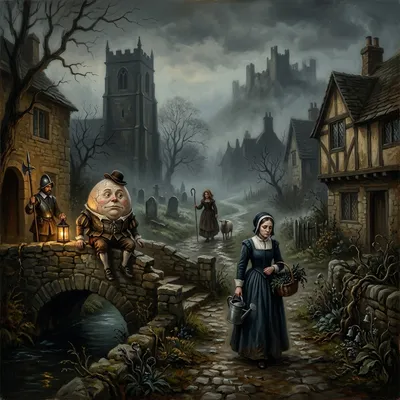
Why are nursery rhymes so dark? Partly because they came out of a harsher world, where plague, public execution and grinding poverty were ordinary facts of life, and the songs people sang carried those realities along with everything else handed down the generations. Rhymes were also a safe way to say the unsayable: under watchful monarchies, gossip about the powerful could be folded into verses that sounded like harmless nonsense.
The famous origin stories, though, are another matter. We took the ten that circulate most widely and checked each against the earliest printed version of its rhyme. Not one of them holds up. Some fail because the rhyme turns out to be a century or two younger than the event it supposedly encodes. Some explain a line that was not in the rhyme to begin with. One was invented by a tourist board in 1996.
Two things worth separating, because they get muddled. Plenty of nursery rhymes genuinely are dark: Goosey Goosey Gander really does throw an old man down the stairs, and the Coventry Carol really is sung to children about to be killed. That is not in dispute. What does not survive scrutiny is the specific historical decoding, the claim that this rhyme is secretly about that king. Below is each story as it is usually told, followed by what the record actually shows.
The 10 Famous Dark Origins, Fact-Checked
| Nursery Rhyme | The dark story you have heard | Verdict | Earliest known text | |
|---|---|---|---|---|
| 1. | Ring-a-Ring o' Roses | The Great Plague of 1665 | Myth | 1881 |
| 2. | Mary, Mary, Quite Contrary | Bloody Mary executing Protestants | No evidence | c. 1745 |
| 3. | Jack and Jill | The execution of Charles I | No evidence | c. 1765 |
| 4. | Humpty Dumpty | A cannon at the siege of Colchester | Myth | 1797 |
| 5. | Goosey Goosey Gander | Hunting Catholic priests | Myth | 1784 |
| 6. | Sing a Song of Sixpence | Henry VIII's court and Anne Boleyn | No evidence | c. 1744 |
| 7. | Georgie Porgie | The Duke of Buckingham | No evidence | 1841 |
| 8. | London Bridge is Falling Down | Viking attack, or children entombed alive | No evidence | c. 1744 |
| 9. | Pop Goes the Weasel | Pawning your coat in Victorian poverty | Myth | 1850s |
| 10. | Three Blind Mice | Bloody Mary burning three bishops | Myth | 1609 |
"Myth" means the evidence actively contradicts the story, usually because the rhyme is far younger than the event or because the line being explained was not in the original. "No evidence" means nothing supports it either way, and the dates do not help it.
Ring-a-Ring o' Roses
Also sung as "Ring Around the Rosie". The darker reading ties it to the Great Plague of London in 1665: the "ring of roses" as the ring-shaped rash said to mark the infected, "ashes, ashes" as the burning of victims' possessions, and "we all fall down" as the death toll.
Verdict: myth, and a surprisingly young one. The rhyme cannot be found in print until 1881, in Kate Greenaway's Mother Goose, which is 216 years after the plague. More telling still, nobody connected it to the plague until the mid-twentieth century: interpreters writing before the Second World War never mention it, and the reading only became common currency in Britain around 1951. The plague interpretation is younger than most people's grandparents. Folklorists reject it, and for three further reasons: the symptoms in the rhyme do not match plague symptoms, the exact words the reading depends on are missing from many of the earliest recorded versions, and European and nineteenth-century variants suggest the "fall" was originally a curtsy or a bob, not a death.
Mary, Mary, Quite Contrary
Behind the girl with the green fingers, many hear Mary I of England, remembered as "Bloody Mary" for her persecution of Protestants, with "how does your garden grow?" pointing to the graves of those she executed. Others swap in Mary, Queen of Scots.
Verdict: no evidence. The rhyme first appears around 1745, in Tommy Thumb's Pretty Song Book. Both Marys were sixteenth-century figures, and no proof has been found that the rhyme was known at all before the eighteenth century, leaving a gap of roughly 200 years with nothing in it. The identification is a guess made backwards from the name.
Jack and Jill
Two children climb a hill for a pail of water and Jack takes a tumble. The darker reading recasts them as Charles I and his queen, with the hill standing in for the scaffold. Rival versions offer the executions of Empson and Dudley in 1510, a marriage negotiation by Cardinal Wolsey, a satire on Charles I's tinkering with liquid measures, a Somerset legend from Kilmersdon, and a thirteenth-century Icelandic myth about two siblings stolen by the Moon.
Verdict: no evidence, and the sheer number of theories is the tell. The rhyme first appears around 1765, in a reprint of Newbery's Mother Goose's Melody. As the standard reference works put it, most of these explanations postdate the rhyme's first publication and have no corroborating evidence. When six incompatible theories all fit a verse equally well, the verse is not encoding any of them.
Humpty Dumpty
The story goes that the famous egg was never an egg: Humpty Dumpty was a large cannon mounted on the city wall during the siege of Colchester in 1648, brought down by Parliamentary fire, and no number of the king's horses or men could get it back up.
Verdict: myth, and the most recent invention on this page. This one can be dated almost precisely, because it does not come from folklore at all: Colchester's tourist board began publishing it on their website in 1996. Scholars dismissed it as ingenuity for its own sake and, more bluntly, as a spoof. The evidence runs against it on every count. The rhyme was first printed in 1797, and it was originally a riddle, which is why it never says its subject is an egg; an 1843 account confirms the answer was an egg all along. The verses the cannon story leans on are not written in seventeenth-century style, and the earliest printed versions do not even mention horses and men. A tourist-office flourish from the 1990s is now repeated across the internet as medieval military history.
Goosey Goosey Gander
The popular reading sends this one back to the English Civil War: the "old man who wouldn't say his prayers" as a Catholic priest hiding in a cramped "priest hole", and the fall down the stairs as the fate that met priests when soldiers found them.
The dates rule it out. The earliest printing, in Gammer Gurton's Garland in 1784, has only six lines and ends with a cup of sack and a race of ginger. There is no old man, no prayers and no staircase. Those four lines were grafted on later, apparently in the early nineteenth century, which is more than 150 years after the persecutions the theory depends on. The reading traces to an amateur historian rather than to the Opies, whose Oxford Dictionary of Nursery Rhymes does not endorse it. See the full story on the rhyme's own page.
Sing a Song of Sixpence
The blackbirds baked in a pie are said to hide the court of Henry VIII: the king in his counting house is Henry, the queen eating bread and honey is Catherine of Aragon, the maid in the garden is Anne Boleyn, and the blackbird snipping off her nose nods to her beheading. Other readings make the blackbirds the monks of the Dissolution, or the twenty-four hours of the day.
Verdict: no evidence, and one detail sinks it. The first verse appears around 1744 in Tommy Thumb's Pretty Song Book, and no corroborative evidence has ever been found for any of these readings. The problem is that the earliest version has "naughty boys" in the pie, not blackbirds. Every Henry VIII reading depends on the blackbirds, so unless you assume later printings preserved an older tradition that the earliest printing somehow lost, those meanings cannot be original.
There is one genuinely true thing here, and it is not the Tudor conspiracy: live birds really were baked into pies as table entertainment in the sixteenth century, and period cookbooks describe how to do it. The surreal image needs no code to explain it. It was a real party trick.
Georgie Porgie
The boy who "kissed the girls and made them cry" is often identified as George Villiers, 1st Duke of Buckingham, the favourite of King James I, with the arrival of "the boys" read as the court finally rounding on him.
Iona and Peter Opie listed this among the unsubstantiated conjectures, alongside a rival claim for King George I, and noted that the guesses were then copied from one reference book to the next until they looked like scholarship. The rhyme has no traceable existence before 1841, and Villiers died in 1628, 213 years earlier, with nothing in between connecting them. Worth knowing too: the 1841 text reads "when the girls came out to play", so even the detail the theory leans on is a later change. See the rhyme's own page.
London Bridge is Falling Down
Two grim readings compete. The first ties the rhyme to a real event, the destruction of London Bridge by the Norwegian king Olaf II Haraldsson in 1014. The second is darker: immurement, the practice of entombing people, in some tellings children, alive in the foundations to keep a bridge standing.
Verdict: no evidence for either, and the Viking case is circular. The rhyme first appears around 1744. The Viking version is usually supported by pointing to a verse in the Norse Heimskringla that appears to mention London Bridge falling. It does not. That reading comes from Samuel Laing's very free nineteenth-century translation, and Laing used the nursery rhyme itself as the model for his wording. The rhyme was used to translate the saga, and the saga is now cited as evidence for the rhyme. Some historians doubt the 1014 attack happened at all.
The child-sacrifice reading was a hypothesis floated by the folklorist Alice Bertha Gomme. It was offered as speculation and no evidence has ever been produced for it, at London Bridge or anywhere else in the rhyme's history.
Pop Goes the Weasel
The favourite reading makes this a snapshot of Victorian hardship: "pop" was slang for pawning, "weasel and stoat" was Cockney rhyming slang for a coat, and the rhyme catches poor workers pawning their Sunday best to cover a drink, then buying it back on payday.
Verdict: myth, and the dates run backwards. "Pop" for pawn is genuine period slang, so half of it is sound. But "weasel and stoat" as rhyming slang for a coat is not recorded until the 1930s, and the song dates from the early 1850s. The explanation is roughly eighty years younger than the thing it claims to explain. Iona and Peter Opie noted something more damning still: nobody seemed to know what the phrase meant even at the height of the dance craze in the 1850s, when the song was everywhere. Competing candidates for the weasel include a tailor's flat iron, a hatter's tool, a spinner's weasel (a measuring reel that popped audibly every forty turns), a weasel-skin purse that snapped shut, and the animal. The likeliest answer is that the phrase was nonsense from the start.
Three Blind Mice
The mice are said to be three Protestant bishops, Hugh Latimer, Nicholas Ridley and Thomas Cranmer, "blind" for refusing Mary I's Catholicism, with the farmer's wife and her carving knife standing for their deaths.
Verdict: myth, on three separate counts. The rhyme was printed in 1609, in Ravenscroft's Deuteromelia, which is 51 years after Mary I died in 1558. The Oxford Martyrs were burned at the stake, not blinded, so the central image does not even match. And the earliest lyrics do not describe anything being done to the mice at all; the tail-cutting is a later addition. The theory requires a rhyme written after the fact, about an injury that did not happen, using a line that was not there yet.
How to tell a real origin from an invented one
These stories spread because they are satisfying, not because they are documented, and the same few tests catch most of the invented ones.
Check the date of the earliest printed text. This is the single most useful test and it settles most cases. If a rhyme cannot be found in print until a century or more after the event it supposedly encodes, and no earlier reference to it exists, the connection is almost certainly imagined. Ring a Ring o' Roses and Goosey Goosey Gander both fail on exactly this.
Check whether the line being explained is actually in the original. Rhymes accumulate verses over time. More than one famous "dark origin" turns out to explain a line that was added generations after the rhyme first appeared, which means the explanation cannot be the reason the line exists.
Ask who first proposed it. A surprising number of these readings trace to a single twentieth-century writer, or to one comment that got copied from book to book until repetition made it look settled. Iona and Peter Opie, whose Oxford Dictionary of Nursery Rhymes remains the standard reference, listed several of the best-known theories specifically in order to dismiss them.
Be suspicious of a perfect fit. Real folk transmission is messy. When every single element of a rhyme maps neatly onto one historical episode, that usually means someone worked backwards from the episode.
None of which makes the rhymes less interesting. The genuine history is often stranger than the invented version, and knowing which is which is the point of a page like this.
Curious when these rhymes actually date from? Explore the full timeline of nursery rhymes through history, where every dated rhyme on the site is sorted century by century.