

Ring-a-Ring o' Roses


Lyrics
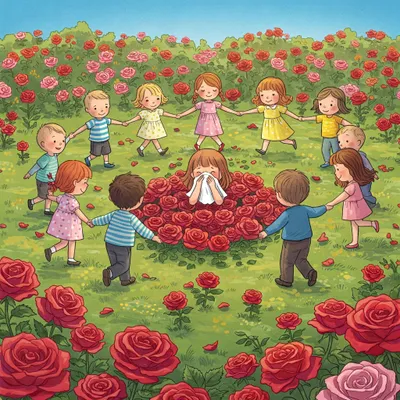
Ring-a-ring o' roses,A pocket full of posies,A-tishoo! A-tishoo!We all fall down.
History and Meaning
Almost everyone has heard that "Ring-a-Ring o' Roses" is secretly about the Great Plague: the rosy rash, the posies, the sneeze, the falling down dead. Almost everyone is wrong. It is a circle-dance game, and the plague story did not appear until the twentieth century, long after the rhyme itself.
Origins
The song is cataloged under number 7925 in the Roud Folk Song Index. While similar circle-dance rhymes were documented across Europe in the mid-nineteenth century, the earliest known English publication appeared in 1881. The rhyme was illustrated and published in London in Kate Greenaway's book Mother Goose or the Old Nursery Rhymes. Similar variations have been recorded in German, French, and Italian folklore, suggesting a widespread European tradition of circle-singing games.
Meaning & Interpretation
The lyrics are associated with a traditional playground game where children form a ring, spin around, and curtsy or fall down on the final line. In traditional European culture, roses and posies are common symbols of joy, celebration, and romance.
A popular theory suggests that the rhyme originated during the Great Plague of London in 1665, claiming that "roses" represents a rosy rash, "posies" refers to herbs carried for protection, "a-tishoo" represents sneezing from illness, and "falling down" represents death. However, folklorists and historians reject this theory. The plague interpretation only emerged in the mid-twentieth century and is not supported by historical records. Early versions of the rhyme did not mention sneezing, and "falling down" referred to a physical bow or curtsy at the end of the game rather than death.
Is Ring-a-Ring o' Roses about the Great Plague?
No, historians and folklorists classify the plague theory as a modern myth. The explanation did not appear until the mid-twentieth century, and the symptoms of the bubonic plague do not match the lyrics.
When was Ring-a-Ring o' Roses first published?
The earliest known English publication of the rhyme was in 1881 in Kate Greenaway's illustrated book Mother Goose.
Music Video
If the player is unavailable, watch this video on YouTube.
Free Printable Coloring Page
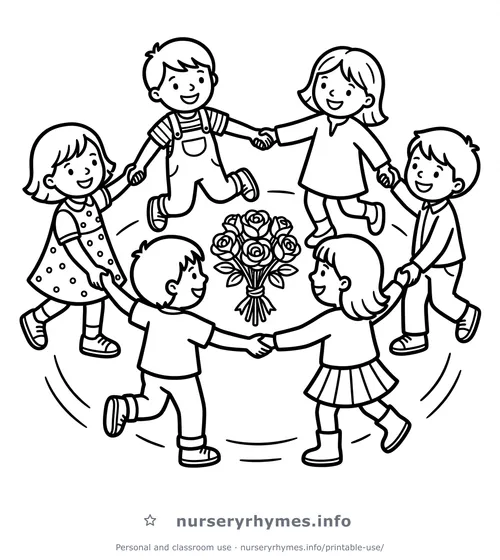
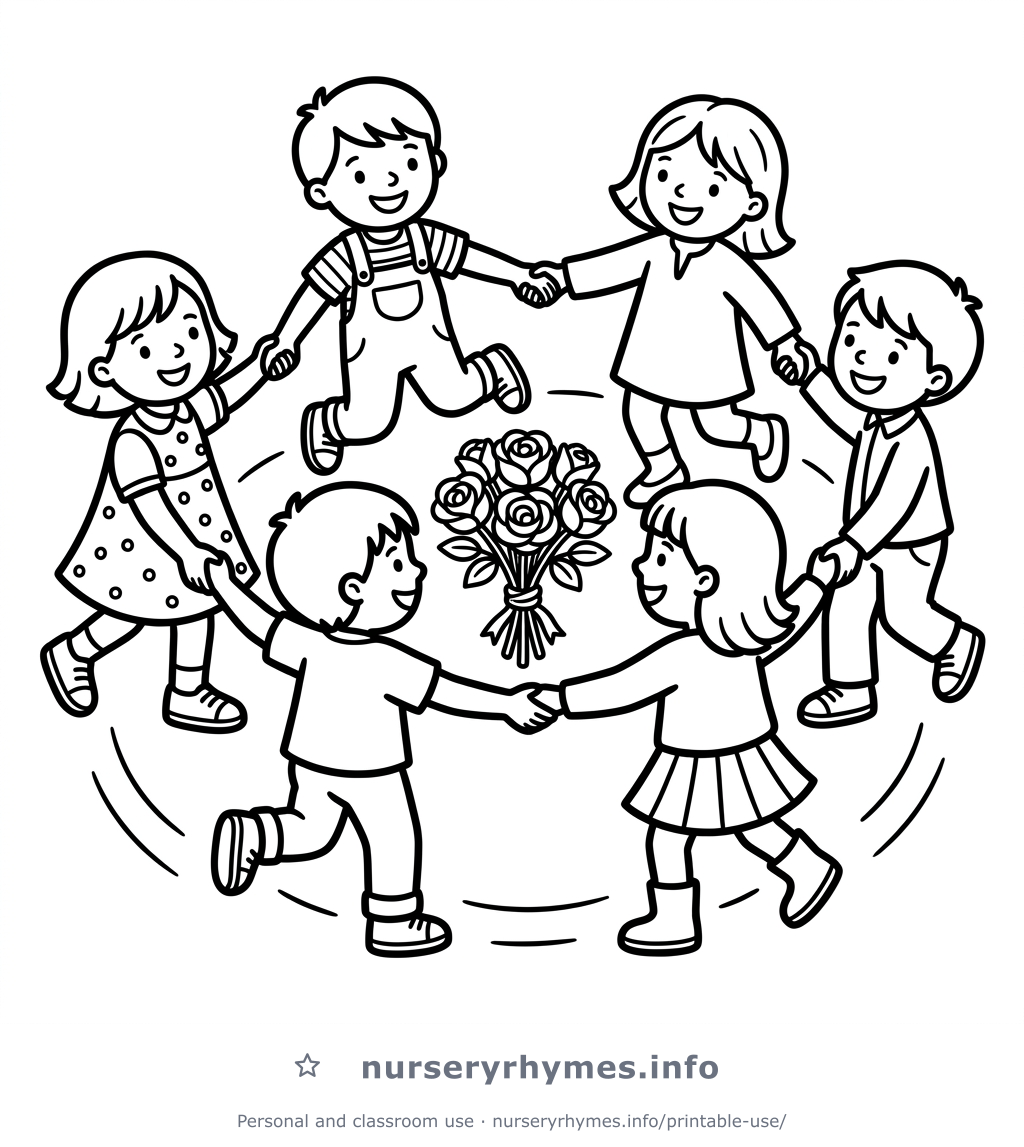
Print this Ring-a-Ring o' Roses coloring sheet for free and let little ones bring it to life with crayons or pencils.
Full-resolution PNG · Fits the paper size selected in your print dialog · Personal and classroom use
Related Nursery Rhymes






Lyrics from nurseryrhymes.info