
My Hat, It Has Three Corners

Lyrics
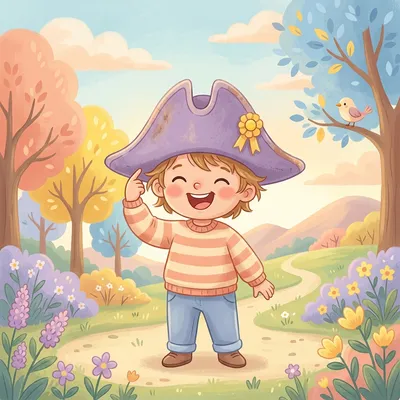
My hat, it has three corners,Three corners has my hat,And had it not three corners,It would not be my hat.
Round two: sing it again, but do not sing the word "hat". Pat the top of your head instead.
My ... it has three corners,Three corners has my ...And had it not three corners,It would not be my ...
Round three: keep patting for "hat", and now leave out "three" as well. Hold up three fingers.
Round four: keep both, and leave out "corners". Bend one arm and tap the point of your elbow.
Round five: keep all three, and leave out "not". Shake your head, or wag a finger.
Last round: only "my", "it has", "and had it", and "it would be" are still sung. Everything else is hands.
History and Meaning
The point of this song is to sing it wrong. It has four short lines and one idea, and it is sung over and over. On each repeat, one more word is taken out of the tune and replaced by a gesture, until a whole room is patting heads, holding up fingers and jabbing elbows in near silence. The only sound left is whoever forgot.
The English words translate the German "Mein Hut, der hat drei Ecken", which is still one of the best known kindergarten songs in German-speaking countries and is played there the same way, with the same four gestures.
Origins
The song is German traditional. Its words circulated in oral tradition and among children before they appear in printed collections, so no single origin date can be given honestly, and dates offered for it should be read as dates of printing rather than of composition.
The tune is genuinely contested. German-language sources most often connect it to a Neapolitan canzonetta, sometimes given as "O mamma, mamma cara", a wandering melody cited by the composer Reinhard Keiser in his 1707 singspiel "Der angenehme Betrug oder Der Carneval von Venedig". Other accounts link the same melody to the Viennese song "O du lieber Augustin", and others simply call it an Italian carnival tune. These accounts have not been reconciled, and the moment at which this particular text was joined to the melody cannot be established from the surviving record. Anyone stating a single confident answer is going beyond the evidence.
The hat itself dates the song. A three-cornered hat is a tricorne, the brim turned up on three sides, which was ordinary men's headwear across Europe through much of the eighteenth century. It was not a costume or a joke at the time. The turned-up brim shed rain away from the face, and the shape was common enough that a song could point at it without explaining anything.
Meaning & Interpretation
The verse says nothing. It is a closed loop: the hat has three corners, and if it did not have three corners it would not be that hat. Nothing is described, nobody does anything, and the second half only restates the first.
That emptiness is the design. Because the words carry no information, you can delete them one at a time without losing the thread, which is precisely what a substitution game needs. A song with a story would break as soon as you removed a noun. This one survives being stripped to almost nothing, and the sillier it gets, the better it works.
How do you play the gesture game?
Sing the verse straight through once so everyone has the tune. On the second time through, stop singing the word "hat" and pat the top of your head with a flat hand instead, in the rhythm the word would have taken. On the third round, keep the head pat and also drop "three", holding up three fingers. On the fourth round, keep both and drop "corners", bending one arm and tapping the point of your elbow, since the elbow is the corner. On the fifth round, drop "not" as well, with a headshake or a wagged finger. Each round keeps everything from the round before and adds one more silence, so the singing thins out and the miming builds. Groups vary the order, and some stop after three substitutions with young children.
Why does this song work so well with children?
It trains memory and attention under time pressure. A child has to hold four rules at once while a tune keeps moving, and there is no pause to think. The comedy does the teaching, because the funny part is the slip: somebody always sings "hat" out loud when they were supposed to pat, and the mistake is obvious to everyone at the same instant.
For teachers and party leaders, the practical value is that it needs nothing. No props, no space, no reading, and it scales from four children to forty. Speeding up each round raises the difficulty without changing the rules. It also works with children who are shy about singing, since by the later rounds they are barely singing at all.
What is a three-cornered hat?
It is a tricorne, a hat with a wide brim folded up against the crown on three sides to make three points. It was standard everyday headwear for European and colonial American men through much of the 1700s, worn by soldiers, sailors and civilians alike, and it went out of general use around the end of that century.
Related Nursery Rhymes



Lyrics from nurseryrhymes.info