
My Mother Said, I Never Should
Lyrics
My mother said, I never shouldPlay with the children in the wood.If I did, she would say,"Naughty girl to disobey."
The wood was dark, the grass was green,In came Sally with a tambourine.I went to the sea, no ship to get across,I paid ten shillings for a blind white horse.
I upped on his back and was off in a crack,Sally, tell my mother I shall never come back.
History and Meaning
This is a rope rhyme before it is a nursery song. The four-beat lines exist to match the turn of a long skipping rope, and the story they tell is a runaway story: a girl is warned to stay out of the wood, goes anyway, buys a blind white horse for ten shillings, and sends word back that she is not returning. Sung in a room it sounds like a scolding. Chanted over a turning rope, it is a dare.
It is also a rhyme with an editorial problem, and this page handles it openly rather than quietly. See the question below on the omitted lines.
Origins
"My Mother Said" is a long-established British skipping and playground rhyme. Its first printing is not firmly established, and this page does not put a date on it. Like most rope rhymes it lived in the mouths of children for a long time before anyone thought it worth writing down, which is the usual reason playground texts have vague paper trails while nursery-book rhymes have crisp ones.
What can be said is that the text is unstable in exactly the way oral rhymes are. Stanzas get added, dropped, and swapped between regions. Some versions stop after the mother's warning. Others carry on through the father, the teapot lid, Sally and her tambourine, the sea, the horse, and the escape. The version above prints the opening warning and the escape sequence, which are the parts most children actually skip to.
Meaning & Interpretation
The rhyme is built on disobedience and consequence, and then it refuses to deliver the consequence. The mother forbids the wood. The child goes. What follows is not a punishment but an adventure, and the last line is a message sent home rather than a return to it. That reversal is why the rhyme has stayed popular with children and slightly less popular with the adults turning the rope.
The blind white horse costing ten shillings is the detail people remember. Ten shillings was half a pound in pre-decimal British money, a real but modest sum, and buying a blind horse with it is plainly a bad bargain. The line works as comedy: the runaway's grand escape is made on the worst horse available.
Sally with the tambourine arrives from nowhere and leaves the same way. She is the messenger in the final line, the one who has to carry the news back. Children rarely ask who she is.
How is My Mother Said skipped?
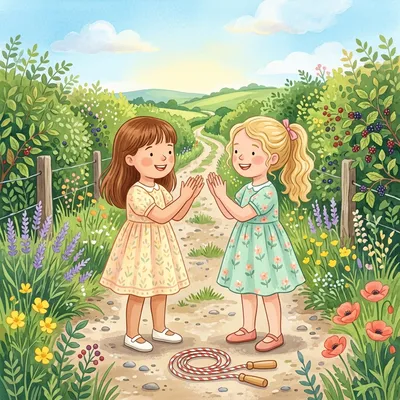
It is chanted over a long rope turned by two players while a third skips in the middle, with one jump landing on each stressed syllable: MY moth-ER said, I NEV-er SHOULD. The steady beat is the whole point, and the rhyme's short lines keep the rope at a walking-pace turn that younger skippers can hold. A common finish is for the turners to speed the rope up on the last two lines, the move usually called "peppers", so the skipper either matches the pace or trips out and the next child runs in. Some groups act the rhyme instead, shaking a hand at "tambourine" and slapping the thigh on "off in a crack". If your group prefers longer chants, Not Last Night but the Night Before uses the same long-rope setup, and Cinderella Dressed in Yella ends with a counting sequence that decides who skips longest.
Why does this page leave out one of the verses?
Fuller traditional versions of this rhyme contain a verse referring to Romani people using a term now widely regarded as a slur against Romani and Traveller people. That verse turns on a nineteenth-century stereotype of Romani people as a danger to children, a stereotype that did real and lasting harm to those communities. This page does not reproduce it. Parents who meet the older wording in a secondhand songbook or an online lyric page are not imagining it, and there is no need to pretend otherwise when a child asks.
What does "ten shillings for a blind white horse" mean?
A shilling was a pre-decimal British coin worth one twentieth of a pound, so ten shillings was half a pound. The joke is that the runaway spends real money on an animal that cannot see where it is going. The horse then carries her off "in a crack", meaning instantly, which only makes the bargain funnier.
Related Nursery Rhymes


Lyrics from nurseryrhymes.info