

My Shadow


Lyrics
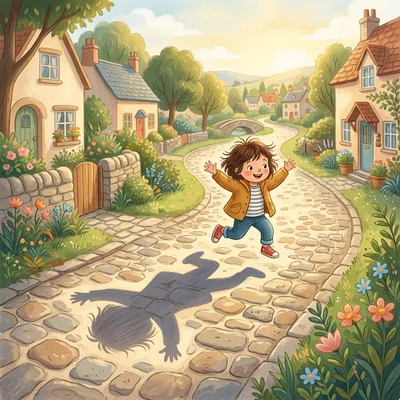
I have a little shadow that goes in and out with me,And what can be the use of him is more than I can see.He is very, very like me from the heels up to the head;And I see him jump before me, when I jump into my bed.
The funniest thing about him is the way he likes to grow,Not at all like proper children, which is always very slow;For he sometimes shoots up taller like an india-rubber ball,And he sometimes gets so little that there's none of him at all.
He hasn't got a notion of how children ought to play,And can only make a fool of me in every sort of way.He stays so close beside me, he's a coward you can see;I'd think shame to stick to nursie as that shadow sticks to me!
One morning, very early, before the sun was up,I rose and found the shining dew on every buttercup;But my lazy little shadow, like an arrant sleepy-head,Had stayed at home behind me and was fast asleep in bed.
History and Meaning
Robert Louis Stevenson wrote "My Shadow" for A Child's Garden of Verses, the collection of 64 poems that Longmans, Green and Co. published in 1885. It runs to four stanzas of rhyming couplets in a long, swinging line, and it never leaves the voice of the child speaking. The whole poem rests on one decision: the shadow is treated not as an effect of light but as a companion, and a fairly disappointing one. He copies everything. He will not play properly. He grows in a way no child would. And in the last verse he lets the child down completely.
That is why the poem has stayed in schoolrooms and recitation books for well over a century. A listener of five does not need any of it explained. They already have a shadow, they have already noticed it doing exactly these things, and the poem hands them a complaint they were half forming themselves.
Origins
Stevenson began the collection at Braemar in Scotland during the summer of 1881, under the working title Penny Whistles. Much of the writing came later, in 1883 and 1884 at Hyeres in the south of France, where a lung haemorrhage left him bedridden and unable to work on prose. Ill health confined him for long stretches of his adult life, and a good deal of A Child's Garden of Verses looks back at childhood from a sickroom. The finished book carried a dedication to Alison Cunningham, the Edinburgh nurse who had sat up with him through the illnesses of his own early years.
The poem has been reprinted and re-illustrated more or less continuously since. Along with the other short pieces in the book it became a fixture of school readers on both sides of the Atlantic, which is why so many adults can still produce the first line without meaning to. Three more poems from the same 1885 collection sit elsewhere on this site: Bed in Summer, The Swing and The Cow.
Meaning & Interpretation
Read the four stanzas as a character sketch and the structure becomes obvious. First the shadow is a copier, "very, very like me from the heels up to the head". Then he is a show-off who grows and shrinks with no regard for how growing is supposed to work. Then he is a coward who will not leave the child's side for a second. Finally he is a lie-abed. Every single accusation describes something a real shadow genuinely does. Stevenson simply reclassifies each one as a personal failing.
The growing is the part children ask about, and it has a plain answer. A shadow is the patch of ground your body keeps the sunlight off. When the sun is low, early or late in the day, the light comes in at a shallow slant and that patch stretches out long across the ground. When the sun is high overhead near midday, the patch shrinks to a puddle around your feet. Nothing about the child has changed at all; only the angle of the light has.
The last stanza is the one worth reading twice. The child gets up before sunrise, goes out to find dew on every buttercup, and the shadow is not there. "Had stayed at home behind me and was fast asleep in bed." Before the sun clears the horizon there is no direct sunlight, so there is no sharp shadow to be cast. The child does not put it that way, of course. The joke is exact physics and pure imagination at the same time, which is a difficult thing to pull off in sixteen lines.
Why does a shadow change size?
A shadow is the area your body blocks the sun from reaching, so its length depends entirely on the angle of the light. Early morning and late afternoon sun comes in low and almost sideways, stretching the shadow out long and thin. At midday the sun is high overhead and the shadow shrinks to a short shape near your feet. The child in the poem has not grown or shrunk; only the sun has moved.
Why is the shadow asleep in bed in the last verse?
Because the child got up before sunrise. With the sun still below the horizon there is no direct sunlight to cast a shadow, so nothing follows the child outside. Stevenson keeps the explanation out of it and lets the child conclude that the shadow is simply lazy.
What do "nursie" and "arrant" mean?
"Nursie" is an affectionate name for a nursemaid, the woman employed in a Victorian household to look after the children. Stevenson had one himself, Alison Cunningham, and the book is dedicated to her. "Arrant" is an old word meaning complete or utter, so "an arrant sleepy-head" is a thorough, hopeless lie-abed.
Who wrote My Shadow?
Robert Louis Stevenson, the Scottish writer better known for Treasure Island and Strange Case of Dr Jekyll and Mr Hyde. He was born in Edinburgh in 1850 and died in Samoa in 1894. "My Shadow" appeared in A Child's Garden of Verses in 1885, and the poem has been in the public domain for many years.
Related Nursery Rhymes




Lyrics from nurseryrhymes.info