

The Swing


Lyrics
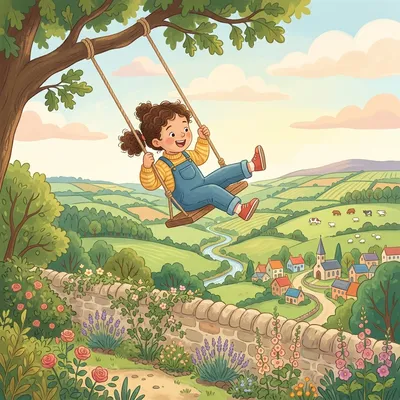
How do you like to go up in a swing,Up in the air so blue?Oh, I do think it the pleasantest thingEver a child can do!
Up in the air and over the wall,Till I can see so wide,Rivers and trees and cattle and allOver the countryside,
Till I look down on the garden green,Down on the roof so brown,Up in the air I go flying again,Up in the air and down!
History and Meaning
Robert Louis Stevenson published "The Swing" in 1885, in a book of sixty-four short poems called A Child's Garden of Verses. He was thirty-four and had spent much of the previous decade ill. A lung haemorrhage in 1883 left him confined to a darkened room at Hyeres in the south of France with his right arm bound to his side; he wrote with his left hand, on paper pinned to a board laid across the bed. Most of the collection was made under those conditions.
The poem is twelve lines long and contains no story. A child gets on a swing, rises high enough to see over the garden wall, looks at rivers and trees and cattle, then comes back down. That is the whole of it.
Origins
Stevenson was born in Edinburgh in 1850 and was a sickly child in a cold city, kept indoors through long stretches of bronchial illness. His nurse, Alison Cunningham, sat up with him through those nights, and he called her Cummy. A Child's Garden of Verses is dedicated to her.
He drafted the poems at Hyeres in 1883 and 1884 under the working title Penny Whistles, then gathered them into a volume after settling at Bournemouth, and Longmans, Green and Co. published the book in 1885. The poems look back at a Scottish childhood from a considerable distance, written by a man who by then could rarely go outside. Several of the best known sit near "The Swing" in the same collection: Bed in Summer, My Shadow and The Land of Nod all come from it, as does The Cow.
There is no evidence that Stevenson had a particular swing in mind, and he never named one. The garden in the poem reads like the walled Edinburgh gardens of his early years.
Meaning & Interpretation
The subject is the view, not the swinging. The child on the ground can see a garden and a wall. At the top of the arc the wall stops mattering and the whole countryside opens up: rivers, trees, cattle, distance. Then gravity takes it all back and the world shrinks to a green garden and a brown roof. The poem is about a prospect you get to hold for about one second at a time.
The lines move the way the swing does. The stanzas run in long-short pairs, and the words climb and drop with the arc, ending on "Up in the air and down!" so that the poem stops at the bottom of a stroke rather than the top. Read it aloud at swinging speed and the rhythm does most of the work.
A man who often could not leave his bed wrote a poem about being carried high enough to see over a wall. He does not comment on this anywhere in the verse, and the poem is not sad. It is worth knowing all the same.
Who wrote The Swing?
Robert Louis Stevenson, the Scottish author of Treasure Island and Kidnapped, wrote it for A Child's Garden of Verses, published in 1885. He is far better known for his novels, but the children's poems have stayed in print continuously for well over a century and are among the most reprinted verse in English for young readers.
What can the child in the poem see?
Rivers, trees, cattle and open countryside, all of it beyond the garden wall and visible only at the top of the swing's arc. At the bottom the view drops back to the garden itself and the brown roof of the house. The contrast between the two views is the point of the poem.
Was Stevenson really ill when he wrote it?
Yes. Stevenson suffered from severe respiratory illness for most of his life, and a haemorrhage in 1883 confined him to bed at Hyeres during the period when he was drafting these verses. He eventually left Europe for the Pacific in search of a climate he could survive in, and died in Samoa in 1894 at forty-four.
How can you act out The Swing with children?
Sit a child on a swing and recite it in time with the pushes, one line per stroke, so the rhythm and the motion line up. Without a swing, children can rock forward and back from a seated position, or stand and sway with arms out, rising on the "up" lines and crouching on the last one. The repeated "up in the air" gives them an obvious cue to reach.
Related Nursery Rhymes

Lyrics from nurseryrhymes.info