

The Spider and the Fly

Lyrics
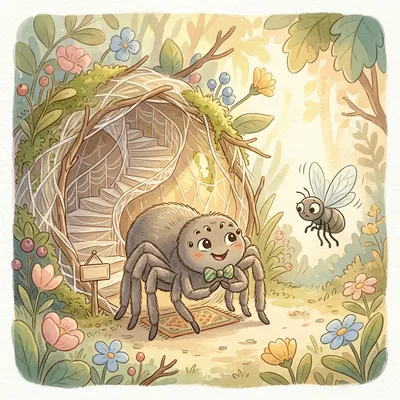
"Will you walk into my parlour?" said the Spider to the Fly,"'Tis the prettiest little parlour that ever you did spy;The way into my parlour is up a winding stair,And I have many curious things to show when you are there.""Oh no, no," said the little Fly, "to ask me is in vain,For who goes up your winding stair can ne'er come down again."
"I'm sure you must be weary, dear, with soaring up so high;Will you rest upon my little bed?" said the Spider to the Fly."There are pretty curtains drawn around, the sheets are fine and thin,And if you like to rest awhile, I'll snugly tuck you in!""Oh no, no," said the little Fly, "for I've often heard it said,They never, never wake again who sleep upon your bed!"
History and Meaning
Mary Howitt wrote a poem so effective that its opening line escaped the poem entirely. "Will you walk into my parlour?" is now standard English for an invitation that sounds generous and is not, used by people who have never read a word of the rest. The poem itself is longer than most readers remember, and its argument is stranger than the phrase suggests. Only the first two stanzas are printed above. The rest is described below.
Origins
Mary Howitt (1799 to 1888) was an English writer raised in a strict Quaker family, and she published prolifically for both adults and children, often alongside her husband William. She was also the first translator of Hans Christian Andersen into English, which put her at the centre of nineteenth-century children's writing in Britain. Sources disagree on when "The Spider and the Fly" first appeared, with some giving 1828 and others 1829, and the conflict has never been settled. It circulated in her collections of verse for children and was reprinted constantly through the Victorian period, sometimes under the subtitle "A New Version of an Old Story".
Howitt wrote it as a teaching poem, and she said so inside the text. The final stanza breaks off from the story and addresses child readers directly, warning them against idle and flattering words and against listening to counsel of that kind. Victorian children's verse very often ended this way. What kept this particular poem alive after the fashion for stated morals died out is the quality of the dialogue that comes before it.
Meaning & Interpretation
The mechanism is worth being precise about, because it is the whole point. The Spider never once uses force. He has no web-grabbing scene, no chase, no strength of any sort. He asks, and the Fly refuses.
He offers the parlour, and she says that whoever climbs the winding stair never comes down. He offers the bed, and she says that those who sleep there never wake. He offers food from his pantry, and she refuses again. Three times she is invited and three times she declines, and by any normal reading of a cautionary tale she has already won.
Then he changes tactic. He stops talking about what he has and starts talking about her: her wings, her eyes, the colours of her body, and he mentions that there happens to be a looking-glass on his parlour shelf. He then withdraws and waits. The Fly comes back on her own, circling nearer, thinking about her own brilliance, and the Spider takes her from his doorway. She is caught, and the poem does not dwell on it.
The Fly is not undone by ignorance. She knew every danger and named it out loud. She was undone by hearing herself praised. That is a much sharper idea than most verse written for children in the 1820s, and it is why teachers still set the poem.
What does "Will you walk into my parlour" mean?
It means an invitation that is deliberately made to look attractive and welcoming when the person offering it intends harm. In the poem the Spider uses the line to lure the Fly toward his web, describing his parlour as pretty and full of curious things. The phrase passed into ordinary English during the Victorian period and is now used, often half-jokingly, whenever someone is being coaxed into a trap: a bad deal, a loaded question, a room they should not enter. Speakers frequently use it without knowing it comes from Mary Howitt.
Did Lewis Carroll parody The Spider and the Fly?
Yes. "The Lobster Quadrille" in Alice's Adventures in Wonderland (1865), which begins with a whiting inviting a snail to walk a little faster, is a documented parody of Howitt's poem, matching its rhythm and its wheedling invitation. Carroll worked this way throughout the book, taking verse his readers had been made to memorise and turning it inside out. The same technique produced How Doth the Little Crocodile, his version of an Isaac Watts moral poem. That Howitt's lines were familiar enough to be worth parodying within about thirty-five years says a good deal about how widely the poem had spread.
Related Nursery Rhymes


Lyrics from nurseryrhymes.info