
The Walrus and the Carpenter


Lyrics
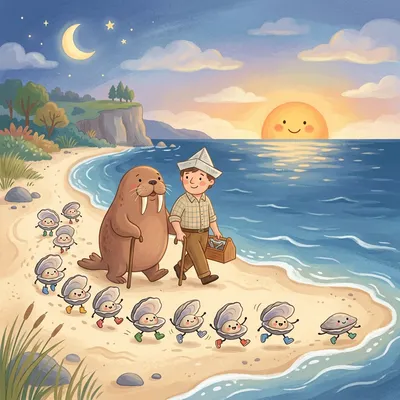
The sun was shining on the sea,Shining with all his might:He did his very best to makeThe billows smooth and bright,And this was odd, because it wasThe middle of the night.
The moon was shining sulkily,Because she thought the sunHad got no business to be thereAfter the day was done,'It's very rude of him,' she said,'To come and spoil the fun!'
The sea was wet as wet could be,The sands were dry as dry.You could not see a cloud, becauseNo cloud was in the sky:No birds were flying overhead,There were no birds to fly.
The Walrus and the CarpenterWere walking close at hand;They wept like anything to seeSuch quantities of sand:'If this were only cleared away,'They said, 'it would be grand!'
'If seven maids with seven mopsSwept it for half a year,Do you suppose,' the Walrus said,'That they could get it clear?''I doubt it,' said the Carpenter,And shed a bitter tear.
'O Oysters, come and walk with us!'The Walrus did beseech.'A pleasant walk, a pleasant talk,Along the briny beach:We cannot do with more than four,To give a hand to each.
The eldest Oyster looked at him,But never a word he said:The eldest Oyster winked his eye,And shook his heavy head,Meaning to say he did not chooseTo leave the oyster-bed.
But four young Oysters hurried up,All eager for the treat:Their coats were brushed, their faces washed,Their shoes were clean and neat,And this was odd, because, you know,They hadn't any feet.
Four other Oysters followed them,And yet another four;And thick and fast they came at last,And more, and more, and more,All hopping through the frothy waves,And scrambling to the shore.
The Walrus and the CarpenterWalked on a mile or so,And then they rested on a rockConveniently low:And all the little Oysters stoodAnd waited in a row.
'The time has come,' the Walrus said,'To talk of many things:Of shoes, and ships, and sealing-wax,Of cabbages, and kings,And why the sea is boiling hot,And whether pigs have wings.'
'But wait a bit,' the Oysters cried,'Before we have our chat;For some of us are out of breath,And all of us are fat!''No hurry!' said the Carpenter.They thanked him much for that.
'A loaf of bread,' the Walrus said,'Is what we chiefly need:Pepper and vinegar besidesAre very good indeed,Now if you are ready, Oysters dear,We can begin to feed!
'But not on us!' the Oysters cried,Turning a little blue.'After such kindness, that would beA dismal thing to do!''The night is fine,' the Walrus said.'Do you admire the view?
'It was so kind of you to come!And you are very nice!'The Carpenter said nothing but'Cut us another slice:I wish you were not quite so deaf,I've had to ask you twice!'
'It seems a shame,' the Walrus said,'To play them such a trick,After we've brought them out so far,And made them trot so quick!'The Carpenter said nothing but'The butter's spread too thick!'
'I weep for you,' the Walrus said.'I deeply sympathize!With sobs and tears he sorted outThose of the largest size,Holding his pocket-handkerchiefBefore his streaming eyes.
'O Oysters,' said the Carpenter,'You've had a pleasant run!Shall we be trotting home again?'But answer came there none,And this was scarcely odd, becauseThey'd eaten every one.
History and Meaning
Tweedledee recites this to Alice in Through the Looking-Glass, and when it finishes she tries to decide which of the two characters she likes better. She settles on the Walrus, because he was at least sorry. Tweedledee points out that he ate more than the Carpenter. She switches to the Carpenter, and Tweedledum points out that he ate as many as he could get. There is no good option, which is the joke.
Origins
Carroll published Through the Looking-Glass, and What Alice Found There in 1871, six years after Alice's Adventures in Wonderland. The poem sits in Chapter Four, handed to Alice by the Tweedle brothers as a recitation.
The Carpenter is an accident. Carroll wrote the poem leaving the second character open and offered his illustrator John Tenniel a choice of three words that fit the metre: carpenter, butterfly, or baronet. Tenniel picked the carpenter, and drew him with a paper hat. Had he chosen differently, the phrase in the language now would be the Walrus and the Butterfly.
Meaning & Interpretation
The mechanism is the same one Mary Howitt used in The Spider and the Fly: the victims are invited rather than caught. The Walrus is courteous throughout. He talks about the weather, admires the oysters, weeps over their fate, and keeps eating while he weeps.
Readers have long tried to make it an allegory. One popular reading casts the Walrus and the Carpenter as figures for particular religions or political systems. Carroll gave no such intention, and the poem sits inside a nonsense book recited by a character who is himself absurd. Treating it as a coded argument tends to say more about the reader than the text.
What it does contain is one of the most quoted lines in English. "The time has come, the Walrus said, to talk of many things: of shoes and ships and sealing-wax, of cabbages and kings" is now used, usually with no memory of the oysters, to announce that a serious conversation is starting.
What does "of cabbages and kings" mean?
It is a list assembled to be deliberately incoherent, running from the humble to the grand with no logic connecting the items. The phrase is now used to mean a wide-ranging conversation that hops between trivial and important subjects. O. Henry took Cabbages and Kings as a book title in 1904.
Why is it a carpenter?
Because Tenniel chose it. Carroll supplied three metrically interchangeable options, carpenter, butterfly and baronet, and left the decision to his illustrator. The carpenter has no significance beyond that, which is worth knowing before reading deep meaning into the character.
Is The Walrus and the Carpenter an allegory?
There is no evidence Carroll meant one. Various later readings assign the two characters to religions or ideologies, but these were applied long after publication and Carroll never endorsed them. The poem is nonsense verse recited by Tweedledee inside a nonsense book.
What happens to the oysters?
The Walrus and the Carpenter invite the young oysters for a walk, lead them a good distance from home, and then eat every one. The Walrus expresses sympathy while doing it. Carroll does not soften the ending, and Alice's attempt afterwards to find the kinder of the two is the point of the scene.
Related Nursery Rhymes
Lyrics from nurseryrhymes.info