
One for the Money
Lyrics
One for the money,Two for the show,Three to make ready,And four to go!
History and Meaning
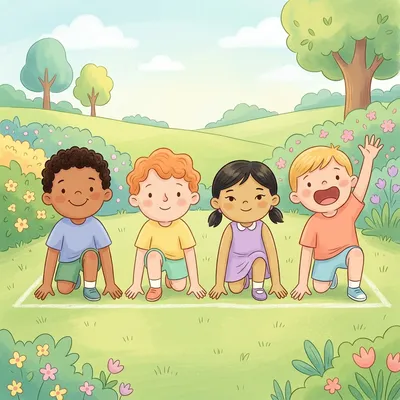
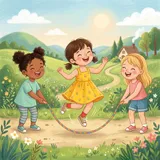
This is not a song. It is a starting pistol made of words, the children's version of "on your marks, get set, go", and it has been shouted at the top of driveways and across school fields for roughly two hundred years. Four short lines, one job: get everybody moving at the same instant. Nobody sits down to sing it. Somebody yells it, and the race begins.
Origins
The count comes out of oral tradition rather than a printed songbook, so there is no single author and no first edition to point at. Wordings close to the modern version turn up in American print from the 1820s onward, and older cousins survive alongside it, including the run-up "One to make ready, two to prepare, three to go". Folklorists generally place it in the family of British and American children's counting formulas, the same group that produced "on your marks" and the various out-counting rhymes used to pick who is It.
The money and show wording has led some writers to connect it to horse racing, where a bet on a horse to place or to show pays out on the first few finishers. That reading is plausible but not documented, and the rhyme may simply be using two familiar rhyming nouns to fill the first two beats. What is certain is the function. Every recorded use is a start signal, whether for a footrace, a jumping game, or a swing on a rope.
The phrase reached a worldwide audience in the 1950s. Carl Perkins wrote "Blue Suede Shoes" in 1955 and recorded it at Sun Records in Memphis that December, opening with a version of the count: "One for the money, two for the show, three to get ready, now go, cat, go". Sun released it as a single at the start of 1956. Elvis Presley recorded his own version at the end of January 1956, after Perkins, and it is Presley's that most people remember, which is why the songwriting credit is so often misremembered. The song is Perkins's, words and music.
Meaning & Interpretation
The mechanics are what make it work. A three-beat count leaves no room for anticipation, so runners jump the start. This one runs to four, and the third line is the trick: "three to make ready" sounds like the last number but is not. It holds everyone a beat longer, tightens the tension, then releases it on "four to go". The delay is the whole design.
It also gives the caller something to do. A child counting a race has to build suspense, and the rhyme supplies a rhythm to lean on, slow across the first three lines and fast on the last. Many families say "three to get ready" instead of "make ready", and both are old. The number of beats matters more than the wording.
Is One for the Money a nursery rhyme or a countdown?
It is a countdown, used to start races and games rather than to be sung. It is collected with nursery rhymes because it comes from the same body of children's oral tradition, but it has no tune, no verses, and no story. The four lines exist to synchronise a group of children into moving at once.
Who wrote Blue Suede Shoes, Carl Perkins or Elvis Presley?
Carl Perkins wrote it and recorded it first, at Sun Records in December 1955, using the counting rhyme as his opening line. Elvis Presley recorded his version the following January and made the song famous internationally, but he did not write it. Perkins holds the writing credit.
Why does the rhyme count to four instead of three?
Counting to four adds a false ending. "Three to make ready" arrives where a listener expects the final number, so it stalls the start by one beat and stops children setting off early. The extra count is a fairness device as much as a rhythmic one.
Related Nursery Rhymes


Lyrics from nurseryrhymes.info