

Ten Little Indians


Lyrics
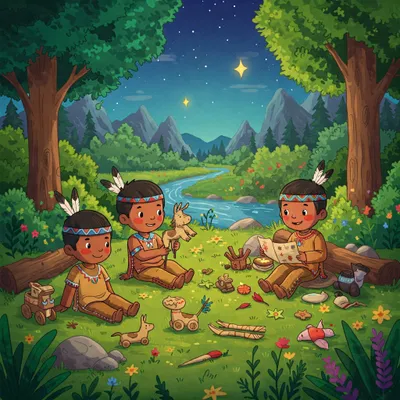
One little, two little, three little Indians,Four little, five little, six little Indians,Seven little, eight little, nine little Indians,Ten little Indian boys.
Ten little, nine little, eight little Indians,Seven little, six little, five little Indians,Four little, three little, two little Indians,One little Indian boy.
History and Meaning
"Ten Little Indians" survives in classrooms as a simple count to ten and back, but its origins are ugly. It began in 1868 as a blackface minstrel song, "Ten Little Injuns," and its disappearing-one-by-one structure has been called a "genocidal nursery rhyme." Many teachers now use animal or number versions instead.
Origins in minstrel shows
The earliest known version of this counting song was composed by American songwriter Septimus Winner in 1868 under the title "Ten Little Injuns." It was written for performance in blackface minstrel shows, a form of entertainment now widely recognised as deeply racist. The original song described ten characters meeting various unfortunate ends, reducing the count by one with each verse.
In 1869, Frank J. Green adapted the song, changing the subjects to "Indians" (referring to Native Americans). While this redirected the mockery toward a different group, it maintained the troubling structure in which each verse describes a mishap or disappearance that reduces the count by one, a theme critics have noted mirrors the real historical displacement and killing of indigenous peoples.
How did it become a children's song?
Despite its dark origins, the counting structure of the song made it appealing for use in early education. By the early 20th century, simplified versions focusing on counting up to ten and back down again had become common in nurseries and schools. Many of these sanitised versions removed the violent verses entirely, keeping only the counting framework.
The catchy melody and the repetitive structure made it an effective tool for teaching young children to count both forwards and backwards. This educational value helped the song persist in classrooms long after its problematic origins had been forgotten by most people using it.
Why is the song controversial?
Native American advocates and scholars have criticised "Ten Little Indians" as a song that normalises the erasure of indigenous peoples through whimsical narrative. The original verses, in which "Indians" disappear one by one through accidents or mishaps, have been described as a "genocidal nursery rhyme" that trivialises real historical violence.
The casual use of the word "Indians" (rather than the names of specific nations or peoples) reduces diverse indigenous cultures to a single stereotype. This flattening of identity, combined with the disappearance narrative, has led many educators and parents to move away from the original version.
Agatha Christie connection
The rhyme inspired Agatha Christie's 1939 mystery novel, originally published under a title now considered offensive, and later renamed "And Then There Were None." In the novel, ten strangers on an isolated island are murdered one by one, mirroring the structure of the counting rhyme. The book became one of the best-selling mystery novels of all time, further embedding the rhyme in popular culture.
Modern alternatives
Today, many educators use alternative versions that preserve the counting structure while removing the offensive content. Common substitutes include "Ten Little Aeroplanes," "Ten Little Soldier Boys," "Ten Little Teddy Bears," and simply "Ten Little Numbers." These versions keep the educational value of the original, teaching children to count to ten and back, without the harmful cultural associations.
The shift away from the original lyrics reflects a broader movement in children's education to examine the origins of traditional songs and stories, and to update them where necessary to reflect modern values of respect and inclusion.
Music Video
If the player is unavailable, watch this video on YouTube.
Related Nursery Rhymes





Lyrics from nurseryrhymes.info