
Frog Went A-Courting


Lyrics
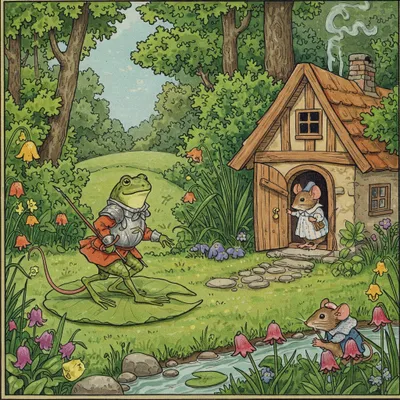
Frog went a courtin' he did ride, uh-huhFrog went a courtin' he did ride, uh-huhFrog went a courtin' he did rideWith sword and pistol by his side, uh-huh uh-huh uh-huh
He Rode up to Miss Mousie's door, uh-huhHe Rode up to Miss Mousie's door, uh-huhHe rode up to Miss Mousie's doorAnd climbed up to miss mousie's floor, uh-huh uh-huh uh-huh
Took Miss Mousie on his knee, uh-huhTook Miss Mousie on his knee, uh-huhTook Miss Mousie on his knee,And asked her, will you marry me, uh-huh, uh-huh, uh-huh
Without my Uncle Rat's consent, uh-huhWithout my Uncle Rat's consent, uh-huhWithout my Uncle Rat's consent,I wouldn't even marry the President, uh-huh, uh-huh, uh-huh
Uncle rat ran quickly down, uh-huhUncle rat ran quickly down, uh-huhUncle rat ran quickly downTo get his niece a wedding gown, uh-huh, uh-huh, uh-huh
History and Meaning
A frog rides off with a sword and a pistol at his side to propose to Miss Mouse, and the wedding cannot go ahead without Uncle Rat's blessing. "Frog Went A-Courting" tells that animal romance, and it is genuinely old: a version turns up in a Scottish text from 1549.
What is the historical meaning behind Frog Went A-Courting?
Some historians and folklorists suggest the song may have served as a political satire. A popular theory claims that the frog in the song represents François, Duke of Anjou, a French nobleman who courted Queen Elizabeth I of England (symbolized by the mouse) in the late sixteenth century. The courtship was highly unpopular among the English public, and the song may have been a covert way of poking fun at the royal affair.
When was the song first recorded?
The song's earliest recorded mention appeared in 1549 under the title "The frog came to the myl dur" in Scots in Robert Wedderburn's The Complaynt of Scotland. A later reference to the song is found in the Stationers' Register of 1580, which lists a license for "A Moste Strange Weddinge of the Frogge and the Mouse." In 1611, Thomas Ravenscroft published a musical version of the song in his collection Melismata.
How did the song spread to America?
The song is believed to have been brought to North America by the Pilgrims and other early European settlers. In the colonies, where formal entertainment was scarce, families would sing and play the song to pass the time. Since the 1620s, the song has entertained generations of children and adults throughout the United States, with singers adapting the lyrics and creating new verses to fit their local cultures.
Why are there so many different versions of the song?
Because the song was passed down through oral tradition for centuries, many different performers added, modified, or forgot verses. Deciding which and how many verses to include can be a challenge, as there are hundreds of them recorded. Most versions share the same opening verse, featuring Mr. Frog arriving with a sword and pistol by his side. From there, the details of the wedding feast and the fates of the characters vary significantly, with child-friendly versions usually ending happily with a wedding celebration.
Music Video
If the player is unavailable, watch this video on YouTube.
Related Nursery Rhymes



Lyrics from nurseryrhymes.info