

I See the Moon
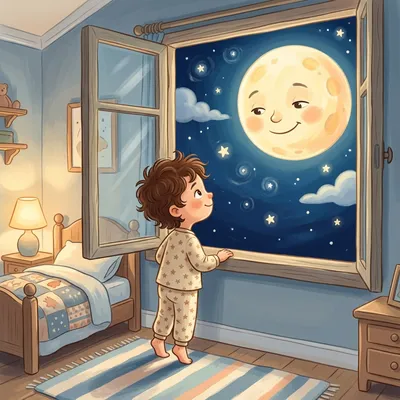


Lyrics
I see the moon,And the moon sees me.God bless the moon,And God bless me.
History and Meaning
Four lines, sixteen words, and a blessing that travels in both directions. "I See the Moon" reached print in 1784 and has barely changed since, which is unusual for a rhyme that spread mainly by being said aloud at bedtime rather than read off a page.
The brevity is the whole design. A child too small to sit through a full lullaby can learn this one in a single evening, and the two halves mirror each other exactly: the child sees the moon, the moon sees the child, the moon is blessed, the child is blessed. Nothing in it needs explaining to a two-year-old.
One warning before the history. There is a popular song from 1953 with the same title, written by Meredith Willson, and it is a completely separate modern composition that is still under copyright. None of its words appear on this page. The rhyme below is the old public-domain one.
Origins
The rhyme was first recorded by the literary antiquary Joseph Ritson in Gammer Gurton's Garland: or, The Nursery Parnassus, a chapbook of English nursery rhymes published in 1784 and one of the earliest printed collections of its kind. Ritson set it as a pair of long lines rather than a quatrain: "I see the moon, and the moon sees me, God bless the moon, and God bless me." The four-line version most families use today simply breaks those lines at the commas.
It surfaced again in 1843 in Traditional Nursery Songs of England, edited under the pen name Felix Summerly. Summerly was Henry Cole, the civil servant behind the Great Exhibition of 1851 and the museum that became the V&A. His book paired old nursery texts with pictures by well-known artists of the day, and "I see the moon" appears there in the same two-line shape Ritson had used, sitting between "Is John Smith within?" and "Jack and Jill".
By the end of the nineteenth century the rhyme had crossed the Atlantic and taken on a second job. Clifton Johnson collected it in What They Say in New England: A Book of Signs, Sayings, and Superstitions (1896), where it is not a lullaby at all but a moon-wishing charm. You were to look at the moon, recite the lines with an added wish about somebody you wanted to see, name that person, and expect to see them within a day or two. The blessing and the wish ran side by side in oral tradition for a long time, and folk versions with extra lines about a faraway person are much older than any twentieth-century recording.
Meaning & Interpretation
The rhyme is a blessing, not a story. It asks for good on the moon first and on the speaker second, in that order, which reads oddly until you notice that the moon has already done something for the child by looking back.
That reciprocity is the reason the rhyme still earns its place at bedtime. Very young children are only starting to work out that other things have a point of view, and this hands them the idea in four lines. The watching goes both ways, and someone is keeping an eye on them. It is a small, calm thought to fall asleep on.
It also has a practical use that parents discover on their own. The moon over one house is the same moon over another, so families separated by a deployment, a night shift, a hospital stay, or an ocean often use these lines as a shared ritual. Both people look at the same object at roughly the same time and say the same words. Nothing in the rhyme states that outright, but the structure invites it, and this is exactly the version that grandparents tend to teach.
Is this the same as the 1953 song?
No. Meredith Willson, the composer who later wrote The Music Man, published a popular song called "I See the Moon" in 1953. It is a separate modern composition with its own melody and its own lyrics, and it remains in copyright. The Mariners took it to number 14 in the United States in 1953, and The Stargazers reached number one in the UK in 1954 with a version that sold more than 300,000 copies. Nancy Sinatra recorded it again in 1963. The traditional nursery rhyme predates all of that by around 170 years and shares only the opening idea and the title.
How old is I See the Moon?
The earliest known printing is 1784, in Joseph Ritson's Gammer Gurton's Garland. Nobody knows how long it had been spoken before that, since Ritson was collecting rhymes that were already in circulation, but 1784 is the firm date anyone can point to. That makes it one of the older surviving English bedtime rhymes still in everyday use.
What age is this rhyme good for?
It works from about twelve months, earlier than most rhymes, because it is short enough to finish before an infant loses interest and repetitive enough to be predictable. Toddlers often take over the last line themselves. Older children can point at the actual moon while saying it, which turns it into a nightly window ritual rather than a recitation.
Are there other versions of the words?
Yes, several. Folk collectors recorded variants that add lines about blessing sailors at sea, or about the moon seeing somebody the speaker wants to see, the form Clifton Johnson wrote down in New England in 1896. Some families add a line naming an absent relative. The four-line blessing above is the version with the longest documented history and the one printed in the 1784 and 1843 collections.
Related Nursery Rhymes



Lyrics from nurseryrhymes.info