

Wynken, Blynken, and Nod



Lyrics
Wynken, Blynken, and Nod one night sailed off in a wooden shoe,Sailed on a river of crystal light, into a sea of dew."Where are you going, and what do you wish?" the old moon asked the three."We have come to fish for the herring fish that live in this beautiful sea;Nets of silver and gold have we!" said Wynken, Blynken, and Nod.
The old moon laughed and sang a song, as they rocked in the wooden shoe,And the wind that sped them all night long ruffled the waves of dew.The little stars were the herring fish that lived in that beautiful sea,"Now cast your nets wherever you wish, never afraid are we";So cried the stars to the fishermen three: Wynken, Blynken, and Nod.
All night long their nets they threw to the stars in the twinkling foam,Then down from the skies came the wooden shoe, bringing the fishermen home;'Twas all so pretty a sail, it seemed as if it could not be,And some folks thought 'twas a dream they'd dreamed of sailing that beautiful sea,But I shall name you the fishermen three: Wynken, Blynken, and Nod.
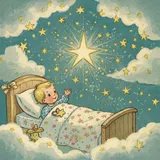
Wynken and Blynken are two little eyes, and Nod is a little head,And the wooden shoe that sailed the skies is a wee one's trundle-bed.So shut your eyes while Mother sings of wonderful sights that be,And you shall see the beautiful things as you rock in the misty sea,Where the old shoe rocked the fishermen three: Wynken, Blynken, and Nod.
History and Meaning
Three fishermen sail off in a wooden shoe to net the stars, then drift home through "a sea of dew." The last verse gives the game away: Wynken and Blynken are a child's two eyes, Nod is the nodding head, and the shoe is a trundle-bed. Eugene Field published this dream of falling asleep in 1889.
Origins
Eugene Field (1850 to 1895), often called the "Poet of Childhood," wrote the poem in early 1889, and it made its print debut in the Chicago Daily News on March 9, 1889. Later that year, it was included in Field's collection "A Little Book of Western Verse." The poem quickly captured the public's imagination, leading to numerous sheet music settings, illustrated editions (including a famous painting by Maxfield Parrish), and an animated short film by Walt Disney Productions in 1938.
Meaning & Interpretation
The poem describes a fantastical night journey of three fishermen who sail across a crystal river in a wooden shoe to catch herring fish, which are actually the twinkling stars in the sky. In the final stanza, Field explains the allegory: "Wynken" and "Blynken" represent a child's two eyes, "Nod" is the child's sleepy head, and the "wooden shoe" is the child's trundle-bed. The "sea of dew" is a metaphor for the dream world. By turning the physical act of falling asleep into a magical sailing adventure, the poem helps ease children into sleep.
Who wrote Wynken, Blynken, and Nod?
The lullaby poem was written by the American writer and journalist Eugene Field. It was first published on March 9, 1889, in Chicago.
What do the names Wynken, Blynken, and Nod represent?
According to the final stanza of the poem, Wynken and Blynken represent a sleeping child's two eyes, while Nod represents the child's nodding head as they fall asleep. The wooden shoe they sail in represents a trundle-bed.
Music Video
If the player is unavailable, watch this video on YouTube.
Related Nursery Rhymes





Lyrics from nurseryrhymes.info