

Loch Lomond


Lyrics
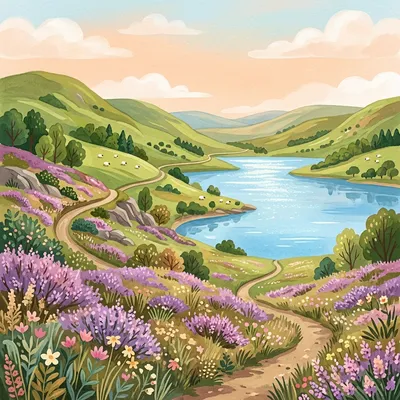
By yon bonnie banks and by yon bonnie braes,Where the sun shines bright on Loch Lomond,Where me and my true love were ever wont to gae,On the bonnie, bonnie banks o' Loch Lomond.
Chorus
O ye'll tak the high road and I'll tak the low road,And I'll be in Scotland afore ye,But me and my true love will never meet againOn the bonnie, bonnie banks o' Loch Lomond.
'Twas there that we parted in yon shady glen,On the steep, steep side o' Ben Lomond,Where in purple hue the Hieland hills we view,And the moon comin' out in the gloamin'.
History and Meaning
Loch Lomond is a real loch, about twenty miles northwest of Glasgow, and the largest stretch of fresh water in Britain by surface area. The Highland Boundary Fault runs straight through it, which is why the southern end is broad and shallow and dotted with wooded islands while the northern end narrows into steep Highland country. Ben Lomond rises from the eastern shore. The song names all of that, and almost everyone can sing the chorus, usually with no idea what the chorus is actually saying.
Origins
The earliest known printing is in Vocal Melodies of Scotland, published in 1841. No author is credited there, and none has ever been established. Lady John Scott, the Borders songwriter behind "Annie Laurie", is sometimes named as the writer, but the account attached to her is that she wrote the tune and words down after hearing a boy singing them in the streets of Edinburgh. That makes her a collector rather than the composer.
Both words and melody are almost certainly older than the 1841 book, and song collectors have traced versions back into the eighteenth century. The song is usually tied to the Jacobite rising of 1745, when supporters of Charles Edward Stuart marched south into England, turned back at Derby, and were beaten at Culloden the following April. Large numbers of prisoners were held at Carlisle afterwards. Tradition says one of them wrote the song. There is no manuscript, no name and no contemporary record behind that claim, so it is a story about the song rather than a documented fact about it.
Meaning & Interpretation
Whatever its origin, the song is a parting. The singer describes the banks and braes where he and his true love used to walk together, names the glen where they said goodbye, and then says plainly that the two of them will never meet again. The second verse is almost entirely scenery: purple hills, a moon coming up at dusk. Setting the loss inside a landscape that pretty is what gives the song its weight, and most performances slow the chorus down to let it land.
The tune has had a long second life well outside Scotland. The American singer Maxine Sullivan had a hit with a swing arrangement of it in 1937, which put the melody into jazz repertoire, and choirs, pipe bands and sports crowds have kept it in circulation ever since.
What do "the high road" and "the low road" mean?
Nobody knows for certain, and every explanation you will read is interpretation rather than documented fact. The best-known reading is that the chorus is spoken by one of two Jacobite soldiers captured after the 1745 rising: the singer is to be put to death, and his spirit will travel home to Scotland by the "low road" of the dead, arriving before his companion, who is released and must walk the ordinary "high road" home on foot. That reading depends on an older Celtic idea that the soul of a man who dies far from home returns by a hidden road faster than the living can walk.
Other readings exist and are perfectly reasonable. Some take the two roads literally as the main highway and the lesser one, with no supernatural meaning at all. Another version says the heads of executed rebels were carried south to north along the main road while grieving families walked home by the lower one. There is also a plain reading in which two lovers simply part and take different routes, and one of them knows they will not meet again. The song never explains itself, which is a large part of why people are still arguing about it.
What do the Scots words mean?
bonnie - lovely, pretty, fine brae (braes) - hillside, slope yon - that one over there wont to gae - used to go, in the habit of going tak - take afore - before, ahead of glen - a narrow valley between hills ben - a mountain, as in Ben Lomond Hieland - Highland hue - colour, shade gloamin - twilight, dusk o' - of loch - a lake, or a sea inlet
Where is Loch Lomond?
It sits in west-central Scotland, running roughly north to south for about twenty-four miles, with its southern tip close to Glasgow and its northern end deep in the Highlands. Since 2002 it has been part of Loch Lomond and The Trossachs National Park, the first national park created in Scotland. Ben Lomond, the mountain named in the second verse, stands on the eastern shore and is the most southerly of Scotland's Munros.
Related Nursery Rhymes

Lyrics from nurseryrhymes.info