

Swan Swam Over the Sea
Lyrics
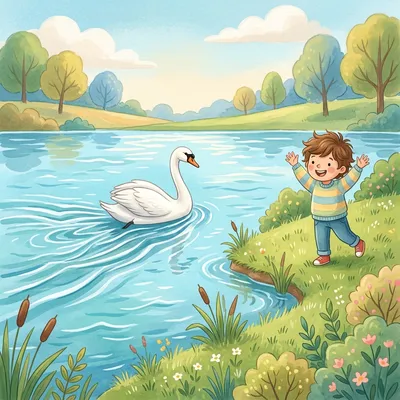
Swan swam over the sea,Swim, swan, swim!Swan swam back again,Well swum, swan!
History and Meaning
Twelve words, and almost every one of them opens with the same two-consonant cluster. "Swan Swam Over the Sea" is one of the shortest tongue twisters in the English nursery repertoire, and its difficulty is concentrated rather than cumulative. Longer twisters like Peter Piper let you build a rhythm and ride it to the end. This one gives you four short lines and expects you to come apart inside the first two.
The trap is built into the vocabulary. Swim, swam and swum are the three principal parts of a single verb, and swan is a bird that happens to sound like a fourth form of it. Say the rhyme at speed and your mouth reaches for the verb pattern it already knows.
Origins
The rhyme is anonymous traditional verse with no established author and no securely dated first printing. It circulated orally as a speech exercise long before anyone bothered to write it down, which is the normal pattern for twisters. They are teaching tools first and literature second, so early collectors often passed over them.
One common assumption is worth correcting. The rhyme is frequently filed alongside the great Victorian nursery collections, but it does not appear in James Orchard Halliwell's The Nursery Rhymes of England, the standard nineteenth century gathering of English nursery material and the book usually credited with preserving this repertoire. The fifth edition of 1886, the fullest version, contains no swan rhyme at all.
Where the rhyme is solidly attested is in the popular Mother Goose anthologies of the early twentieth century. It appears in The Little Mother Goose of 1912, illustrated by Jessie Willcox Smith, and in The Real Mother Goose of 1916, illustrated by Blanche Fisher Wright, the edition that put it in front of several generations of children. From there it moved into elocution manuals, classroom warm-ups and speech practice sheets, where it still does most of its work today.
Meaning & Interpretation
Nothing is hidden here. A swan swims out to sea, a voice on the shore calls encouragement, the swan swims back, and the same voice congratulates it. That is the whole event.
Some nursery rhymes attract theories about plague, politics or royal scandal. This one does not, and there is no evidence it ever meant anything beyond what it says. It exists to be difficult to pronounce. The swan is in it because the word swan sits inside the sw- family, not because the bird stands for anybody.
The cheering voice does give the rhyme a small shape that children respond to. There is a journey out, a journey back, and applause at the end, which is more story than most twisters manage in twelve words.
Why is Swan Swam Over the Sea hard to say?
Three things overlap. First, every stressed word opens with the cluster sw-, which forces your mouth from /s/, made with the tongue tip and spread lips, straight into /w/, made with rounded lips and the back of the tongue. Doing that six times in twelve words is genuine physical work. Second, the words are nearly identical apart from their vowels, so there is very little margin for error. Third, and most importantly, swim, swam and swum are the present, past and past participle of one verb, so the brain wants to run them in that familiar order and keeps substituting swum where swan belongs.
A fourth complication catches many speakers out. The a in swan is not the a in swam. After a w sound, English usually pulls a short a backwards into a rounded vowel, which is why want, wash, watch and swap do not rhyme with ant, cash, catch and slap. So swan rhymes with gone, while swam rhymes with ham. Your mouth expects the two words to match, and they refuse to.
What does "well swum, swan" mean?
It means well done. The phrase compliments the swan on its swimming and is built exactly like well played or well fought, with the adverb well in front of a past participle. Swum is the past participle of swim, so the line praises a completed action: the bird has finished its swim and the speaker approves. The construction sounds old-fashioned now but was ordinary English when the rhyme was circulating.
Is it "swan swam over the sea" or "swan, swan, over the sea"?
Both versions are in print and neither is wrong. The Little Mother Goose of 1912 gives the swam wording that most people know today, while The Real Mother Goose prints the opening as "Swan, swan, over the sea", repeating the noun instead of using the verb. The rest of the rhyme stays stable across versions. The doubled opening is arguably the harder of the two to say, since it removes the vowel contrast that gives your mouth a moment of relief in the first line.
How do you practise Swan Swam Over the Sea with a child?
Slowly, and in pieces. Take one line at a time at half speed and let the child feel the lips round on each w before moving on. The four vowel sounds are the whole point of the exercise, so it helps to say swim, swam, swum, swan on their own first, exaggerating the difference between them, and only then put them back into the rhyme. Speed comes last. Children tend to enjoy the failures as much as the successes here, and the rhyme is short enough that a wrong attempt costs nothing, which makes it a gentler first twister than longer ones like Betty Botter or Woodchuck.
Related Nursery Rhymes



Lyrics from nurseryrhymes.info