
The Friendly Beasts

Lyrics
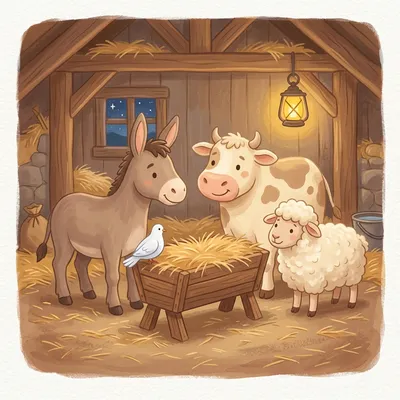
Jesus our brother, kind and good,Was humbly born in a stable rude,And the friendly beasts around Him stood,Jesus our brother, kind and good.
"I," said the donkey, shaggy and brown,"I carried His mother up hill and down,I carried her safely to Bethlehem town.""I," said the donkey, shaggy and brown.
"I," said the cow, all white and red,"I gave Him my manger for His bed,I gave Him my hay to pillow His head.""I," said the cow, all white and red.
"I," said the sheep with curly horn,"I gave Him my wool for His blanket warm,He wore my coat on Christmas morn.""I," said the sheep with curly horn.
"I," said the dove from the rafters high,"I cooed Him to sleep so He would not cry,We cooed Him to sleep, my mate and I.""I," said the dove from the rafters high.
Thus every beast by some good spell,In the stable dark was glad to tellOf the gift he gave Emmanuel,The gift he gave Emmanuel.
History and Meaning
The tune of this carol was written for a donkey. Not metaphorically: the melody comes from "Orientis Partibus", a Latin song used in the medieval Feast of the Ass, a church celebration at which a real donkey was led into the building. Seven or eight centuries later an American writer put new English words to it, and the animal that started the whole thing kept its place at the front of the song.
The English text belongs to Robert Davis (1881-1950). It was published in 1920 in "The Coming of the Prince of Peace", a nativity play issued by the H. W. Gray Company with music arranged by Clarence Dickinson. Many websites and record sleeves date the words to 1934; the 1920 printing settles the matter.
Origins
"Orientis Partibus" is a Latin sequence usually dated to the twelfth or early thirteenth century and traditionally attributed to Pierre de Corbeil, who became Archbishop of Sens around 1200. Its opening line means roughly "from the eastern lands" and the verses praise the donkey by name, describing the animal that came from the east carrying its load. Copies survive from Sens and from Beauvais, two French cathedral towns where the January festivities involving the ass were best documented.
Davis wrote his words for a staged nativity, which explains their shape. Each animal is given a short speech and a gift, so the song can be handed out among a group of children with almost no rehearsal. The play credited the melody simply as twelfth century, arranged by Dickinson. Davis kept the donkey as the first speaker, which is the one direct link between his English verses and the medieval Latin original, where the donkey was the only subject.
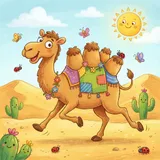
Later singers have added animals of their own. Camels, cats, goats and even a rooster turn up in recordings and school songbooks. None of those verses are Davis's, and the four animals above with the two framing verses are the version he wrote.
Meaning & Interpretation
The carol works as a set of small confessions. Nobody in it gives anything expensive. The donkey gives labour, carrying Mary on the road to Bethlehem. The cow gives up its feeding trough and the hay in it. The sheep gives the wool off its own back. The dove gives sound, cooing until the baby sleeps. Every gift costs the giver something ordinary and useful, which is the whole argument of the song, made without a single line of explanation.
That restraint is why it survives in classrooms where other carols get cut. The theology is thin enough to sing anywhere and the images are concrete: brown fur, white and red hide, a curly horn, rafters. Children who cannot follow "Emmanuel" can follow a cow giving away its dinner.
What was the Feast of the Ass?
The Feast of the Ass, or Festum Asinorum, was a medieval Christian celebration held mainly on 14 January, marking the donkey's part in the nativity story and the flight into Egypt. At Beauvais a woman carrying a child rode a draped donkey to the church of St Stephen, where the animal was stationed near the altar for the Mass. The song "Orientis Partibus" was sung as part of these observances, and its melody is the one now used for "The Friendly Beasts".
Who wrote The Friendly Beasts?
The English words are by Robert Davis (1881-1950), published in 1920 in the nativity play "The Coming of the Prince of Peace" from the H. W. Gray Company, with the medieval tune arranged by Clarence Dickinson. The date 1934 is frequently repeated online and is wrong.
What gift does each animal give?
The donkey carried Mary from Nazareth to Bethlehem. The cow gave its manger as a bed and its hay as a pillow. The sheep gave wool for a blanket. The dove and its mate cooed the baby to sleep. The final verse gathers all four together as gifts given to Emmanuel.
How is The Friendly Beasts used in nativity plays?
It was written for one, so the staging is built in. Assign a child to each animal, have the whole group sing the opening and closing verses, and let each animal step forward alone for its own verse. Four speaking parts and no dialogue to memorise makes it a common choice for younger classes, and extra children can be added as unspeaking beasts standing around the manger.
Related Nursery Rhymes

Lyrics from nurseryrhymes.info