
The Fox Went Out on a Chilly Night

Lyrics
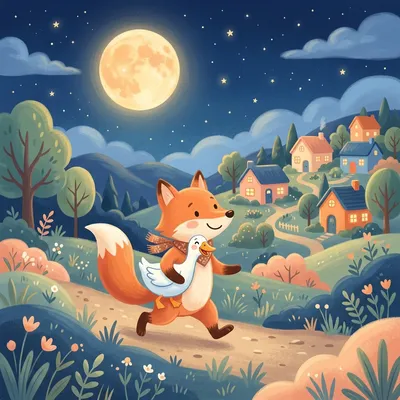
The fox went out on a chilly night,He prayed to the moon to give him light,For he'd many a mile to go that nightBefore he reached the town-o, town-o, town-o,He'd many a mile to go that nightBefore he reached the town-o.
He ran till he came to a great big bin,Where the ducks and the geese were kept therein,He said, "A couple of you are going to grease my chinBefore I leave this town-o, town-o, town-o,"A couple of you are going to grease my chinBefore I leave this town-o.
He grabbed the grey goose by the neck,He threw a duck across his back,He didn't mind the quack, quack, quack,And the legs all dangling down-o, down-o, down-o,He didn't mind the quack, quack, quack,And the legs all dangling down-o.
Then the fox and his wife without any strifeCut up the goose with a carving knife,They never had such a supper in their lifeAnd the little ones chewed on the bones-o, bones-o, bones-o,They never had such a supper in their lifeAnd the little ones chewed on the bones-o.
History and Meaning
A fox leaves his den at night, takes a goose and a duck from a farm, and carries them home so his family can eat. That is the entire plot, and the song is on the fox's side from the first line to the last. Folklorists catalogue it as Roud 131, and under that same number sit two Middle English poems about a fox robbing a farmyard, copied out by scribes in the 1490s.
Those poems are the song's ancestors, not its lyrics. Five centuries separate them, and the wording has almost nothing in common. The plot is medieval; the words on this page are not.
Origins
The older of the two surviving Middle English texts is "The Fals Fox", written into the James Ryman manuscript (Cambridge University Library MS Ee.1.12) in 1492. It opens "The fals fox came vnto oure croft". The second, usually called "The Fox and the Goose", was copied around 1500 onto a leaf of British Library MS Royal 19 B iv, and begins "Pax vobis, quod the ffox, for I am comyn to toowne", the fox greeting the poultry with a priest's Latin blessing before he robs them. Both are carols with a joke at their centre, and both are written in a language a modern child could not read aloud. Neither contains a chilly night, a moon, or a "town-o".
The song in its familiar shape appears much later. A verse of it was printed in Gammer Gurton's Garland in 1810, Victorian broadside printers kept it in their catalogues, and collectors took it down across England, Scotland and Ireland under titles including "A Fox Jumped Up" and "Daddy Fox". The Roud index records roughly two hundred versions, close to half of them collected in the United States, where the song travelled with settlers and where the "town-o" chorus became standard. Burl Ives recorded it for a mass audience in the middle of the twentieth century. Peter Spier's illustrated edition of 1961 was named a Caldecott Honor Book, which is how it reached a great many American classrooms.
Meaning & Interpretation
Almost every other farmyard song for children puts the listener with the farmer or with the frightened bird. This one does the opposite. The fox prays for light, walks a long way, works for his supper and brings it home, and the last verse is his family eating better than they ever have. A children's song that ends with the predator's household well fed is genuinely rare.
The killing is never shown. The goose is taken by the neck, the duck goes over the fox's back, the legs dangle, and the next thing that happens is dinner. Longer traditional versions add Old Mother Flipper-Flopper putting her head out of the window to shout that the grey goose is gone, and a verse in which the fox cubs count themselves off, eight, nine, ten. The farm loses two birds and the fox family eats. The song states both and judges neither.
The structure is what makes it singable. Each verse is three rhyming lines, then the refrain, then a repeat of that third line and the refrain again. Every new piece of the story arrives twice, so a child who missed it the first time catches it on the way past. The refrain word shifts to fit whatever the verse has just rhymed on: town-o while the fox is travelling, down-o when the legs are hanging, bones-o once the cubs are chewing. Working out which word is coming next is half the fun of singing it.
How old is The Fox Went Out on a Chilly Night?
The story is more than five hundred years old, but the words children sing today are not. Two Middle English poems about a fox raiding a farmyard survive in manuscripts from 1492 and about 1500, and folk song scholars treat them as the same song family as the modern one. They are written in Middle English, their verses are different, and they contain no chilly night and no "town-o" refrain. The English lyrics in common use took their shape in the eighteenth and nineteenth centuries, with the American "town-o" chorus settling in during the nineteenth.
What does "town-o" mean?
It means "town", with a sung syllable tacked on to fill out the tune. Folk singers add vowel sounds like this to stretch a short word across the notes at the end of a line, and the "o" turns an ordinary word into a chorus a whole room can join. The town in question is the settlement where the farm and its poultry are, which is why the fox has many a mile to go.
Is the song too dark for young children?
Nothing violent is described. The fox picks up a goose and a duck, carries them home, and the family has supper. Children generally take it the way they take a story about a hungry animal in a picture book, and the tune is bright and comic throughout. If a child does ask what happened to the goose, the plain answer is that foxes eat birds, which is the reason the song exists.
Related Nursery Rhymes


Lyrics from nurseryrhymes.info