
The First Noel


Lyrics
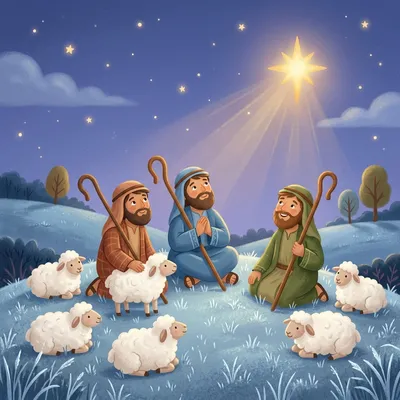
The first Noel the angel did sayWas to certain poor shepherds in fields as they lay;In fields where they lay keeping their sheep,On a cold winter's night that was so deep.
Chorus
Noel, Noel, Noel, Noel,Born is the King of Israel.
They looked up and saw a starShining in the east, beyond them far;And to the earth it gave great light,And so it continued both day and night.
And by the light of that same starThree Wise Men came from country far;To seek for a king was their intent,And to follow the star wherever it went.
History and Meaning
The carol came to print through Cornwall. Davies Gilbert, a Cornish MP and scientist who later served as president of the Royal Society, put nine stanzas of "The First Nowell" into the 1823 second edition of his book Some Ancient Christmas Carols, a collection of carols sung in the west of England. Ten years later William Sandys printed the text again, almost unchanged, in Christmas Carols, Ancient and Modern (1833), and this time he added the tune. Neither man composed any of it. Both were writing down something already old and already being sung.
That gives the carol an unusually clear paper trail for a folk song, and it also preserves a small puzzle. In the words as they stand, the shepherds are the ones who look up and see the star.
Origins
The oldest known copy of the text is a manuscript written out by John Hutchens for Gilbert around 1816 or 1817, now held at Kresen Kernow, the Cornish archive in Redruth. Gilbert's first edition appeared in 1822 without the carol; "The First Nowell" was added to the enlarged 1823 edition. The song itself is anonymous and probably older still, with the seventeenth century usually given as a rough estimate.
Sandys, a London solicitor with strong Cornish antiquarian interests, published the pairing of words and melody in 1833. The version most choirs sing today comes later again, from Christmas Carols New and Old (1871), edited by Henry Ramsden Bramley for the words and John Stainer for the music. Stainer's four-part setting fixed the tune in the shape now treated as standard, smoothing variants that had been circulating in different parishes.
The melody is odd for an English folk tune. It is essentially one musical phrase sung twice, followed by a refrain that varies the same phrase. That repetition has prompted a long-running theory, argued by the hymnologist Erik Routley among others, that what we sing as the tune began life as a harmony line rather than a melody. A set of church gallery parts found in Westmorland suggested it may have been the treble part to a different carol, "Hark, hark what news the angels bring", remembered orally until the harmony outlived the melody it was written against.
Meaning & Interpretation
"Noel" looks French, and its ancestry is French, but the word has been English for a very long time. It entered the language in the late 1300s as nowel or nouel, taken from Old French noel, meaning the Christmas season, which came in turn from the Latin natalis dies, or birthday, used in church Latin for the birth of Christ. It appears in Sir Gawain and the Green Knight, written around 1375 to 1400. So the shout in the chorus is a Middle English word with a Latin root, not a French borrowing dropped into a British carol.
The early printings spell it Nowell, which is why hymnals and choral scores often still use that form while popular songbooks print Noel. Both are the same word.
The story the verses tell is stripped to essentials: an announcement, a light in the sky, travellers following it. There is almost no description and no doctrine, just a sequence of events with the refrain landing after each one. That structure suits singing in the street or in a crowded room, where a repeated line matters more than a complicated one.
Why do the shepherds see the star in The First Noel?
Because the carol combines the two nativity accounts in the Bible, which keep them separate. In Matthew, the star is seen and followed by wise men from the east. In Luke, the shepherds are visited by an angel and a host of angels, with no star mentioned at all. The carol has the angel speak to the shepherds, then has the shepherds look up and see the star, then brings in the wise men by the light of that same star. Folk carols routinely merge sources this way, telling the nativity as one continuous story rather than as two separate gospel narratives.
Is The First Noel a Cornish carol?
The evidence points that way, though it cannot be proved outright. Its earliest surviving text was written down in Cornwall for a Cornish collector, and both of the men who first published it, Gilbert and Sandys, were gathering carols from Cornwall and the West Country. The song may have been sung more widely before anyone recorded it, but Cornwall is where it was caught.
Is it spelled Noel or Nowell?
Both spellings are correct and refer to the same word. Nowell is the older English form and the one used by Gilbert in 1823, by Sandys in 1833, and in most hymnals and choral editions since. Noel, closer to the modern French spelling, became the common form in general use and is what most popular songbooks and recordings print.
Related Nursery Rhymes

Lyrics from nurseryrhymes.info