
The Holly and the Ivy

Lyrics
The holly and the ivy,When they are both full grown,Of all the trees that are in the wood,The holly bears the crown.
Chorus
The rising of the sunAnd the running of the deer,The playing of the merry organ,Sweet singing in the choir.
The holly bears a blossomAs white as the lily flower,And Mary bore sweet Jesus ChristTo be our sweet Saviour.
The holly bears a berryAs red as any blood,And Mary bore sweet Jesus ChristTo do poor sinners good.
History and Meaning
The oldest copies of this carol that anyone can actually put a hand on are Birmingham broadsides from the early nineteenth century, one of them printed by H. Wadsworth some time between 1814 and 1818. You will see the date 1710 attached to the carol constantly, in programme notes and on album sleeves. That date rests on a document nobody has ever produced.
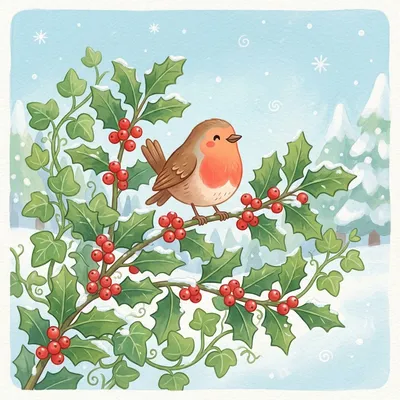
Ivy gets one mention, in the opening line, and then vanishes. Every verse after that belongs to the holly.
Origins
The words survive in three broadsides printed at Birmingham in the first decades of the 1800s. The carol reached a wide readership in 1861, when Joshua Sylvester included it in A Garland of Christmas Carols, and again in 1868 in William Henry Husk's Songs of the Nativity. Husk is the source of the famous early date. He reported that the printer's copy behind the text was said to come from an old broadside printed "a century and a half since", which would put it around 1710. He was passing on what he had been told. The broadside itself has never been located, in any library or private collection, in the 160 years since. It may have existed. It may have been a printer's boast. Either way, a reported source became a hard date through nothing more than repetition, and it is still being repeated.
The tune most people sing is separately documented and much better evidenced. Cecil Sharp collected it on 13 January 1909 from Mary Ann Clayton, a sixty-four year old woman living on Sheep Street in Chipping Campden, Gloucestershire, who remembered the carol from her own childhood. Sharp's manuscript of that transcription still exists. He published the result in English Folk-Carols in 1911, and that setting is the one that spread through twentieth-century hymnals and school assemblies. The carol is catalogued as number 514 in the Roud Folk Song Index.
Meaning & Interpretation
Pairing holly with ivy is older than this carol and did not begin as a Christmas subject. A group of English carols written down in the fifteenth century sets the two plants against each other in a contest, with holly cast as masculine and ivy as feminine. One of them keeps up the refrain "Nay, Ivy, nay, it shall not be, ywis, let Holly have the mastery". Holly wins each round. Both plants were among the evergreens brought indoors in midwinter, and the songs treat them as rivals with settled characters, which suggests a custom the singers already knew rather than one the songs invented. What that custom meant to the people practising it is not recorded, so the honest description is a documented tradition of paired plant songs and midwinter greenery, not a reconstructed ritual.
The Christian layer sits on top of that and is easy to trace, because it works feature by feature. The white blossom is matched to purity and to Mary. The red berry is matched to blood. In the verses that follow the ones above, the sharp prick becomes the crown of thorns and the bitter bark becomes the gall offered at the crucifixion. It is a carol about Christmas that keeps pointing at Easter.
The chorus refuses to join in. The rising of the sun, the running of the deer, an organ and a choir: three of those four images have nothing Christian about them, and they sit oddly against verses that are entirely about the Nativity and the Passion.
How old is the carol?
The earliest surviving text is on Birmingham broadsides from the early nineteenth century, roughly 1812 to 1830. The carol was first printed in a collection by Joshua Sylvester in 1861. The widely quoted date of about 1710 comes from William Henry Husk, who reported at second hand that a printer's copy was said to derive from an old broadside printed a century and a half earlier. That broadside has never been found, so 1710 should be described as a claim rather than a date. The tune in common use was collected by Cecil Sharp in 1909 and published in 1911.
What do the holly and the ivy stand for?
In the carol itself, holly stands for the Nativity story: white blossom for Mary, red berry for blood, thorn for the crown of thorns, bitter bark for the gall. Ivy is named once and then dropped. The pairing comes from an older English tradition of songs that set the two evergreens against each other, holly treated as masculine and ivy as feminine, recorded in manuscripts from the 1400s.
Why does the chorus mention the running of the deer?
Nobody knows. The refrain shares no imagery with the verses, and no explanation for the deer has ever been settled on. Various suggestions have circulated over the years, including mishearings of other words, but none of them is supported by an early text. Singers simply inherited the refrain along with the verses.
Related Nursery Rhymes

Lyrics from nurseryrhymes.info